
The Big Catch 2 and the Structure Behind Fishin Frenzy
Why Fishin Frenzy The Big Catch 2 should not be treated as a typical slot
Fishin Frenzy The Big Catch 2 is often approached with the wrong expectations. On the surface, it looks familiar: the theme is recognisable, the layout is simple, and the mechanics appear easy to follow. This leads many players to assume they are dealing with a straightforward continuation of the Fishin Frenzy formula. In reality, the game operates on a very different logic.
This is not a slot designed to entertain through constant interaction. It does not rely on frequent line wins, visual overload, or layered mechanics competing for attention. Instead, it is built around restraint. Large parts of the experience are deliberately quiet, sometimes even uneventful, and that is not a flaw. It is a structural choice.
The Big Catch 2 is less concerned with how often something happens and more concerned with what happens when it finally does. Progress in this game is not measured in small, incremental rewards, but in the gradual accumulation of potential. The base game exists primarily as a staging area. Its purpose is not to satisfy, but to prepare.
This design choice immediately separates The Big Catch 2 from many modern slots that aim to keep players constantly engaged. Here, engagement is delayed. Tension is created through waiting, not stimulation. For players accustomed to steady feedback, this can feel uncomfortable. For others, it introduces a slower, more deliberate rhythm that feels intentional rather than manipulative.
Understanding this from the outset is important. Fishin Frenzy The Big Catch 2 is not trying to impress you on every spin. It is asking whether you are willing to engage with a system that values escalation over immediacy. If you approach it expecting constant reinforcement, the game will feel empty. If you approach it as a long-form structure built around a single dominant mechanic, it begins to make sense.
This page is written with that perspective in mind. It does not attempt to persuade or promise outcomes. It exists to explain how the game is constructed, what it prioritises, and why it behaves the way it does. Only then can it be evaluated on its own terms.
The place of The Big Catch 2 within the Fishin Frenzy series
To understand The Big Catch 2, it helps to see it not as an isolated release, but as part of a gradual shift within the Fishin Frenzy series. Earlier entries in the franchise were built around simplicity and familiarity. Fixed paylines, predictable bonus triggers, and a clear division between base game and feature were the norm. They offered reassurance more than experimentation.
Over time, the series began to move away from that model. The introduction of collect mechanics and feature-centric gameplay marked a change in priorities. Instead of spreading value evenly across the game, newer titles started concentrating it into specific moments. The Big Catch line represents the most focused expression of that shift.
The Big Catch 2 does not expand the series by adding more features. It refines it by narrowing the focus. Rather than layering mechanics on top of one another, it commits almost entirely to the idea of collection and conversion. Everything else exists in service of that goal.
Compared to Megaways adaptations, which emphasise volatility through constantly changing reel structures, The Big Catch 2 takes a more contained approach. Its volatility comes not from visual complexity, but from how value is withheld and released. The game does not overwhelm the player with possibilities. It restricts them.
This makes The Big Catch 2 a divisive entry in the series. For players who enjoyed the steady pacing of earlier Fishin Frenzy titles, the game may feel sparse. For those drawn to high-impact, feature-driven slots, it can feel precise and intentional. Neither reaction is wrong. They reflect different expectations.
What is clear is that The Big Catch 2 represents a point where the series stops trying to appeal to everyone. It assumes a level of patience and acceptance of delayed outcomes. In doing so, it clarifies its own identity. This is not a celebration of abundance, but an exercise in control.
Seen in this light, The Big Catch 2 is less a sequel and more a statement. It shows how far the Fishin Frenzy series is willing to move away from traditional slot design in order to explore a narrower, more concentrated experience. Whether that experience resonates depends entirely on how the player chooses to engage with it.
Design through simplicity: why the base game feels deliberately empty
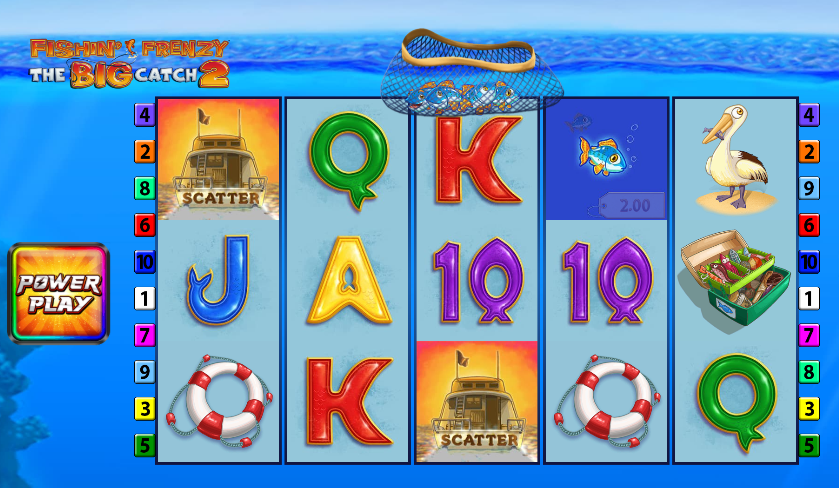
At first glance, the base game of Fishin Frenzy The Big Catch 2 can feel underwhelming. Five reels, three rows, ten fixed paylines. No expanding grids, no shifting reel sets, no visual distractions competing for attention. For players used to modern slot design, this simplicity can be mistaken for a lack of ambition.
That interpretation misses the point.
The base game is not designed to be expressive. It is designed to be neutral. Its role is not to deliver excitement, but to maintain structural discipline. By keeping the base game mechanically restrained, the designers ensure that nothing competes with the core objective of the slot: reaching a state where value can be collected and converted.
In many slots, the base game functions as a reward loop in its own right. Wins arrive frequently enough to sustain engagement, even if they are small. In The Big Catch 2, that loop is intentionally weakened. Line wins exist, but they are not the focus. They do not carry the emotional weight of progress. They are incidental.
This creates a subtle but important shift in player behaviour. Instead of reacting to each spin, the player begins to evaluate sessions in broader terms. Time becomes the primary variable. The game teaches patience by refusing to provide constant validation. Nothing in the base game pretends to be more important than it is.
This restraint also serves a practical purpose. By keeping the base game predictable and uncluttered, the game preserves clarity when the bonus is triggered. There is no cognitive adjustment required. The player does not need to relearn the interface or reinterpret symbols. The transition into the feature feels continuous rather than theatrical.
In this sense, the base game functions like a blank canvas. It absorbs time without demanding interpretation. That may sound unappealing, but it is precisely what allows the bonus mechanics to carry real weight when they appear. Without this emptiness, escalation would lose its contrast.
The simplicity is not an absence of design. It is design applied selectively.
Symbols as functions, not decoration
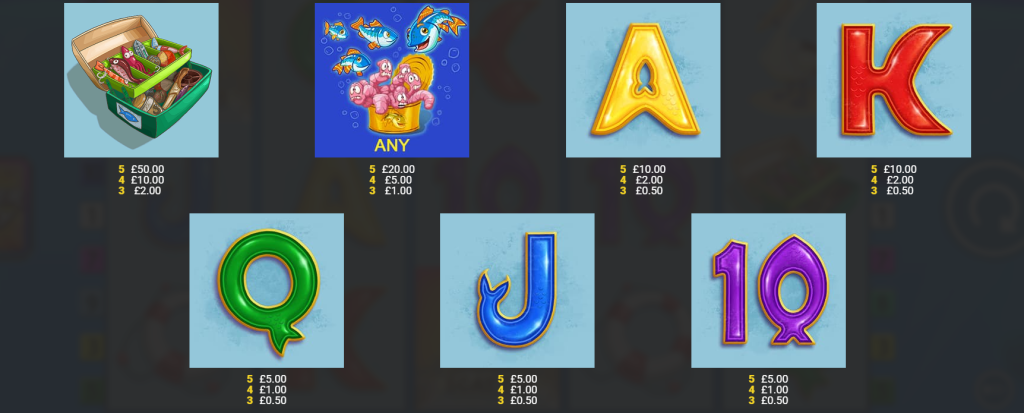
One of the clearest indicators of The Big Catch 2’s design philosophy is how it treats symbols. In many slots, symbols exist primarily as aesthetic elements. They vary in value, but their purpose rarely extends beyond forming combinations. In Fishin Frenzy The Big Catch 2, symbols are closer to functional components than visual tokens.
Fish symbols are not defined by their position on a paytable. They are defined by the values they carry. Their importance does not come from alignment, but from potential. Until that potential is realised, they remain dormant, visible reminders of something that has not yet been converted into a result.
The Fisherman symbol reinforces this shift. It is not a character in the narrative sense, and it is not a multiplier in disguise. It is a mechanism. Its appearance does not directly reward the player. Instead, it enables conversion. It turns stored values into realised outcomes, but only under specific conditions.
This creates a layered relationship between symbols. Fish represent possibility. Fishermen represent activation. Neither is meaningful in isolation. Only when they intersect does the game progress. This dependency is central to how tension is built. The player is not waiting for a single symbol to appear, but for a configuration that allows the system to resolve.
Traditional low-value symbols still exist, but they are marginal. They fill space and facilitate line wins, but they do not define the experience. Their presence reinforces the idea that not all symbols are equal in function, even if they share the same visual hierarchy.
By reducing symbols to their mechanical roles, The Big Catch 2 strips away much of the ambiguity common in slot design. The player is not encouraged to project meaning onto animations or themes. The system is visible. You can see what matters, and you can see what does not.
This clarity is not accidental. It supports a game where progress is slow, conditional, and dependent on alignment rather than accumulation. Symbols do not entertain on their own. They wait to be used.
In Fishin Frenzy The Big Catch 2, symbolism is not narrative. It is operational. And once that is understood, the rest of the game’s structure becomes easier to read.


The collect mechanic as the central architecture of the game
Everything in Fishin Frenzy The Big Catch 2 ultimately points toward a single idea: collection as a form of delayed resolution. This is not a supporting feature layered onto the game. It is the structural core around which every other element is arranged.
The collect mechanic does not reward activity. It rewards alignment. Fish symbols appear carrying values, but those values are inert. They sit on the reels without consequence, visible but unresolved. Their presence creates anticipation, not gratification. Nothing is paid simply because a value exists.
The Fisherman symbol is the gatekeeper of this system. When it appears, it does not enhance a win or multiply a result. It performs a conversion. It turns latent values into realised outcomes, but only if those values are present and positioned to be collected. The system demands coincidence rather than persistence.
This distinction matters. In many slots, progress is driven by repetition. The more you spin, the more likely something is to happen. In The Big Catch 2, repetition alone is insufficient. You can spin indefinitely without progress if the necessary alignment does not occur. This introduces a different kind of tension, one that is structural rather than emotional.
The collect mechanic also reshapes how wins are perceived. Because value is accumulated before it is awarded, outcomes feel less like isolated events and more like conclusions. When a collect finally happens, it resolves something that has been building over time. The win is not surprising; it is overdue.
This changes the rhythm of play. Instead of reacting to each spin, the player begins to observe the board state. Attention shifts from immediate results to configuration. What matters is not whether the last spin paid, but whether it moved the system closer to resolution.
The game never states this explicitly, but it teaches it through repetition. Players who remain focused on line wins will find the experience thin. Players who recognise the collect mechanic as the primary narrative begin to read the game differently. They stop asking when the next win will come and start asking what needs to be in place for the system to activate.
In that sense, The Big Catch 2 is less about winning and more about timing. The collect mechanic does not increase generosity. It increases dependency. And it is this dependency that defines the game’s identity.
Bonus triggers: what entering Free Spins actually represents
Triggering Free Spins in Fishin Frenzy The Big Catch 2 is often treated as an achievement in itself. In reality, it is better understood as a transition rather than a reward. Entering the bonus does not resolve the game’s tension. It relocates it.
The conditions for triggering Free Spins are straightforward, but the implications are not. When the bonus begins, the game does not suddenly become generous. It becomes focused. The base game’s restraint gives way to a space where the collect mechanic can operate more freely, but not more predictably.
Free Spins are where the game allows escalation, but escalation is conditional. The presence of Fish symbols and Fishermen becomes more frequent, yet their interaction remains uncertain. The system offers more opportunities for alignment, not guarantees of outcome.
This is where many expectations break down. Players often assume that the bonus exists to deliver the game’s main payout. In The Big Catch 2, the bonus exists to test the collect system under pressure. It increases exposure to variance rather than smoothing it.
The most important thing to understand is that entering Free Spins does not complete the process the base game began. It intensifies it. The same rules apply, but the stakes are higher. Values grow larger, conversions become more consequential, and missed alignments feel more significant.
This is why the bonus can feel both promising and unforgiving. It offers the possibility of resolution, but it also magnifies the cost of failure. The system does not change its logic to accommodate the player. It simply accelerates it.
Seen this way, Free Spins are not the payoff. They are the proving ground. They reveal whether the structural tension built in the base game can successfully resolve into a meaningful outcome. Sometimes it does. Sometimes it does not. Both results are consistent with the design.
Understanding this reframes the entire bonus experience. Free Spins are not the end of the journey. They are the moment where the game’s architecture is most exposed.
Free Spins as a progressive system rather than a single event
In many slots, Free Spins function as a contained sequence. They begin, they play out, and they end. Their purpose is clear: deliver a burst of activity, distribute a portion of the game’s RTP, and return the player to the base game. Fishin Frenzy The Big Catch 2 approaches Free Spins differently. Here, the bonus is not a sequence. It is a system.
From the first free spin, the bonus establishes a sense of continuity. Nothing resets. Values carry over. Tension accumulates. The player is not working toward a predefined outcome, but toward the possibility of escalation. This distinction is subtle, but it fundamentally changes how the feature should be interpreted.
The presence of multiple Fisherman symbols within the bonus introduces a progression mechanic that operates independently of spin count. Each Fisherman does not simply collect values; it contributes to an internal threshold. When that threshold is reached, the bonus changes state. Fish values increase. Additional free spins are awarded. The system acknowledges accumulation, not just occurrence.
What makes this structure unusual is that progression is not guaranteed. The bonus can end without ever reaching its upgraded state. It can also reach it late, leaving little time to benefit from the increased values. The game does not balance outcomes to ensure satisfaction. It balances them to preserve internal consistency.
This creates a layered form of anticipation. Early in the bonus, the player is waiting for collection. As the bonus progresses, the focus shifts toward whether escalation will occur. Each spin carries multiple questions: will values appear, will they be collected, and will that collection move the system forward?
The absence of certainty is not an oversight. It is the defining characteristic of the bonus. Free Spins are not designed to resolve tension efficiently. They are designed to stretch it across a limited window. This makes successful bonuses feel earned, while unsuccessful ones feel abruptly incomplete.
Importantly, the progression system does not override the core collect logic. It amplifies it. Higher fish values increase potential, but they do not simplify conversion. The same dependencies remain. The system never becomes forgiving. It only becomes more consequential.
For players who expect bonuses to follow a predictable arc, this can be jarring. For those who appreciate internal logic over spectacle, it creates a rare sense of coherence. The bonus does not pretend to be a reward. It presents itself as a test of whether the underlying architecture can sustain pressure.
RTP profiles and game versions: what the numbers do not immediately reveal
| Version type | RTP range | Structural changes |
|---|---|---|
| Standard Base build profile | ~95% Operator-selected configuration | None Same rules and feature logic |
| Alternative configs Lower RTP profiles | ~93% / ~92% Different long-run return target | None Mechanics remain identical |
| Rapid Fire Tempo variant | ~93% Typical published profile | Faster tempo Same maths idea, quicker pacing |
Discussions around Fishin Frenzy The Big Catch 2 often become fixated on RTP, usually framed as a single percentage that defines the game’s value. This framing is misleading. The game does not operate under one universal RTP. It exists across multiple RTP profiles, each representing a different long-term return configuration.
Commonly cited RTP values include 95%, 93%, and 92%, with certain variants, such as Rapid Fire editions, operating under their own parameters. These differences are not cosmetic. They reflect deliberate choices made at the operator level, often influenced by regulatory, commercial, or portfolio considerations.
What remains consistent across these profiles is the game’s structural behaviour. The distribution of value, the role of the collect mechanic, and the progressive nature of the bonus do not change. RTP adjustments modify the balance of returns over time, not the way those returns are generated.
This is where misunderstanding often arises. Players may assume that a lower RTP version of the game is inherently harsher or less functional. In reality, the experience of volatility, delayed resolution, and conditional escalation remains largely the same. What changes is the theoretical efficiency of the system over a timescale far beyond any single session.
The presence of multiple RTP profiles also highlights a broader truth about modern slot distribution. The game a player experiences is the result of an agreement between developer and operator. The title sets the framework. The configuration defines the long-term expectation.
Because RTP differences are rarely explained in detail within casino interfaces, players are left to infer meaning from numbers without context. This often leads to overemphasis on small percentage differences and underemphasis on structural design.
In the case of The Big Catch 2, this imbalance is particularly pronounced. The game’s defining characteristics are mechanical, not numerical. RTP informs the boundaries of the system, but it does not explain its behaviour. Understanding the architecture does far more to clarify expectations than comparing percentages.
When RTP is viewed as a supporting parameter rather than a central promise, it regains its proper role. It describes the efficiency of the system, not its temperament. Fishin Frenzy The Big Catch 2 has a temperament defined by restraint, dependency, and delayed resolution. No RTP value alters that reality.
Max win as a mathematical and marketing construct
Few aspects of Fishin Frenzy The Big Catch 2 generate as much confusion as the game’s maximum win. Depending on where you look, you may encounter figures that differ dramatically. Some sources cite a relatively modest cap. Others promote numbers that appear far more ambitious. This discrepancy is not unique to this title, but it is particularly visible here.
The first thing to understand is that a max win figure is not a prediction. It is a boundary condition. It defines the upper limit of what the game allows within its mathematical model, not what it expects to deliver. In a game built around delayed resolution and conditional escalation, this distinction becomes critical.
The Big Catch 2 concentrates its potential into a narrow set of circumstances. Large outcomes require multiple layers of alignment: high fish values, timely collection, and progression within the bonus system. Each of these elements is individually uncertain. Their intersection is rare by design.
This rarity creates space for interpretation. Marketing materials tend to focus on theoretical extremes, presenting the maximum win as a defining feature. Aggregators and review sites may list alternative figures based on different versions of the game, historical data, or incomplete disclosures. The result is a fragmented narrative where the number itself becomes detached from the conditions required to reach it.
What often goes unexamined is how the game positions this maximum internally. Fishin Frenzy The Big Catch 2 does not guide players toward its upper boundary. There is no mechanic that steadily pushes outcomes upward. Instead, the game allows potential to accumulate and then tests whether it can be realised before the system resets.
This makes the max win less of a goal and more of a proof of concept. It demonstrates what the architecture permits, not what it encourages. For most players, the value of this figure lies not in its magnitude, but in what it reveals about the game’s design philosophy. The system prioritises integrity over accessibility. It does not soften conditions to make extremes more reachable.
Understanding max win in this way removes much of the disappointment that often follows unrealistic expectations. The number is not there to be chased. It is there to define the limits of the structure. In The Big Catch 2, those limits exist at the far edge of probability, where multiple unlikely conditions overlap.
When viewed through that lens, max win becomes informative rather than seductive. It tells you how far the system can stretch, not how often it intends to do so.
Volatility and session rhythm: what playing The Big Catch 2 actually feels like
Volatility in Fishin Frenzy The Big Catch 2 is often described in simple terms, usually labelled as medium to high. While technically accurate, this description fails to capture how volatility is expressed over the course of a session. The game does not oscillate rapidly between wins and losses. It stretches time.
Sessions tend to unfold quietly. The base game offers limited feedback, and even when the bonus is triggered, outcomes may remain unresolved until late in the feature. This creates a rhythm that feels subdued for long periods, punctuated by moments of sharp intensity.
The collect mechanic plays a central role in shaping this rhythm. Because value is visible before it is awarded, players experience anticipation without confirmation. Fish values appear, accumulate, and sometimes disappear without resolution. This can create a sense of movement without progress, which is unusual in slot design.
When progression does occur, it often arrives abruptly. A single successful collection can resolve multiple spins worth of tension. If the bonus escalates, the shift in potential is immediate and noticeable. If it does not, the session can end with a feeling of incompleteness rather than loss.
This pattern makes The Big Catch 2 emotionally distinctive. It does not offer frequent reassurance. It does not guide the player toward steady conclusions. Instead, it asks the player to tolerate uncertainty and delayed feedback. For some, this produces engagement through suspense. For others, it produces disengagement through silence.
Importantly, this rhythm is consistent across RTP profiles. While long-term return efficiency may vary, the pacing of outcomes does not. The game feels the same in structure, regardless of configuration. What changes is how generous the system is over extended play, not how it behaves moment to moment.
Understanding this helps align expectations. The Big Catch 2 is not a slot that rewards short sessions or reactive play. It does not communicate frequently. It communicates decisively, but only when conditions allow. Players who interpret silence as failure will find the experience draining. Players who interpret it as tension may find it compelling.
Ultimately, the game’s volatility is not about intensity, but about patience. It rewards those willing to engage with its rhythm on its own terms. That rhythm is slow, conditional, and unapologetically uneven.
Who Fishin Frenzy The Big Catch 2 is designed for — and who it is not
-
Comfortable with long quiet stretchesYou do not need constant feedback to stay engaged.
-
Enjoys systems more than streak-chasingYou can follow a mechanic that stores value and resolves later.
-
Okay with volatility being “lumpy”You expect that a small number of events can carry most of the session impact.
-
Plays for structure, not certaintyYou treat features as probability windows, not guarantees.
-
Prefers clear session boundariesYou like contained sequences where the system escalates and then closes.
-
Needs frequent small wins to “feel okay”If long flats feel like something is broken, this style will frustrate you.
-
Treats bonuses as a promise of returnIf a feature has to “pay back” quickly, the pacing will feel unfair.
-
Chases short-run proofIf you trust small samples, you will misread volatility as a fixed pattern.
-
Hates delayed outcomesIf you want instant resolution each spin, the “stored value” layer will annoy you.
-
Plays to avoid emotional spikesIf sudden swing moments feel stressful, a smoother slot style fits better.
Fishin Frenzy The Big Catch 2 makes very few compromises. It does not attempt to adapt itself to a broad audience, and it does not soften its mechanics to meet common expectations. As a result, the game naturally selects its audience through experience rather than instruction.
This is a slot designed for players who are comfortable with delayed outcomes. Those who can tolerate extended periods of low activity without interpreting them as failure are more likely to engage with its rhythm. The game assumes patience not as a virtue, but as a prerequisite.
Players who enjoy analysing systems rather than reacting to stimuli tend to find more coherence here. The Big Catch 2 rewards attention to structure: how value appears, how it accumulates, and under what conditions it can be converted. It does not reward persistence on its own. Time spent spinning without alignment is not treated as progress.
The game also suits players who are indifferent to cosmetic complexity. There are no layered animations designed to distract from inactivity. Visual feedback is restrained, sometimes to the point of austerity. For those who equate excitement with constant motion, this restraint can feel like absence.
On the other hand, The Big Catch 2 is unlikely to appeal to players who rely on frequent reinforcement. If steady line wins are essential to maintaining engagement, the game will feel unrewarding. If bonuses are expected to provide guaranteed satisfaction, frustration is almost inevitable.
It is also not a game for short, outcome-driven sessions. The structure discourages quick conclusions. Success, when it occurs, often depends on conditions built over time. Entering the game with a fixed expectation of return within a limited number of spins runs counter to its design.
Importantly, this does not make the game superior or inferior. It makes it specific. The Big Catch 2 does not aim to be accommodating. It aims to be internally consistent. Players who align with that philosophy may find the experience unusually clear. Those who do not may perceive it as empty or unresponsive.
Recognising this distinction early prevents misplaced criticism. The game is not failing when it remains quiet. It is operating as intended.
Common misconceptions about Fishin Frenzy The Big Catch 2
Because of its restrained presentation and concentrated mechanics, Fishin Frenzy The Big Catch 2 is often misunderstood. Several recurring assumptions shape how players approach the game, and in many cases, those assumptions work against a meaningful experience.
“The bonus is where the real win always happens.”
While Free Spins concentrate potential, they do not guarantee resolution. The bonus amplifies the collect system, but it does not override it. A bonus without successful alignment can end with little to show for it, and this outcome is consistent with the game’s logic.
“Collect mechanics reduce risk.”
Collection does not imply safety. It implies dependency. Value must exist before it can be collected, and collection itself remains conditional. The mechanic delays resolution; it does not ensure it.
“RTP defines how the game feels.”
RTP defines long-term efficiency, not moment-to-moment experience. In The Big Catch 2, volatility and pacing dominate perception. Different RTP profiles change the theoretical return, but they do not alter the game’s temperament.
“Max win is a realistic target.”
Maximum win figures describe what the system allows, not what it encourages. In a game where outcomes depend on multiple overlapping conditions, extreme results exist at the margins of probability. Treating them as objectives distorts expectations.
“Silence means something is wrong.”
Extended periods without meaningful outcomes are not signals of malfunction or imbalance. They are a feature of a system that prioritises conditional escalation over constant feedback.
Letting go of these assumptions does not make the game easier. It makes it legible. Fishin Frenzy The Big Catch 2 does not reward belief. It rewards understanding.
FAQ — Fishin Frenzy The Big Catch 2
What Fishin Frenzy The Big Catch 2 is really offering
Fishin Frenzy The Big Catch 2 does not attempt to redefine slot design, but it does make a clear statement about what it values. It prioritises structure over stimulation, coherence over immediacy, and conditional progression over constant reward. In doing so, it creates an experience that feels markedly different from many contemporary slots, even those within the same franchise.
At its core, the game is an exercise in restraint. The base game withholds gratification. Symbols exist as placeholders rather than payoffs. Value is visible long before it is realised. This creates a tension that is not resolved through repetition, but through alignment. The system does not respond to effort. It responds to configuration.
The collect mechanic embodies this philosophy. It does not simplify the path to a win. It complicates it. By separating the appearance of value from its conversion, the game forces the player to engage with potential rather than outcome. Progress becomes something that must be assembled, not something that arrives automatically.
Free Spins do not break this logic. They intensify it. The bonus is not a reward for patience, but a concentrated version of the same system under greater pressure. Escalation is possible, but never guaranteed. When progression occurs, it feels earned because it was never promised.
This approach reshapes how RTP, volatility, and maximum win should be interpreted. RTP defines efficiency over an abstract horizon, not comfort within a session. Volatility expresses itself through silence as much as through spikes. Maximum win figures describe what the architecture allows, not what it invites.
What ultimately defines Fishin Frenzy The Big Catch 2 is not generosity or severity, but clarity of intent. The game does not pretend to offer balance where there is none. It does not mask its dependencies behind spectacle. It presents a system and allows the player to decide whether that system is worth engaging with.
For players who seek constant feedback, reassurance, or predictable arcs, the game will feel sparse and unrewarding. For those who value internal logic, delayed resolution, and moments of sharp, meaningful payoff, it offers something rarer: consistency without concession.
Fishin Frenzy The Big Catch 2 is not designed to persuade. It is designed to function. It does not ask for trust. It asks for understanding.