
Sequels of Fishin Frenzy: One Slot Formula, Many Distinct Interpretations
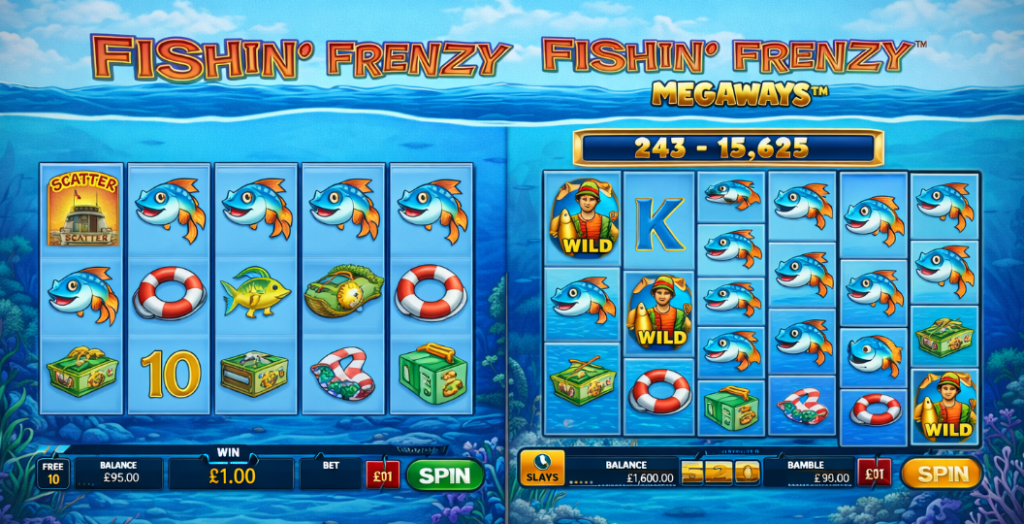
Fishin Frenzy as a Long-Running Slot Series
When people talk about Fishin Frenzy, they often mean a single slot.
That is understandable — the original game left a strong impression, and for many players it became a reference point for fishing-style mechanics. But in reality, Fishin Frenzy has not been a one-off success. It has evolved into a long-running slot series with a clearly recognisable structure, a consistent design language, and a formula that has proven flexible enough to support multiple sequels over time.
What makes the Fishin Frenzy series unusual is not the number of follow-ups, but the way those follow-ups coexist. New releases do not replace earlier versions, and they are not positioned as definitive upgrades. Instead, each sequel explores a slightly different interpretation of the same core idea. Some versions focus on stability and rhythm, others on volatility and extended bonus play, while certain titles experiment with format, scale, or seasonal presentation. Together, they form a catalogue rather than a linear progression.
This is why it makes more sense to view Fishin Frenzy as a system rather than a single product. The series has grown horizontally, not vertically. Players are not pushed forward from one version to the next; they are invited to choose the version that best fits their preferred pace, risk tolerance, and playing style. That approach explains why older Fishin Frenzy games remain relevant long after newer sequels are released.
Another defining trait of the series is restraint. Despite changes in mechanics and structure, the visual identity and thematic framing remain deliberately familiar. The fisherman, the fish values, the aquatic setting — all of these elements persist across versions. This continuity is not accidental. It allows players to recognise a Fishin Frenzy game immediately and engage with it without friction, regardless of whether the underlying mechanics are classic, expanded, or heavily modified.
In an industry where many slot franchises chase novelty for its own sake, Fishin Frenzy has taken a different path. It refines, stretches, and recontextualises a proven idea instead of constantly reinventing it. That is precisely why the series has accumulated so many sequels, and why those sequels still feel connected rather than fragmented.
The Core Fishin Frenzy Formula. What Never Changes
Base → Bonus → Values → Collector → Total
A compact view of the recurring Fishin Frenzy loop. The labels stay short so the diagram does the explaining.
What each step represents
| Step | Meaning in the session |
|---|---|
| Base spins | Sets the pace and creates the runway for the bonus trigger. |
| Bonus trigger | Marks the transition from routine play into the value-building phase. |
| Fish values | Visible value layer appears and accumulates before it is resolved. |
| Collector | The resolving action that gathers the displayed values into one outcome. |
| Total win | Final resolution: the collected value becomes the session result. |
At the heart of every Fishin Frenzy sequel lies the same foundational formula. Understanding this formula is the key to understanding the entire series, because no matter how large or complex a particular version becomes, it is always built on the same underlying logic.
The defining element is the collect-based bonus structure. During bonus rounds, fish symbols display fixed values, and a dedicated collecting symbol gathers those values across the screen. This simple interaction creates a clear objective for the player: values accumulate, tension builds, and outcomes are resolved through collection rather than line-based combinations. It is a mechanic that is easy to grasp but capable of producing a wide range of outcomes depending on how it is implemented.
What makes this formula especially durable is its modular nature. The collect mechanic does not depend on a specific reel layout, number of symbols, or volatility profile. It can function just as cleanly in a compact, controlled environment as it can in a large, highly variable one. That flexibility is the reason the same core idea can support classic formats, expanded bonus features, and even highly dynamic reel systems without losing coherence.
Equally important is what the formula avoids. Fishin Frenzy games do not overload players with layered sub-features, complex progress meters, or opaque bonus rules. The logic of the game remains visible at all times. Players can see where value comes from, how it is accumulated, and when it is collected. This transparency is one of the reasons the series appeals to a broad audience, from casual players to those who prefer analysing mechanics over chasing novelty.
Across all sequels, the bonus round remains the focal point of the experience. Base gameplay serves primarily as a gateway, maintaining a steady rhythm while building anticipation. This balance between restraint in the base game and intensity in the bonus is a constant across the series, even as individual versions adjust pacing, frequency, or potential.
In practical terms, the Fishin Frenzy formula acts like a stable engine. Developers can increase scale, alter volatility, or experiment with presentation, but the core interaction remains intact. For players, this creates trust. They know what kind of experience to expect before the first spin, even if the specific version introduces new dynamics.
This is why Fishin Frenzy sequels feel familiar without feeling redundant. The formula never changes, but the way it is expressed does. And that consistency is not a limitation — it is the foundation that allows the series to keep expanding without losing its identity.
Visual and UX Consistency Across Fishin Frenzy Sequels
Same interface landmarks across the series
This is a UI landmark map, not a screenshot gallery. It shows what stays in the same place across Classic, Big Catch, and Megaways: the collector anchor, the value layer, and the reel window.
Fixed reel window
Predictable spacing and a familiar read of outcomes.
Familiar frame, more space
Same landmarks, a cleaner read and expanded bonus presence.
Same landmarks, dynamic reel grid
The frame stays familiar even as the reel window varies.
Landmark matrix (what stays, what shifts)
One of the most striking aspects of the Fishin Frenzy series is how little it changes on the surface. To an untrained eye, many sequels appear almost identical at first glance. The same fisherman, the same fish symbols, the same familiar aquatic backdrop. In a market where visual reinvention is often treated as a necessity, this level of consistency stands out — and not by accident.
The visual language of Fishin Frenzy is deliberately conservative. Colours, symbol shapes, animations, and even sound cues remain closely aligned across the series. This approach creates immediate recognition. A player does not need to relearn the environment or decode new visual metaphors. From the first spin, the interface feels familiar, predictable, and controlled.
From a user experience perspective, this consistency serves a very specific purpose. Fishin Frenzy games are built around a bonus-driven structure, where attention is meant to stay on values, collections, and outcomes rather than on interpreting new mechanics. By keeping the visual layer stable, the games reduce cognitive friction. Players are free to focus on timing, rhythm, and bonus development instead of adapting to new layouts or symbol hierarchies.
This design philosophy also explains why changes between sequels are often subtle rather than dramatic. Adjustments are typically made to spacing, reel behaviour, or animation pacing rather than to the core presentation. Even when new mechanics are introduced, they are framed within the same visual vocabulary. The fisherman still collects. The fish still display values. The environment still reinforces a calm, controlled atmosphere, even when volatility increases beneath the surface.
Consistency also builds trust. Over time, players associate the Fishin Frenzy look and feel with a certain type of experience. That trust carries across sequels. When a player loads a new version, they already understand the tone of interaction, the speed of feedback, and the structure of rewards. This lowers the barrier to entry and encourages experimentation within the series without fear of confusion.
In premium slot design, restraint is often more difficult than novelty. Fishin Frenzy demonstrates how visual repetition, when executed with intention, can become a strength rather than a limitation. The series does not rely on spectacle to signal progression. Instead, it allows mechanical depth and structural variation to do the work, while the interface remains a stable anchor throughout the entire catalogue.
Evolution of the Fishin Frenzy Series. A Logical Timeline
Classic → Big Catch → Bigger Formats → Megaways → Special Editions
A phase map with one purpose: show direction. The formula stays recognisable; the experience shifts through scale, duration, and variability.
Classic: the baseline
stableThis phase defines the UI language and the bonus loop: clear pacing, clear value build, clean resolution.
- What stays: collector anchor + readable value layer.
- What changes next: more room for bonus development, without extra rules.
- Who it fits: players who prefer consistent sessions.
Direction profile
Although Fishin Frenzy sequels are not meant to be played in a strict order, the series does follow a clear internal logic of evolution. This progression is not defined by release dates or version numbers, but by how each phase responds to changing player expectations while preserving the core formula.
The earliest versions of Fishin Frenzy established a foundation built on control and clarity. Gameplay was compact, outcomes were readable, and bonus rounds followed a relatively contained structure. These games prioritised rhythm over scale, offering a steady experience where anticipation built gradually and resolution came quickly. For many players, this phase defined what Fishin Frenzy was meant to feel like.
As the series developed, the focus shifted towards expansion rather than reinvention. The Big Catch era introduced larger potential within the same familiar framework. Bonus rounds became more generous in scope, collections grew more substantial, and sessions gained a stronger sense of build-up. Importantly, this expansion did not complicate the rules. The same mechanics were simply allowed more space to operate.
The next phase marked a more pronounced shift in behaviour. Megaways and larger-format versions introduced variability as a central feature. Reel structures became less predictable, outcomes more volatile, and bonus rounds more dynamic. While the visual and thematic elements remained unchanged, the underlying experience became sharper and less controlled. This phase appealed to players who wanted the Fishin Frenzy formula with higher tension and less certainty.
Alongside these main branches, the series also explored experimental and seasonal variations. These releases did not attempt to redefine the core identity, nor were they positioned as replacements for the main line. Instead, they functioned as parallel expressions of the same idea, testing alternative pacing, formats, or presentation without committing the entire series to those changes.
What is important to understand is that this evolution is additive, not corrective. Newer versions do not fix problems in older ones. They address different preferences. Each phase remains relevant because it serves a distinct type of player. The series grows by layering options, not by discarding foundations.
Viewed as a whole, the Fishin Frenzy timeline reveals a franchise that understands its own limits and strengths. It expands where the formula allows, experiments at the edges, and preserves its core at all times. This balance between stability and progression is what has allowed the series to grow without fragmenting, and why its sequels feel connected even as they diverge in experience.
Risk Profiles: How Different Fishin Frenzy Sequels Feel in Play
Low risk → medium → high volatility (feel-based)
This is an experience map, not a maths chart. It shows where the main Fishin Frenzy branches usually sit in terms of session stability and swing potential — without numbers and without RTP.
Although all Fishin Frenzy games share the same foundation, they do not feel the same once play begins. One of the most important differences between sequels lies in how risk is distributed across a session. This is not something that can be reduced to numbers alone. It is expressed through pacing, volatility, and the emotional rhythm of the game.
Some Fishin Frenzy versions are built around control. Spins resolve quickly, swings are measured, and bonus rounds tend to deliver outcomes that feel balanced rather than extreme. These games suit players who prefer a steady tempo, where progress is incremental and the experience remains calm even during bonus play. Risk exists, but it is moderated. The emphasis is on consistency rather than surprise.
Other sequels push the same formula into a more dynamic space. Here, anticipation plays a larger role. Bonus rounds may take longer to resolve, collections can fluctuate more dramatically, and outcomes are less predictable. These versions introduce sharper contrasts between quiet base play and intense bonus sequences. The sense of risk is heightened, not because the rules change, but because the range of possible outcomes expands.
At the far end of the spectrum sit the most volatile interpretations of Fishin Frenzy. These games are defined by irregular rhythm and pronounced swings. Long stretches of subdued activity can be followed by sudden bursts of value during bonuses. The experience is less about maintaining balance and more about tolerating uncertainty in pursuit of stronger peaks. For some players, this creates tension and excitement; for others, it feels deliberately demanding.
What makes this risk profiling effective is that it is transparent. Fishin Frenzy sequels do not disguise their intent. A player quickly senses whether a particular version leans towards stability or volatility simply by observing how bonuses develop and how often meaningful collections occur. This clarity allows players to self-select, choosing versions that align with their personal comfort zone rather than being pushed into a one-size-fits-all model.
Taken together, the series offers a spectrum rather than a hierarchy. No version is objectively safer or riskier in isolation. Each one represents a deliberate tuning of the same mechanics, designed to create a distinct emotional experience while remaining recognisably Fishin Frenzy.
Types of Fishin Frenzy Sequels. Understanding the Series Breakdown
Three ways the series branches
Use this as a navigation anchor: pick the branch that matches your preferred pace and swing profile, then jump into the relevant titles.
Classic Line
The most readable versions — familiar flow, controlled swings, fast orientation.
High-Volatility Line
Less predictable rhythm — wider variance and stronger contrast between quiet and peak moments.
Special & Seasonal
Side paths — theme or format variations that keep the core recognisable.
Classic Line
If you want the series at its most readable, start here. The collector loop is clear, bonus pacing is controlled, and sessions feel consistent.
Looking at Fishin Frenzy sequels individually can be misleading. The series becomes far easier to understand when its games are grouped by intent rather than by release order or naming convention. When viewed this way, clear categories emerge, each serving a different role within the wider ecosystem.
The classic line forms the backbone of the series. These games adhere closely to the original structure, preserving familiar pacing, reel layouts, and bonus behaviour. They prioritise accessibility and consistency, making them suitable entry points for new players as well as reliable options for those who value a controlled experience. In these versions, the Fishin Frenzy formula appears in its most balanced and recognisable form.
The high-volatility line takes the same mechanics and stretches them. Reel structures become more variable, bonus outcomes less predictable, and session flow more uneven. These sequels are designed for players who already understand the core formula and want to explore its limits. They do not replace classic versions; they sit alongside them, offering an alternative interpretation that emphasises tension and fluctuation over rhythm.
Alongside these main branches are special and seasonal editions. These games are not attempts to redefine the series, nor are they stepping stones in its evolution. Instead, they function as side paths. Some introduce thematic variations, others experiment with format or scale, but all remain anchored to the same collect-based logic. Their purpose is variety rather than progression, giving players new ways to engage with a familiar system without committing the series as a whole to permanent change.
This breakdown reveals an important design principle behind Fishin Frenzy. The series does not chase a single direction. It expands outward, creating parallel options instead of linear upgrades. Players are not expected to move from one category to another. They are free to remain within the segment that best matches their preferences.
By structuring the series this way, Fishin Frenzy avoids the trap of escalation for its own sake. Each sequel has a defined role, and each role is supported by the same stable foundation. The result is a franchise that feels cohesive without being repetitive, and diverse without becoming unfocused.
Megaways and Bigger Versions: What Actually Changes Beneath the Surface
Classic vs Megaways: the grid changes, the logic stays readable
This is a schematic, not a slot screenshot. The left side shows a fixed 5×3 window. The right side shows a variable reel structure: each reel can display a different number of symbol positions, which changes rhythm and variance without changing the core idea.
Classic uses a fixed window: every spin is presented in the same shape.
That fixed shape keeps pacing consistent. The player reads outcomes in a predictable grid and the interface feels stable over long sessions. The important point is not “less” or “more”, but the fact that the structure does not change from spin to spin.
- Reel window: fixed shape every spin.
- Reading speed: high, because spacing is consistent.
- Session feel: steadier rhythm, fewer structural surprises.
Classic window (5×3)
Megaways window (variable)
Megaways and larger-format Fishin Frenzy versions are often described as simple expansions — more reels, more symbols, more combinations. That description is technically accurate, but it misses the more important point. These versions do not merely increase scale; they fundamentally alter how the core Fishin Frenzy formula behaves over time.
In classic formats, the experience is governed by predictability. Spins follow a stable rhythm, and bonus rounds tend to resolve within a familiar emotional range. Megaways and bigger versions disrupt that rhythm. Reel structures become variable, and with that variability comes uncertainty. The player no longer experiences a consistent pattern of outcomes; instead, each spin carries a slightly different weight.
What changes most noticeably is the pacing of anticipation. In expanded versions, bonus rounds often feel longer, not because they are mechanically more complex, but because their outcomes are spread across more stages. Collections may build gradually, pause, then surge unexpectedly. This elongation of tension creates a different psychological loop. The player is no longer waiting for a single decisive moment, but navigating a sequence of smaller developments that may or may not culminate in a strong resolution.
Importantly, the core mechanic remains untouched. Fish values are still collected. The fisherman still performs the same role. What changes is the environment in which that interaction takes place. By increasing the number of potential symbol positions, Megaways versions amplify variance without introducing new rules. The game becomes less about consistency and more about tolerance for fluctuation.
This is why these versions are often perceived as more demanding. They require patience and a willingness to accept uneven sessions. Long stretches of modest outcomes are not signs of malfunction; they are inherent to the structure. When significant bonuses do arrive, they feel earned not through complexity, but through endurance.
Larger-format versions that do not strictly follow the Megaways model often pursue a similar goal through different means. Additional reels, extended bonus mechanics, or layered collection phases all serve to stretch the same core interaction across a broader canvas. The effect is comparable: more space for variance, more room for extremes, and a heightened contrast between quiet play and explosive moments.
Crucially, these versions are not superior interpretations of Fishin Frenzy. They are specialised ones. They cater to players who already understand the series and are willing to engage with its mechanics over longer, less predictable arcs. For others, the classic structure remains the more comfortable and satisfying choice. The strength of the series lies in offering both without forcing a preference.
Why Fishin Frenzy Keeps Getting New Versions
The series expands sideways, not forwards
This ecosystem view explains why sequels keep appearing without replacing older titles. The centre stays stable (the core formula), while different branches explore scale, variability, themes, and alternative formats.
Core Formula
One stable interaction: readable value build, collector resolution, familiar UI anchors.
Big Catch: expansion, not replacement
The Big Catch line exists to stretch the bonus arc and give the series more room without changing the core interaction.
- Not linear: it is a parallel branch, not a “next level”.
- Not replacement: older versions remain valid entry points.
- Side expansion: more scale and presence, same recognisable logic.
The continued expansion of the Fishin Frenzy catalogue is not a coincidence, nor is it the result of a lack of new ideas. It is a consequence of how effectively the core formula adapts to different contexts without losing its identity.
Unlike many slot concepts that rely heavily on novelty, Fishin Frenzy is built around a mechanic that remains engaging even when repeated. The collect-based bonus structure creates a clear sense of purpose, and that clarity does not diminish with familiarity. In fact, it often improves. Players learn how value develops, how tension accumulates, and how outcomes resolve, which makes each new variation easier to approach.
This adaptability allows developers to respond to changing player preferences without abandoning what already works. When demand shifts towards higher volatility, the formula can be stretched. When interest returns to simpler, more controlled experiences, the same mechanics can be presented in a tighter format. Seasonal themes, experimental layouts, and alternative pacing models can all be explored without requiring a fundamental redesign.
Another reason for the series longevity is coexistence. New Fishin Frenzy versions do not render earlier ones obsolete. A player who prefers a specific balance of risk and rhythm can continue playing that version indefinitely. Meanwhile, newer releases simply add options. This layered approach reduces fatigue. The series does not ask players to move on; it invites them to choose.
There is also a strategic advantage in maintaining a recognisable franchise across multiple interpretations. Familiarity lowers resistance. Players are more willing to try a new version of Fishin Frenzy than an entirely unknown concept, even if the new version introduces higher volatility or structural changes. That willingness supports experimentation without alienation.
Most importantly, the series avoids the trap of escalation for its own sake. Not every new version aims to be bigger, faster, or more intense. Some refine pacing. Others adjust scale. Some exist purely to explore alternative formats. This selective expansion keeps the series flexible rather than bloated.
Fishin Frenzy continues to grow because its foundation is not fragile. It does not depend on a single configuration or a narrow audience. It functions as a framework — one that can be tuned, stretched, and recontextualised while remaining instantly recognisable. That is why the series keeps generating sequels, and why those sequels feel like parts of a coherent whole rather than disconnected attempts to repeat success.
Spin Behaviour and Bonus Flow Differences Across the Series
Classic bonus vs extended bonus pacing
Two bonuses can share the same identity and still feel completely different in motion. This block focuses on tempo and resolution: how quickly a bonus stabilises, how many layers it runs through, and how long it takes to “cash out” the outcome.
Classic Bonus
short / fast resolveTrigger
Quick entry into the feature.
Value appears
One main layer to read.
Collect
Resolution happens early.
Exit
Back to base quickly.
Pace profile
Extended Bonus
layered / long resolveTrigger
Entry often leads into a build-up.
Layer 1
Values accumulate across reels.
Layer 2
Additional passes before collection.
Collect
Resolution arrives later.
Pace profile
Beyond visual familiarity and shared mechanics, Fishin Frenzy sequels differ most clearly in how they behave over time. These differences are not always obvious from a feature list, but they become apparent once a session unfolds. Spin behaviour and bonus flow define the true character of each version, shaping how the game feels rather than how it looks.
In more compact Fishin Frenzy formats, spin behaviour is deliberately restrained. Base game spins resolve quickly, symbol distributions remain readable, and outcomes rarely feel abrupt. The game establishes a steady rhythm early on, encouraging longer sessions built around repetition rather than interruption. Bonuses tend to appear with a sense of regularity, and when they do, their structure follows a clear arc: accumulation, collection, resolution.
As the series expands into larger and more volatile interpretations, this rhythm begins to fragment. Spins no longer feel uniform. Some carry little weight, others introduce sudden shifts in momentum. This irregularity is not accidental; it is a structural choice designed to stretch anticipation. Players experience longer periods of subdued activity, punctuated by moments where bonus potential escalates rapidly.
Bonus flow changes accordingly. In classic versions, bonuses often feel contained, delivering outcomes within a familiar range and timeframe. In expanded and Megaways-based versions, bonuses can unfold in phases. Collections may build slowly, stall, then accelerate unexpectedly. This layered progression alters how players perceive time within the bonus. Instead of a single peak, there are multiple points of tension and release.
Another important distinction lies in how bonuses conclude. Some Fishin Frenzy games resolve decisively, bringing closure quickly once the final collection occurs. Others allow bonuses to linger, extending the experience through additional spins, modifiers, or secondary collection phases. These differences influence not only excitement, but also fatigue. A longer bonus may feel more dramatic, but it also demands more attention and patience.
What unites all versions is clarity. Despite variations in flow, the player is never uncertain about what is happening. Values are visible, collections are explicit, and progression remains understandable even when outcomes fluctuate. This transparency is a hallmark of the series and one of the reasons players can move between versions without feeling lost.
Ultimately, spin behaviour and bonus flow determine whether a Fishin Frenzy sequel feels calm or demanding, brisk or drawn out. These traits cannot be judged in isolation. They emerge over time, through repetition and observation, and they are central to choosing the version that best aligns with a player’s expectations.
Who Each Fishin Frenzy Sequel Is Made For
A practical fit, not a ranking
This is a simple mapping: pick the version that matches your comfort with rhythm and variability. No promises, no numbers — just the cleanest entry points.
| Player Type | Best Fit |
|---|---|
New players Want a clean first read of the collector loop and bonus resolution. |
Classic
Fixed structure, consistent pacing, easiest orientation. |
Risk seekers Prefer sharper swings and less predictable session rhythm. |
Megaways
Variable reel window, uneven rhythm, stronger contrast. |
Variety Want different themes or formats while keeping the identity familiar. |
Specials
Side editions that refresh context without a new rulebook. |
New players
Fixed structure and the cleanest first read of the loop.
Risk seekers
Variable structure and sharper swings across sessions.
Variety
Theme/format shifts while the identity stays familiar.
Because Fishin Frenzy sequels vary in rhythm, volatility, and bonus structure, they naturally appeal to different types of players. Understanding who each version is designed for is far more useful than searching for a universally “best” game within the series.
Some versions are clearly oriented towards accessibility. Their controlled pacing, familiar structure, and moderate risk profile make them suitable for players who value predictability. These games reward patience without demanding constant attention, and they provide a comfortable environment for those who prefer steady play over prolonged tension. They are also the most forgiving entry points for players encountering the Fishin Frenzy formula for the first time.
Other sequels are aimed at players who already understand the mechanics and want more variation within the same framework. These versions introduce sharper contrasts between base play and bonuses, creating moments of heightened anticipation without abandoning clarity. They suit players who enjoy observing patterns, adjusting expectations, and engaging with the flow of the game rather than its surface features.
At the more demanding end of the spectrum are versions built for players who actively seek volatility. These games ask for resilience. Sessions may be uneven, and rewards are less evenly distributed. In return, they offer stronger peaks and a more intense emotional arc. They are not designed to be comfortable; they are designed to challenge tolerance for uncertainty while staying within a familiar conceptual space.
Seasonal and experimental editions serve a different audience altogether. They appeal to players who already appreciate the series and want variation without committing to a permanent change in play style. These versions provide novelty through context and format rather than through structural overhaul. For some, they act as a break from routine; for others, they become occasional alternatives rather than mainstays.
What is notable is that the series does not attempt to funnel players from one type of game to another. There is no implied progression from simple to complex, or from stable to volatile. Each version exists as a parallel option. Players are free to remain within the segment that matches their preferences, revisiting other interpretations only when curiosity arises.
This inclusivity is one of the reasons the Fishin Frenzy series has maintained relevance across multiple releases. It does not demand loyalty to novelty. It accommodates familiarity, experimentation, and intensity in equal measure, allowing players to define their own relationship with the franchise.
Complete Fishin Frenzy Sequels Overview
A controlled catalogue, not a wall of links
This is the full index of the series, grouped so the page stays readable. Use search if you already know a name, or open one group at a time to keep context.
A Structured Catalogue of the Entire Series
Over time, Fishin Frenzy has grown into a broad and carefully layered catalogue rather than a simple chain of numbered sequels. While individual pages may focus on specific aspects such as demo play, RTP details, or feature variants, all titles listed here belong to the same extended system built around a shared mechanical identity.
This overview is designed to show the full scope of the Fishin Frenzy sequels as they currently exist. Instead of separating games by technical page type or keyword intent, the series is organised by structural role and gameplay purpose. This makes it easier to understand not only what games exist, but why they exist.
The Big Catch Series: The Structural Backbone
The Big Catch line represents the most stable and recognisable expansion of the original Fishin Frenzy concept. These games preserve the visual language, bonus structure, and pacing philosophy of the first release, while gradually extending scale and depth.
- Fishin Frenzy Big Catch
The foundational sequel that established how the original formula could be expanded without sacrificing control. It introduced longer bonus engagement while maintaining a measured rhythm that defines the classic Fishin Frenzy experience. - Fishin Frenzy Big Catch 2
A refinement rather than a reinvention. Bonus development becomes more pronounced, but the underlying interaction remains unchanged. This version is often favoured by players who want familiarity with slightly more room for variation. - Fishin Frenzy Big Catch 3
The most extended interpretation within the Big Catch line. Bonus rounds tend to feel longer and more layered, appealing to players who are comfortable with sustained engagement rather than rapid resolution.
Together, these titles form the backbone of the Fishin Frenzy sequels. They define what the series is meant to feel like at its most balanced.
Megaways Interpretations: Variable Rhythm and Increased Tension
Megaways versions represent a deliberate shift away from rhythmic stability towards variability and fluctuation. While the collect-based bonus mechanic remains intact, the environment in which it operates becomes less predictable.
- Fishin Frenzy Megaways
Applies the Fishin Frenzy formula to a dynamic reel structure, introducing uneven spin behaviour and a wider range of possible outcomes. The experience prioritises anticipation over consistency. - Fishin Frenzy Big Catch Megaways
Combines two expansion philosophies: the extended bonus focus of the Big Catch line and the irregular rhythm of Megaways mechanics. This version demands patience and tolerance for volatility, rewarding players who engage over longer sessions.
These titles are not intended to replace classic formats. They exist to serve players who seek sharper contrasts and less controlled progression.
Extended-Scale Variants: Bigger Without Becoming Chaotic
Not all expansions rely on reel variability. Some Fishin Frenzy sequels focus on scale, stretching bonus phases and session arcs while preserving structural clarity.
- Fishin Frenzy Even Bigger Fish
A large-format interpretation that amplifies bonus development and increases contrast between base play and collection phases without abandoning transparency. - Fishin Frenzy Big Splash
A variation that emphasises expanded bonus presence and visual intensity while retaining the familiar Fishin Frenzy rhythm.
These versions sit between classic and high-variability formats, offering depth without fully embracing unpredictability.
Feature-Led and Power Formats
Certain Fishin Frenzy sequels explore alternative formats rather than direct mechanical expansion. These titles experiment with how the core mechanic is presented, accessed, or distributed across gameplay.
- Fishin Frenzy Power 4 Slots
Places the Fishin Frenzy mechanic within a multi-slot environment, shifting focus from a single reel set to a broader structural layout. - Fishin Frenzy Power Play
An experimental format that adjusts bonus pacing and session flow while remaining anchored to the familiar Fishin Frenzy identity.
These games function as exploratory branches within the ecosystem rather than steps in a linear evolution.
Prize-Driven and Jackpot-Oriented Versions
Some titles emphasise prize structure more directly, integrating the Fishin Frenzy mechanic into reward-focused formats that highlight jackpots and line-based outcomes.
- Fishin Frenzy Jackpot King
A version that blends the traditional collect mechanic with a stronger emphasis on jackpot-style rewards, appealing to players drawn to prize-centric gameplay. - Fishin Frenzy Prize Lines
Focuses attention on line-based prize distribution while retaining the series’ recognisable visual and mechanical framework.
These versions demonstrate how the Fishin Frenzy formula can adapt to different reward philosophies without losing coherence.
Seasonal and Special Editions
Seasonal and crossover editions provide contextual variation rather than structural change. They maintain the established gameplay while adjusting theme or presentation.
- Fishin Frenzy Christmas
A festive edition that preserves core mechanics and pacing, offering seasonal atmosphere without altering the underlying experience. - Fishin Frenzy All Stars
A special format that places the Fishin Frenzy mechanic alongside broader slot elements, functioning as a crossover rather than a direct sequel.
One Ecosystem, Multiple Interpretations
Although these games are often accessed through separate demo pages, RTP-focused entries, or feature-specific views, they all belong to the same Fishin Frenzy sequel ecosystem. None of them invalidates another. Each one exists to satisfy a particular preference, whether that preference leans towards control, volatility, scale, or variation.
Seen as a complete catalogue, the Fishin Frenzy series is not a checklist to complete but a map to navigate. Its strength lies in offering multiple interpretations of a single, stable formula — allowing players to choose how they engage with it, rather than prescribing a single path forward.
Fishin Frenzy Sequels FAQ
Fishin Frenzy sequels: common questions
Tap a question to reveal the answer directly underneath. The focus here is structure and behaviour, not marketing claims.
| Question |
|---|
|
Fishin Frenzy sequels are different interpretations of the same core slot formula. Each version uses the familiar collect-based bonus mechanic, but adjusts scale, volatility, pacing, or format to create a distinct playing experience. |
|
No. While they share the same foundation, the games differ in how they behave during play. Some versions focus on stability and rhythm, others introduce higher variability, longer bonuses, or alternative formats. The similarities are intentional; the differences are structural. |
|
They do not. Older versions remain relevant and playable because new releases are designed to coexist rather than replace. Each sequel serves a different preference rather than correcting or upgrading previous games. |
|
Versions that use dynamic reel structures or extended formats tend to feel more volatile, as outcomes fluctuate more and bonus development is less predictable. Classic formats generally provide a more controlled experience. |
|
All core versions are built around the same collect-based bonus concept, but the way that bonus unfolds can vary. Some bonuses resolve quickly, while others develop across multiple phases or longer sequences. |
|
Visual consistency is a deliberate design choice. By keeping symbols, layout, and theme familiar, the series allows players to focus on gameplay behaviour rather than learning new interfaces with each version. |
|
That depends on personal preference. Players who value clarity and balance may prefer classic formats, while those seeking stronger swings may gravitate towards larger or more variable versions. There is no single recommended starting point. |
|
No. These pages present different views or aspects of the same underlying games. They do not represent additional sequels, but alternative ways of accessing or analysing existing ones. |
A Series Built on Structure, Not Noise
The longevity of the Fishin Frenzy series is not the result of chance, timing, or superficial popularity. It is the outcome of a deliberate design philosophy that prioritises structural clarity over constant reinvention. At its core, the series is built around a mechanic that is easy to recognise, easy to follow, and flexible enough to support variation without distortion.
What distinguishes Fishin Frenzy from many other long-running slot franchises is restraint. The games do not attempt to overwhelm the player with layers of complexity or novelty-driven features. Instead, they refine a single interaction and explore how that interaction behaves under different conditions. Scale changes. Volatility shifts. Pacing adapts. But the underlying logic remains visible at all times.
This consistency creates something rare in modern slot design: confidence. Each sequel feels intentional. There is no sense that versions exist simply to fill gaps or chase trends. Even when new formats are introduced, they are framed as alternatives rather than corrections. The series does not move forward by abandoning its past; it grows by accommodating different ways of engaging with the same idea.
Another important aspect is coexistence. Fishin Frenzy sequels are not stepping stones. A player is never expected to progress from one version to another in order to experience the “full” game. Older titles remain relevant because they continue to serve a purpose. Newer ones add options, not pressure. This layered approach respects player preference and avoids the fatigue that often accompanies serial releases.
Viewed as a complete catalogue, Fishin Frenzy becomes more than a collection of slots. It functions as a framework. One that can support controlled play and high variability, short sessions and extended engagement, familiar rhythm and experimental structure. The series does not define a single ideal experience. It offers a range of calibrated ones.
That is ultimately why Fishin Frenzy continues to expand. Not because it needs to reinvent itself, but because its foundation allows it to adapt without losing coherence. Each sequel reinforces the same central identity while exploring a different edge of it. The result is a franchise that feels stable, mature, and deliberately designed.
In an industry often driven by excess, Fishin Frenzy demonstrates the value of precision. One formula. Many interpretations. And a series that understands exactly what it is — and what it does not need to become.