How Scratchcards Actually Work
A quiet introduction: when familiarity becomes misleading
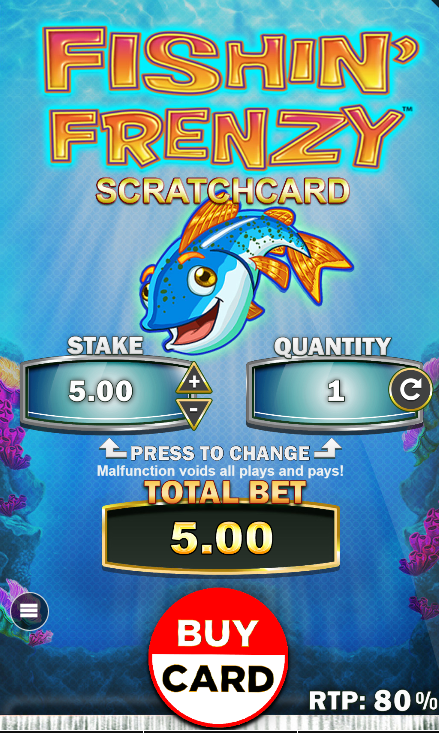
At first glance, Fishin’ Frenzy Scratchcard feels comfortable.
The name is familiar. The theme is familiar. Even the atmosphere feels borrowed from something you already know. Water, fishing gear, calm colors, a slow visual rhythm. Your brain immediately categorizes it as something close to the Fishin’ Frenzy slot.
And that first categorization is exactly where the misunderstanding begins.
This game is not a variation of the slot.
It is not a simplified version.
It is not a “faster way” to play Fishin’ Frenzy.
What you are looking at is a completely different type of gambling product, using familiarity as a soft entry point. The resemblance exists on the surface only. Underneath, the logic is not just different — it is almost opposite.
This page is written for players who want to understand what they are interacting with, not just what they are clicking. There are no promises here, no tactics, no shortcuts. Only structure, behavior, and the quiet mechanics that shape how this game actually works.
Once you see that structure clearly, the game stops feeling mysterious. And when a gambling product loses its mystery, it becomes much easier to approach calmly.
What an online scratchcard really is — beyond the scratching motion
What an online scratchcard really is
The outcome is generated before you scratch — scratching is just the reveal layer.
The word scratchcard sounds simple, almost harmless. It carries a strong association with physical cards, coins, and instant results. Online versions try very hard to preserve that feeling — and at the same time, they quietly transform it.
In an online scratchcard, including Fishin’ Frenzy Scratchcard, the outcome is generated before you interact with the card. Not during the scratching. Not gradually. Not in response to where or how you move your cursor.
The scratching itself is not a mechanic.
It is a reveal layer.
This distinction matters more than most players realize. Because scratching feels active. It feels like participation. It creates the impression that something is unfolding in real time, guided by your actions.
In reality, nothing is unfolding.
You are uncovering a finished result, piece by piece.
Online scratchcards are instant win games in the purest sense: single events with fixed outcomes, wrapped in an interface designed to slow down perception and add texture to the reveal. Fishin’ Frenzy Scratchcard leans heavily into this design philosophy, using animation and layered screens to stretch a moment that is, mathematically, already complete.
Understanding this does not ruin the game.
It simply places it where it belongs.
Why the Fishin’ Frenzy name works so well here
The Fishin’ Frenzy brand carries a very specific emotional weight. The original slot trained players to expect something calm, readable, and relatively transparent. Even when outcomes were unpredictable, the structure felt approachable.
Using that brand for a scratchcard is not about continuity of gameplay.
It is about continuity of trust.
When players see the Fishin’ Frenzy name, they bring assumptions with them:
- that the game will be simple to understand
- that nothing too aggressive will happen
- that the pace will feel controlled
These assumptions lower resistance. They make players more willing to engage with a format that, under a different name, might feel more abstract or lottery-like.
But here is the important part:
Fishin’ Frenzy Scratchcard does not behave like the slot that built the brand. It borrows the visual language, not the logic.
The game relies on recognition to smooth over a structural shift — from session-based play to single-event play. That shift is subtle enough that many players never consciously notice it. They just feel that the game behaves differently, without fully understanding why.
That gap between expectation and reality is not accidental. It is carefully designed.
Scratchcard vs slot: a difference most players never slow down to notice
Scratchcard vs Slot
Same “instant win” vibe — totally different logic under the hood.
| Aspect | Slot | Scratchcard |
|---|---|---|
| Outcome timing | During play (spin resolves) | Before interaction (reveal only) |
| Session logic | Yes — runs of variance, “tempo” phases | No — each card is isolated |
| RTP behaviour | Cyclical feel (volatility rhythm) | Fixed per card (no live swing) |
| Player influence | Perceived: timing, stop habits, “reads” | None: scratching changes nothing |
| What UI is doing | Animating a decision being made | Masking a decision already made |
| Best mental model | “A machine resolving a spin” | “A sealed envelope being opened” |
Slots and scratchcards often get grouped together because they both feel digital and fast. But from a structural perspective, they live in different worlds.
A slot spin is part of a sequence.
A scratchcard is a standalone event.
Slots rely on cycles, volatility curves, and session dynamics. Even when players don’t understand the math, they intuitively sense that time matters. There is a before and an after.
Scratchcards remove that dimension almost entirely. There is no “warming up.” No rhythm. No recovery. Each card exists in isolation, unaffected by what came before it.
Fishin’ Frenzy Scratchcard disguises this isolation through layered reveals and bonus-like screens. It creates the illusion of progression inside a single outcome. Multiple panels, additional features, extra reveals — all of them are fragments of the same pre-generated result.
This is where confusion often arises. Players feel momentum where none exists. They interpret extended reveals as continuation, when in reality it is just delayed disclosure.
Once you see this clearly, the game stops feeling unpredictable in a dramatic way. Instead, it starts to feel precise, contained, and finite.
Interaction design: why scratching feels meaningful even when it isn’t
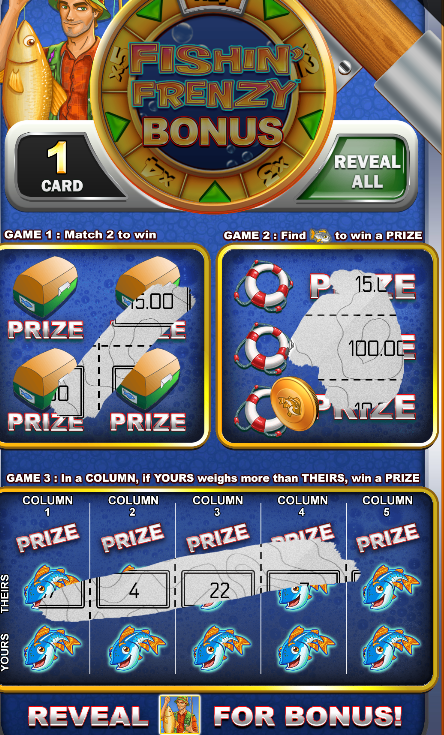
The act of scratching is deceptively powerful. It turns observation into action. Even though the result is fixed, the process of uncovering it creates a sense of authorship — I did this.
Fishin’ Frenzy Scratchcard uses this effect deliberately. The interface is slow enough to build anticipation, but not slow enough to feel tedious. The motion is smooth, the sound design is soft, and each revealed symbol feels like a small decision point, even though no decisions are actually being made.
This is not manipulation in a crude sense.
It is interaction design doing exactly what it was meant to do: making passive information feel active.
The danger only appears when players confuse interaction with influence. When scratching starts to feel like control, expectations shift. And when expectations shift in an instant-win format, disappointment usually follows.
Seen clearly, the scratching motion is just a lens — a way to look at a result from different angles, one piece at a time.
And once you accept that, the game becomes quieter. Slower. More honest.
Bonus layers that are not really bonuses
Bonus layers that are not really bonuses
Bonus screens can feel like a “second chance” — but most of the time it’s the same outcome, just revealed in layers.
One of the most common misunderstandings around Fishin’ Frenzy Scratchcard comes from the word bonus. The game presents additional screens, secondary mechanics, and visual transitions that strongly resemble bonus rounds. To an untrained eye, this feels like an opportunity for the outcome to change, expand, or improve.
But in an instant win format, bonuses work very differently.
What appears as a bonus in Fishin’ Frenzy Scratchcard is not a new event layered on top of the original one. It is a secondary reveal phase of the same result. Nothing new is generated. Nothing is recalculated. The game is simply unfolding a larger structure that was already decided at the moment the card was loaded.
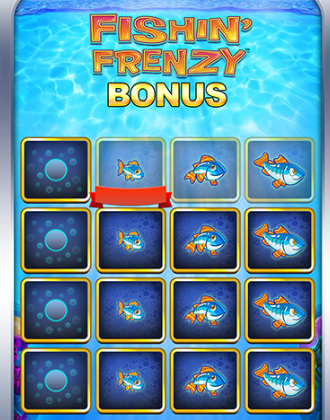
This matters because bonuses usually imply potential. In slots, a bonus round can dramatically shift volatility, introduce new mechanics, or extend a session. In a scratchcard, bonuses serve a different purpose: they stretch time and redistribute attention.
Fishin’ Frenzy Scratchcard uses these layers to soften the finality of instant outcomes. Instead of a single moment of win or loss, the player experiences a sequence of moments — each one feeling like progress, even though all of them belong to the same fixed result.
Seen this way, the bonus layers are not rewards.
They are narrative devices.
The mathematics behind the calm surface
Mathematics & RTP
This is scale, not promise. RTP only exists in the long run.
RTP is a long-run property — not an “expected win”.
Scratchcards rarely talk openly about their mathematics, and for understandable reasons. The math is simple, but often uncomfortable once clearly understood.
In Fishin’ Frenzy Scratchcard, the RTP is applied across a large population of pre-generated outcomes. Each card represents a completed calculation, drawn from a fixed distribution. There is no volatility curve to ride, no “bad run” to recover from, and no favorable moment to wait for.
This is not a flaw.
It is a design choice.
Instant win games trade long-term engagement for immediacy. They remove the emotional rollercoaster of sessions and replace it with clarity: this card either contains value, or it does not.
The lower RTP often associated with scratchcards is not hidden inside complex mechanics. It is openly embedded in the structure. What makes it feel less direct is the presentation — the gradual reveal, the layered screens, the illusion of development.
Once you understand that the mathematics are settled before interaction begins, the game becomes easier to contextualize. It stops being a question of timing or persistence and becomes a matter of acceptance.
The logical glitch: when interaction feels like influence
Logical-Glitch Theory
The “glitch” isn’t in the RNG. It’s in the UX loop that makes the brain feel in control.
This is where Fishin’ Frenzy Scratchcard becomes especially interesting.
The human brain is extremely sensitive to feedback loops. When an action is followed by a response, we instinctively assume causality. Scratchcards exploit this instinct gently, without force or deception.
You scratch. Something appears.
You scratch again. Something else appears.
Even though the outcome is fixed, the sequence creates the illusion of influence. This is the logical glitch: interaction without agency.
Fishin’ Frenzy Scratchcard does not rely on speed or intensity to trigger this effect. It relies on calm repetition. The pace is slow enough to encourage reflection, but structured enough to prevent interruption. You are always one reveal away from the next piece of information.
Understanding this glitch does not make the game worse. In fact, it often makes it more interesting. You begin to observe not just the symbols on the screen, but your own reactions to them. Anticipation, hesitation, mild tension — all arising from a process that, logically, should be neutral.
That gap between logic and perception is where most instant win games live.
Time perception and the illusion of extension
Time perception
Same real minutes — different felt duration. Scratchcards compress time into repeated micro-sessions.
One of the quiet strengths of Fishin’ Frenzy Scratchcard is how it alters time perception.
A single card takes longer to experience than it should, given how little actually happens. This is not accidental. Multiple panels, transitions, and bonus layers turn a moment into a small journey.
The result is a subtle distortion: the game feels longer than it is, and because of that, it feels more substantial. Players often underestimate how quickly multiple cards add up, simply because each one feels self-contained and complete.
Unlike slots, scratchcards do not naturally create pauses. There is no spin cycle to reset attention. Each card ends cleanly, inviting another without friction.
This makes awareness important. Without conscious limits, instant games can compress time quietly, not through excitement, but through smoothness.
Bankroll awareness instead of strategy
Bankroll awareness
Treat each scratchcard like a sealed invoice: fixed cost, fixed exposure, no “session recovery”.
| Checklist | Why it matters |
|---|---|
| One card = one event | There’s no “spin stream” — each buy is a standalone outcome. |
| No recovery mode | Bonus screens may feel like a second chance, but they don’t regenerate results. |
| Predefined exposure | Your cost is known up-front: stake × quantity = the whole risk for that “session”. |
| Decide the stop before you buy | Scratchcards compress time — repeating purchases can escalate faster than it feels. |
| Track by purchases, not minutes | Time perception is unreliable here; counting cards keeps behaviour measurable. |
There is no strategy for Fishin’ Frenzy Scratchcard in the traditional sense. No pattern to read. No mechanic to exploit. No behavior that improves expected outcomes.
What does exist is awareness.
Understanding that each card is a single, complete event changes how you approach spending. Bankroll management here is not about adjusting bets or waiting for signals. It is about deciding, in advance, how many independent events you are willing to experience.
This shifts the focus away from hope and toward intention.
You are no longer chasing a turn in your favor. You are choosing how much exposure you allow.
That distinction may sound subtle, but it changes everything.
Who this game quietly fits — and who it doesn’t
Fishin’ Frenzy Scratchcard fits players who value closure. People who prefer defined outcomes over prolonged uncertainty. Those who enjoy interaction as a form of engagement, not as a means of control.
It does not fit players who rely on rhythm, cycles, or long-session logic. Anyone expecting momentum or recovery will likely feel disoriented, even if they cannot immediately explain why.
And that is perfectly fine.
Not every game needs to be for everyone. Some are designed to be understood slowly, and approached sparingly.
Fishin’ Frenzy Scratchcard belongs to that category — once you stop asking it to behave like something it is not.
Where Fishin’ Frenzy Scratchcard actually belongs
Fishin’ Frenzy Scratchcard is rarely found alongside traditional slot-heavy casino lobbies. Instead, it appears most often on platforms that focus on instant games, bingo ecosystems, and lottery-style products.
This placement is not accidental.
Scratchcards fit environments where games are treated as brief interactions rather than long-form sessions. They are designed to coexist with other single-event formats — games that start and end cleanly, without encouraging prolonged immersion.
Seeing Fishin’ Frenzy Scratchcard in these spaces helps contextualize it correctly. It is not meant to compete with slots for attention or depth. It exists as a different category altogether, one that values immediacy, simplicity, and closure.
Understanding where a game is offered often tells you more about its nature than any feature list ever could.
Questions that usually come too late
Questions that usually come too late Tap to open a compact FAQ table (won’t stretch the page).
| Question | Answer |
|---|---|
| Is Fishin’ Frenzy Scratchcard a slot? | No. Despite the shared theme and branding, it does not behave like a slot in structure, mathematics, or session logic. |
| Is the result decided before I start scratching? | Yes. The entire outcome is generated before any interaction takes place. Scratching only reveals what already exists. |
| Do bonus features change the result? | No. Bonus layers are part of the same pre-generated outcome. They extend the reveal, not the calculation. |
| Is it closer to a lottery or a casino game? | Structurally, it sits closer to lottery-style instant win products, even though its presentation borrows from casino design. |
| Does understanding this reduce the fun? | For some players, yes. For others, it does the opposite — it removes confusion and replaces it with clarity. |
A final, calm perspective
Fishin’ Frenzy Scratchcard does not hide what it is.
It simply does not explain itself unless you stop and look closely.
Once you do, the game becomes smaller, quieter, and more contained. There is no hidden depth waiting to be unlocked, no momentum to build, and no cycle to read. There is only a single moment, revealed slowly, through interaction that feels meaningful even when it isn’t.
This is not a criticism.
It is a description.
Approached with the right expectations, Fishin’ Frenzy Scratchcard can be a clean, finite experience — something to engage with briefly and leave behind without residue. Approached with slot logic, it can feel confusing or disappointing.
The difference lies not in the game itself, but in how clearly it is understood.
And clarity, in gambling, is usually the rarest feature of all.