
Review Fishin Frenzy Slot: Collector Mechanics, Free Spins Architecture and Volatility Structure
Why Fishin Frenzy Still Commands Structural Attention
I have reviewed enough slot machines to recognise when longevity is accidental and when it is structural. Fishin’ Frenzy belongs firmly in the second category. It does not dominate by spectacle. It does not depend on inflated maximum win marketing or cinematic distraction. It survives because its core mechanic is disciplined, readable and repeatable.
Released by Blueprint Gaming, Fishin’ Frenzy entered a market already saturated with five-reel formats and aquatic themes. At first glance, nothing about its geometry suggests disruption. Five reels. Three rows. Ten fixed paylines. Familiar configuration. Modest visual presentation. Controlled sound design. On the surface, it appears conservative.
Yet the game remains relevant because it understands how to stage anticipation. It shows the player numerical value before it releases that value. It separates visibility from conversion. That separation forms the backbone of its collector architecture.
This review is not concerned with surface aesthetics. It is concerned with structure. I will examine how the base configuration supports the collector model, how free spins alter density rather than identity, and how volatility expresses itself across different exposure lengths. Fishin’ Frenzy is not complex, but it is deliberate. And deliberate design tends to endure longer than decorative excess.
The reason this slot continues to command attention is not nostalgia. It is mechanical coherence. Every meaningful outcome within the game is governed by one central principle: value must be collected.
Understanding that principle clarifies everything that follows.
The Structural Identity of Fishin Frenzy: Geometry, RTP and Controlled Volatility
A quick structural snapshot
A compact reference point for how the game is built and where the variance is most likely to concentrate.
| Parameter | Value |
|---|---|
| Layout |
5×3 |
| Paylines |
10 fixed |
| Volatility |
Low–medium |
| Core mechanic |
Conditional collector |
| Primary variance zone |
Free Spins |
| RTP model |
Long-term theoretical |
Fishin’ Frenzy operates on a 5×3 reel layout with ten fixed paylines. The simplicity of this structure is not a limitation; it is a stabilising device. With only ten lines active at all times, combinational noise is reduced. Outcomes are easier to track. Distribution remains readable.
The return to player, depending on operator configuration, typically sits in the mid-ninety-six per cent range. This figure represents long-term theoretical expectation across extensive play, not a short-term guarantee. It is important to separate perception from mathematics. RTP is a statistical average over thousands or millions of spins. It cannot be verified within a single session.
Volatility is generally categorised as low to medium. In practical terms, this means that extreme payout spikes are possible but not dominant. The game does not aim for exaggerated maximum multipliers. Instead, it concentrates reward in moderate but noticeable bursts, primarily during bonus sequences.
The base game contributes steady but modest line wins. Standard symbols pay predictable amounts. These returns are sufficient to maintain session continuity but rarely transformative. Their function is pacing, not escalation.
This pacing matters. If the base game were overly generous, the collector mechanic would lose its structural significance. If it were excessively dry, volatility would skew upward and undermine the slot’s classification. The balance is intentional.
The ten-line format also limits dispersion. Modern high-intensity slots often rely on 40 or more paylines or dynamic ways systems to create constant combinational interaction. Fishin’ Frenzy resists that expansion. By maintaining a narrow line structure, it keeps variance contained.
However, geometry alone does not define the game’s identity. The defining feature lies in how value is displayed and later resolved. The structural identity of Fishin’ Frenzy is therefore not found in its paylines but in its collector economy.
The geometry stabilises. The collector activates. Together, they form a controlled volatility model that has proven durable over time.
The Collector Core: Fish as Visible Value, Fisherman as Conditional Converter
How collection actually resolves
A simple dependency chain: visible value appears first, but payout only materialises when the collector condition is met.
Stage one
Fish symbols display value
Condition
Fisherman required
Resolution
Synchronisation event
Output
Aggregated payout
The central innovation of Fishin’ Frenzy is deceptively simple. Certain symbols — fish — display explicit cash values directly on their surfaces. These values are visible immediately when the reels stop. They vary in size, creating a hierarchy of potential reward.
Importantly, these fish symbols do not automatically grant their displayed amounts. They exist first as potential. Conversion requires the appearance of the fisherman symbol.
The fisherman acts as both a wild and a collector. In the base game, he substitutes for other symbols to form line wins. During free spins, his collector function becomes dominant. When he appears in combination with fish symbols, he gathers their displayed values and converts them into a payout.
This interaction establishes a two-stage reward process:
Stage one: visible potential appears on the reels.
Stage two: conditional synchronisation converts that potential into realised gain.
Neither element is sufficient alone. Fish without fisherman represent dormant value. Fisherman without fish represents inactive collection power. Only when both conditions align does meaningful payout concentration occur.
This synchronisation model compresses reward into specific events rather than distributing it evenly. As a result, individual spins during free spins can produce disproportionately impactful outcomes relative to the game’s overall volatility classification.
Psychologically, the presence of numerical values on fish symbols creates anticipation before confirmation. The player sees what could be collected. When the fisherman fails to appear, the potential disappears with the next spin. When he does appear, the resolution feels decisive.
From a structural standpoint, this design achieves three objectives.
First, it maintains engagement during base play by constantly reminding the player of latent value.
Second, it prevents excessive volatility in the base game by withholding automatic conversion.
Third, it centralises meaningful payouts within synchronised events, preserving the slot’s moderate volatility profile.
The collector core defines Fishin’ Frenzy. Remove it, and the game collapses into a standard ten-line slot with modest line wins. With it, the game gains a mechanical identity that distinguishes it from generic formats.
Everything else — bonus density, volatility perception, session behaviour — extends from this central interaction.
Value appears.
Value waits.
Value converts only under defined conditions.
That discipline is the reason Fishin’ Frenzy remains structurally coherent years after release.
Free Spins as an Amplified Collection Environment
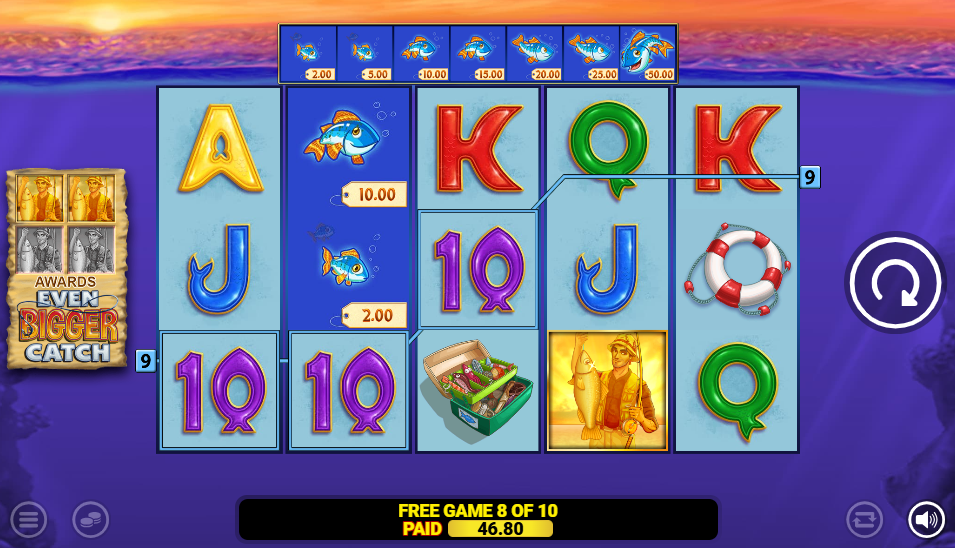
Free spins in Fishin’ Frenzy are triggered when scatter symbols land on reels one, three and five. The requirement is fixed. The trigger is visible. There is no hidden meter, no progressive counter, no background accumulation. Activation is discrete and event-based.
It would be easy to describe the free spins feature as a secondary mode layered on top of the base game. Structurally, that description would be inaccurate. Free spins do not introduce new mathematics. They intensify existing mechanics.
The same reels spin. The same symbols appear. The same collector logic governs outcomes. What changes is density.
During free spins, the frequency of the fisherman symbol increases relative to the base game. This does not mean it appears constantly. It means that the probability of synchronisation events rises within a limited sequence of spins. The environment becomes more conducive to collection.
This shift in density is critical. In the base game, fish symbols displaying cash values may appear regularly, but without consistent collector activation they remain largely ornamental. Free spins alter that balance. The collector function becomes active enough to convert visible potential into realised payout at a higher rate.
The feature therefore acts as an amplifier. It does not replace the collector economy; it accelerates it.
Retriggers extend the amplified environment. When additional scatter combinations land during free spins, extra spins are awarded. Each extension increases exposure within the intensified density phase. However, retriggers are statistically bounded. They are part of the volatility design, not an escape from it.
Most of the slot’s meaningful variance expresses itself during free spins. The base game sustains pacing and moderate returns. The feature concentrates outcome spikes. This distribution does not make the game extreme. It makes it structured.
One must also note what free spins do not do. They do not introduce multipliers that escalate indefinitely. They do not alter the displayed values on fish symbols beyond defined limits. They do not transform the game into a separate, high-risk environment.
Instead, they create a temporary zone where the collector mechanism operates at higher efficiency.
This design explains why players often perceive Fishin’ Frenzy as a “bonus-driven” slot. The majority of notable outcomes occur within free spins. Yet those outcomes remain governed by the same conditional synchronisation principle present from the first spin of the base game.
Free spins are not spectacle. They are concentration.
Payout Compression and Synchronisation Events
The defining experience of Fishin’ Frenzy occurs when multiple fish symbols displaying visible cash values appear on the reels and a fisherman lands on the same spin. This is a synchronisation event. It is also the moment where the game compresses payout.
Compression means that value which might otherwise be distributed across many small line wins is gathered and delivered at once. If three or four fish symbols appear with distinct cash amounts and the fisherman collects them, the aggregated payout feels substantial relative to typical base wins.
This aggregation is not random in its design. It is engineered to create contrast. The base game produces incremental returns. Synchronisation produces visible leaps.
The important distinction is that these leaps remain bounded. Fishin’ Frenzy does not allow unrestricted scaling. The values printed on fish symbols are predefined within controlled ranges. Even when several higher-value fish appear simultaneously, the total remains within moderate limits compared with high-volatility collector slots.
This restraint stabilises the overall volatility profile. Synchronisation events feel decisive, but they do not destabilise the mathematical foundation of the game.
Another important structural detail is that fish symbols often appear without a fisherman. This is not accidental imbalance. It is necessary tension. If every visible fish value were automatically collected, the collector mechanic would lose its conditional nature. By separating appearance from activation, the system preserves anticipation.
Payout compression also affects session rhythm. Extended periods of modest returns can be interrupted by a single synchronisation event that restores balance or produces temporary profit. This rhythm creates a wave-like pattern rather than a flat distribution.
From a statistical perspective, each spin remains independent. There is no stored momentum. There is no hidden progression towards a guaranteed synchronisation. Yet the visible presence of fish values can create the impression that something is building.
That impression is perceptual, not mechanical.
The collector economy therefore relies on incomplete cycles. Fish appear. They vanish. Fisherman appears. Sometimes he collects. Sometimes he does not. The player experiences both potential and denial within short intervals.
This oscillation is the structural engine of the slot.
Why the Game Feels Closer to a Bonus Than It Statistically Is
Many players describe Fishin’ Frenzy as a slot that “always feels close” to triggering free spins or delivering a collector event. This perception arises from visual density and symbol signalling rather than altered probability.
The scatter requirement — reels one, three and five — ensures that near-miss scenarios are common enough to be visible. Two scatters may land, with the third failing to appear. Because the scatter symbol is thematically prominent, its partial appearance draws attention.
Similarly, fish symbols displaying cash values frequently populate the reels. Even when the fisherman does not appear, the presence of visible amounts creates an impression of opportunity. The player sees what could have been collected.
This proximity effect amplifies emotional response. However, it does not influence outcome generation. Each spin is resolved independently by certified random processes. Near-miss results are a natural by-product of symbol distribution, not a signal of approaching success.
The reason the game feels bonus-adjacent is structural transparency. The player can see the components required for a meaningful event. Nothing is hidden. Fish values are explicit. Scatter positions are clear. The collector symbol is recognisable.
Transparency can heighten anticipation. It does not increase probability.
The volatility classification remains anchored in long-term distribution. Over extended sessions, the frequency of free spins and synchronisation events aligns with expected parameters. Short sessions may distort perception, particularly if a feature triggers early or remains absent.
Another factor contributing to this perception is controlled base game pacing. Because line wins occur regularly enough to sustain play but rarely enough to dominate, attention naturally shifts towards the collector mechanism. The base game feels preparatory. The feature feels central.
This structural emphasis leads players to interpret the entire session as a sequence of attempts to reach the next amplified phase. In reality, the game is balanced between base contributions and feature concentration.
Fishin’ Frenzy feels close because it displays potential openly. It feels event-driven because it compresses payout within defined moments. It feels active because visible values appear frequently.
Statistically, however, it remains disciplined.
The difference between perception and distribution is subtle but important. Fishin’ Frenzy does not promise escalation. It offers conditional resolution within a controlled volatility band.
And that restraint is precisely what allows the mechanic to remain effective over time.
Volatility Behaviour Across Short and Extended Sessions
Why short sessions feel sharper than the maths
Perceived intensity drops as exposure increases, while the underlying per-spin volatility remains stable. The gap is a visibility problem, not a probability change.
Volatility in Fishin’ Frenzy cannot be understood by classification alone. Describing the slot as low to medium volatility provides a general framework, but it does not capture how distribution expresses itself across different exposure lengths. The true behaviour of the game becomes visible only when we examine short, moderate and extended sessions separately.
In short sessions, variance appears compressed. With limited spins available, the probability of triggering free spins remains statistically possible but not guaranteed. If the feature activates early and produces a collector synchronisation event, the session can feel disproportionately successful relative to stake. If it does not, the base game’s modest line wins may not be sufficient to offset decline.
This compression creates a binary sensation. The session feels either fortunate or uneventful. Such perception is not a distortion of mathematics but a natural consequence of insufficient exposure to smooth distribution. Short sessions magnify the impact of individual events.
Moderate sessions begin to reveal structural pacing. The base game contributes steady, smaller returns. Free spins are likely to occur within expected frequency bands. The collector mechanism expresses itself multiple times, though not necessarily at peak intensity. At this exposure length, volatility classification begins to feel accurate. Wins and losses interact within a contained rhythm.
Extended sessions present the most balanced view of volatility. Over a larger sequence of spins, feature triggers, retriggers and base game contributions distribute more evenly. No single synchronisation event dominates the entire session narrative. Instead, outcomes aggregate within a bounded range that reflects the game’s intended profile.
It is important to emphasise that return to player remains a long-term theoretical construct. Even extended sessions cannot confirm or invalidate RTP. What they can do is reveal pattern stability. Fishin’ Frenzy does not swing erratically. It oscillates within moderate amplitude.
The collector mechanism intensifies volatility perception because it clusters reward. However, clustering is not the same as escalation. A synchronisation event can produce a noticeable spike, but that spike is proportionate to stake and bounded by predefined value ranges.
Stake size influences session texture but not per-spin probability. Higher stakes reduce total spins within a fixed balance, thereby increasing the perceived sharpness of variance. Lower stakes extend exposure, allowing the moderate volatility profile to emerge more gradually.
From a structural perspective, Fishin’ Frenzy is consistent. It does not alter its temperament. What changes is the lens through which the player observes it.
Volatility here is conditional, not explosive. It depends on synchronisation events. Those events are probabilistic and bounded. Over time, the system reveals its discipline.
Base Game Contribution Versus Bonus Weighting
Understanding Fishin’ Frenzy requires separating base game contribution from bonus weighting. Many players instinctively associate the slot with its free spins feature. While this association is understandable, it risks underestimating the role of the base game in sustaining structural balance.
The base game performs two essential functions. First, it maintains continuity through regular but moderate line wins. Second, it prepares the psychological ground for collector activation by displaying fish symbols with visible values.
Without base game pacing, the collector mechanic would lack context. If fish values appeared only during free spins, the tension between potential and conversion would diminish. Their presence during base play reinforces anticipation, even when conversion remains unlikely outside the feature.
However, base game line wins rarely define profitability. Their magnitude is intentionally modest. This design ensures that the free spins feature carries structural weight. The majority of meaningful payout concentration occurs during amplified collection phases.
This weighting does not create imbalance. It creates hierarchy. The base game stabilises. The feature intensifies.
Bonus weighting also clarifies why session outcomes can feel uneven. If a session includes multiple free spins cycles with effective synchronisation, returns can appear strong relative to stake. If feature frequency aligns with lower expectation bands, the base game alone may not compensate fully.
The system does not guarantee equilibrium within short intervals. It guarantees proportionality over extended exposure.
One must also consider the psychological framing of collector events. When multiple fish values are gathered simultaneously, the aggregated number is displayed prominently. This visibility enhances perceived significance. In contrast, base line wins are incremental and less visually concentrated.
This visual hierarchy reinforces the structural hierarchy.
From a mathematical standpoint, both base game and feature contributions are integrated within the overall RTP. Neither exists independently of the other. Yet their roles differ. The base game distributes continuity. The feature distributes impact.
This balance allows Fishin’ Frenzy to sustain moderate volatility without drifting into extremes. The base game prevents prolonged stagnation. The feature prevents monotony.
Together, they create a system where reward is neither constant nor rare. It is conditional.
Comparing the Series: Original, Megaways and Structural Intensity
How the collector model shifts across the series
The core mechanic remains intact, yet geometry and dispersion alter the intensity and session character of each release.
| Version | Geometry | Volatility | Collector intensity | Session feel |
|---|---|---|---|---|
| Original | 5×3 | Low–medium | Moderate | Controlled |
| Megaways | Variable reels | Medium–high | Elevated | Expansive |
| Enhanced editions | 5×3 | Medium | Modified | Focused |
The original Fishin’ Frenzy established a mechanical identity centred on visible value and conditional collection. Subsequent iterations within the series have retained this core while altering structural intensity.
The original format, with its ten fixed paylines, offers controlled dispersion. Combinational complexity is limited. Collector events occur within a readable grid. Volatility remains moderate. This version suits players who prioritise clarity and predictable pacing.
The Megaways adaptation transforms geometry dramatically. Variable reel heights and expanded ways increase combinational potential. More symbols can land per reel. More fish values can appear simultaneously. Synchronisation events, when they occur, can aggregate larger totals.
This expansion raises volatility. Greater combinational dispersion means outcomes vary more widely. The base game can produce stronger line wins due to expanded ways. The collector mechanic retains its identity but operates within a more volatile framework.
Megaways therefore increases amplitude without abandoning the collector principle. It is structurally riskier than the original but not conceptually different.
Enhanced editions such as Big Catch or related collector-focused variants often refine value ranges or introduce incremental modifiers. These adjustments may slightly elevate intensity or alter feature pacing, yet they do not dismantle the core economy of fish and fisherman.
Across the series, the constant remains clear: visible value requires activation.
What differs is how forcefully that activation expresses itself. The original is measured. Megaways is amplified. Enhanced variants experiment with nuance.
Understanding these distinctions prevents misplaced expectation. A player approaching the original should not anticipate Megaways-level dispersion. Likewise, a player seeking elevated volatility may find the original restrained.
The series demonstrates scalability. Blueprint expanded the mechanic without sacrificing recognisability. Each iteration adjusts structural intensity while preserving identity.
This continuity explains the durability of the brand. The collector economy is adaptable. It can function within conservative or expanded geometries. It can remain moderate or become more volatile.
Yet at its centre, the rule remains unchanged.
Value must be collected.
Session Architecture: Exposure Length, Stake Compression and Behavioural Pacing
Every slot machine contains an internal rhythm. In Fishin’ Frenzy, that rhythm is governed by exposure length and the spacing between synchronisation events. The collector mechanism does not operate continuously; it operates intermittently. Session architecture therefore determines how that intermittence is perceived.
Exposure length defines how much of the volatility curve becomes visible. With limited spins, distribution appears sharp. With extended spins, distribution appears measured. The mathematics do not change between these states. Only the amount of observed data changes.
Stake compression intensifies this effect. Increasing stake within a fixed balance reduces the total number of spins available. Fewer spins mean fewer opportunities for both base stabilisation and feature activation. The session becomes condensed. Outcomes appear more decisive because there is less statistical smoothing.
Reducing stake extends exposure. More spins allow the base game to distribute its incremental returns more evenly. Feature triggers are encountered with greater probability simply because exposure increases. However, the chance per spin remains constant. Extended exposure does not improve probability; it increases opportunity count.
Fishin’ Frenzy is particularly sensitive to this compression because its meaningful variance resides inside synchronisation events. If those events do not occur within a compressed session, the result may feel disproportionately negative relative to classification. Conversely, an early feature activation may create the impression of structural generosity.
Neither impression alters the underlying model.
Behavioural pacing is another essential factor. The visible fish values serve as constant reminders of potential. Even during base play, anticipation persists. This anticipation extends session engagement beyond what line wins alone would sustain.
The pacing is deliberate. The base game rarely feels stagnant because symbols of consequence appear regularly. Yet those symbols do not always resolve. This alternating presence and absence produces tension without chaos.
Importantly, there is no escalation mechanic. The game does not build towards a guaranteed trigger. There is no cumulative collector meter. Each spin resets probability. The architecture is event-based, not progressive.
From a structural standpoint, Fishin’ Frenzy rewards measured expectation. It does not support the illusion of inevitability. The collector economy can activate at any time, but it does not promise to.
Session architecture therefore shapes interpretation rather than outcome. Exposure influences perception. Probability remains fixed.
FAQ
Answers that stay structural
Tap a question to reveal a concise explanation focused on mechanics, probability and session behaviour.
Is Fishin’ Frenzy dependent on its bonus feature?
The bonus carries the majority of concentrated payout events, but the base game contributes essential pacing and moderate returns. Both elements are integrated within the overall distribution model.
Does stake size affect the likelihood of collector activation?
No. Probability per spin remains unchanged regardless of stake. Higher stakes reduce total exposure within a fixed balance, increasing session compression but not altering mathematical chance.
Why do fish values appear so frequently without being collected?
Because the collector mechanic is conditional. Fish symbols display potential value. Conversion requires the fisherman symbol on the same spin. Without synchronisation, potential expires.
Is the slot suitable for long sessions?
Structurally, yes. Its moderate volatility and bounded payout limits allow extended exposure without extreme dispersion. However, long sessions do not eliminate variance.
Is the Megaways version structurally similar to the original?
It retains the collector principle but increases combinational dispersion and volatility. The underlying mechanic remains consistent; intensity changes.
A Collector Model Defined by Discipline
Fishin’ Frenzy endures because it is architecturally consistent. It does not attempt to overwhelm. It does not inflate its maximum potential beyond structural limits. Instead, it builds identity around a single mechanical interaction and refines it carefully.
The collector economy is transparent. Fish symbols display explicit value. The fisherman converts that value only when conditions align. This clarity prevents confusion while preserving tension.
Free spins intensify density without transforming identity. The base game stabilises distribution without diminishing anticipation. Volatility remains moderate because payout concentration is controlled.
Across the broader series, the mechanic proves adaptable. The original format offers measured pacing. Megaways increases amplitude. Enhanced editions experiment with nuance. Yet the defining rule remains unchanged.
Value appears visibly.
Value converts conditionally.
Value remains bounded.
From a structural perspective, Fishin’ Frenzy represents disciplined design in an industry often driven by excess. It does not rely on spectacle to sustain interest. It relies on mechanical coherence.
That coherence is the reason the slot continues to command attention years after release. Not because it promises extremes, but because it delivers structure within clearly defined limits.
In a market saturated with escalating volatility and inflated claims, such restraint is not weakness. It is stability.
And stability, when properly engineered, endures.