
Prize Lines Demo — How Fishin Frenzy Explains Winning Spins
Understanding Prize Lines in Demo Mode
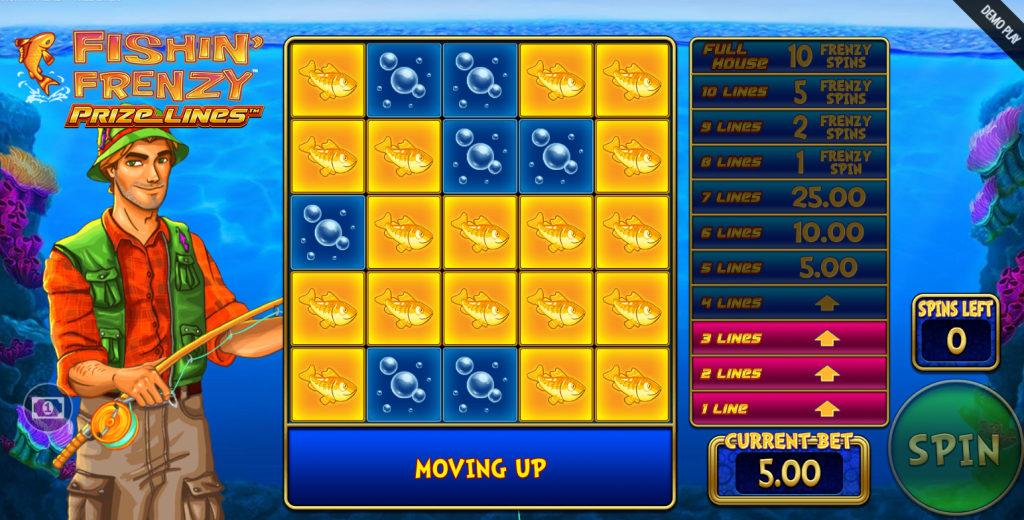
When players open the demo version of Fishin Frenzy, most of them believe they are looking at something familiar: reels spin, symbols land, a win appears, and the interface highlights what looks like a winning line. It feels intuitive. It feels obvious. And in many cases, it is quietly misleading.
This page exists for one reason only — to explain what prize lines actually represent in demo mode, and why they should be read as an interpretation layer rather than a literal map of the spin. Demo play is not designed to teach probability or long-term behaviour. It is designed to explain outcomes after they happen. Prize lines are part of that explanation, not the engine behind it.
In Fishin Frenzy demo mode, prize lines act as a visual and logical bridge between the internal calculation of a spin and the player’s understanding of why a payout occurred. They are not always drawn as traditional straight or zig-zag paths. Sometimes they are implied, sometimes summarised, sometimes reduced to a short label such as “Line Win” without any visible geometry at all. This is not a flaw. It is a design choice.
Many players approach demo mode expecting clarity through visibility: if symbols match, there should be a win; if a win appears, the line should be obvious. Modern slot interfaces do not work that way. The demo environment prioritises readability over precision. Prize lines are simplified, grouped, or even abstracted so the result can be understood quickly, without exposing the full underlying logic of the game.
What follows is not a guide on how to win, and not a breakdown of payout tables. It is an explanation of how demo mode communicates outcomes, and why prize lines in Fishin Frenzy should be read as a narrative device — a way the game tells you what just happened, not how it decided to happen.
What “Prize Line” Actually Means
Expectation vs Engine
A quick side-by-side to keep demo visuals in perspective.
The term “prize line” sounds precise, but in demo mode it is intentionally flexible. In classic slot language, a line refers to a fixed path across the reels, defined before the spin takes place. In demo presentations of Fishin Frenzy, the same word is often used in a broader sense: any logical connection of symbols that results in a payout may be labelled as a prize line, even if no permanent line exists.
This is where confusion usually begins.
A prize line in demo mode should be understood as a resolved winning structure. It is the final explanation layer applied after the game engine has already determined that a win exists. The demo interface then selects a readable way to show that win to the player. Sometimes that explanation takes the form of a visible line. Sometimes it takes the form of grouped highlights. Sometimes it is reduced to a short message and a numerical payout.
Importantly, the word “line” does not guarantee that the win followed a single, continuous, visible route across the reels. In many cases, especially in modern slot logic, the winning condition may involve multiple symbol positions that do not form a clean geometric shape. The demo still needs a label, and “prize line” becomes the umbrella term used to keep the interface simple.
This is why players often see outcomes that feel inconsistent at first glance. A cluster of matching symbols may pay without any obvious line. A visually appealing pattern may result in no win at all. In demo mode, the prize line is not a promise of symmetry or balance — it is a summary of eligibility.
From a design perspective, this approach serves two purposes. First, it reduces cognitive load. The player is not required to understand every rule interaction to recognise that a win occurred. Second, it preserves abstraction. The demo explains what paid, not every reason why it paid. That distinction is subtle, but critical.
When reading prize lines in Fishin Frenzy demo mode, the correct mindset is analytical rather than visual. The highlighted elements show participation, not priority. The label confirms a valid winning condition, not a specific pathway. Once this is understood, many of the apparent contradictions in demo play disappear.
Prize lines, in this context, are best seen as a translation layer between system logic and human perception. They are not there to teach mechanics in full detail. They are there to make results legible.
How Demo Mode Visualises Winning Lines
The demo version of Fishin Frenzy speaks its own visual language. It does not attempt to reveal the full internal logic of the game. Instead, it presents a simplified, curated version of the outcome — one that prioritises clarity, pacing, and emotional continuity over mechanical transparency. Understanding this visual language is essential to reading prize lines correctly.
When a winning spin occurs, the demo does not begin by explaining how the win was constructed. It begins by confirming that a win exists. This confirmation usually arrives through a combination of animation, sound, and selective highlighting. Certain symbols are illuminated. Others fade into the background. Occasionally, a faint animated path appears, suggesting a line or direction. None of these elements should be interpreted in isolation.
How a Demo Win Gets Explained
A clean sequence: the decision happens first, the visuals arrive afterwards.
Spin resolved
The outcome is decided internally before any highlight or animation appears.
Winning condition confirmed
The engine verifies eligibility under the active rule logic — quietly, instantly.
Visual highlights applied
Demo mode selects what to show for clarity, not a full mechanical audit trail.
Payout displayed
The final value is presented as a completed result — not a preview of what comes next.
The order in which wins are displayed is also significant. Demo mode often resolves payouts sequentially rather than simultaneously. One winning structure may be highlighted, paid, and cleared visually before the next is shown. To the untrained eye, this can feel like separate events. In reality, these are fragments of a single resolved calculation being presented in digestible pieces.
Another important detail lies in omission. Demo mode frequently chooses not to highlight every symbol involved in a payout. Some symbols are counted but not emphasised. Others are visually emphasised but play a minor role in the final value. This selective emphasis is intentional. The interface is designed to guide attention, not to document every variable.
Textual indicators such as “Line Win”, “Win”, or a simple numerical payout serve as anchors rather than explanations. They tell the player what category of result has occurred, not the structural breakdown behind it. This is why two spins that look visually similar can produce different outcomes, and why two visually different spins can produce the same payout.
In demo mode, visualisation is narrative. It tells a story about the result after the fact. Prize lines are part of that story — a shorthand representation of success. They are not blueprints, and they are not guarantees of repeatability. Once this narrative function is recognised, the apparent inconsistency of demo visuals begins to make sense.
Core Prize Line Logics Used in Demo
Behind the simplified presentation of demo mode sit several distinct payout logics. These logics are not always announced clearly, and they are rarely explained in full within the interface itself. Instead, they are implied through behaviour, terminology, and visual cues. Understanding these core structures is the key to interpreting prize lines without confusion.
Core Prize Line Logics
Three models the demo may use to explain a win — shown as clean schematics.
The win is explained as one eligible route. The demo highlights a clean line to confirm the structure.
The win is explained as a valid left-to-right connection. The demo may show one path, while the engine counts more.
The win is explained as a connected region. The demo highlights a zone rather than tracing a single route.
Fixed Paylines
Fixed paylines represent the most traditional interpretation of a prize line. In this structure, a predefined path exists across the reels, and a winning condition is met when eligible symbols align along that path. In demo mode, this logic is often hinted at rather than explicitly mapped. A brief animation may trace a path. A subset of symbols may flash together. The rest of the grid remains visually irrelevant.
What matters here is not the elegance of the line, but its eligibility. Demo mode confirms eligibility by highlighting only the symbols that satisfy the payline condition. Symbols that visually resemble part of the pattern but fall outside the predefined path are ignored without explanation. This selective silence is a common source of misunderstanding.
All-Ways Logic Presented as Lines
In many modern implementations, Fishin Frenzy demo mode uses what can be described as all-ways logic while still employing the language of lines. In these cases, there is no fixed path that must be followed. Instead, any valid connection of matching symbols across adjacent reels may contribute to a payout.
Despite this, the demo often labels the result as a “line win”. This is not an error. It is a linguistic shortcut. The term “line” is used because it is familiar, not because it is technically precise. The visual highlight may suggest a path, but that path is illustrative rather than definitive.
This is where players often overinterpret what they see. The highlighted symbols are representatives of a larger set of valid combinations. The demo shows one example, not the full matrix of contributing paths. The prize line, in this context, is a conceptual connector rather than a literal route.
Group and Cluster-Based Wins
The most abstract use of the term “prize line” appears in group or cluster-based logic. Here, wins are determined by proximity rather than direction. Symbols pay because they are connected, not because they align. Demo mode struggles to visualise this cleanly, and so it often resorts to area highlighting or grouped flashes.
In these situations, the word “line” becomes almost metaphorical. It refers to a resolved winning structure, not a spatial arrangement. The demo highlights enough to confirm the win, but rarely enough to explain it fully. This is not a limitation of technology, but a deliberate choice to keep the experience readable.
Across all three logics, one principle remains constant: demo mode does not exist to teach the full rulebook. It exists to translate outcomes into something immediately understandable. Prize lines are the vocabulary of that translation. They describe what paid, not every rule that allowed it to pay.
Hybrid Prize Line Scenarios
Hybrid Win: Layers Behind One Result
A single demo “win” often compresses multiple layers into one clean display.
Base win structure
The eligible pattern is resolved first — paylines, ways, or a cluster.
Modifier / interaction
Extras apply silently — substitutions, expansions, multipliers, bonus states.
Final payout
The demo shows one summed result — clean, readable, already final.
Not all prize lines in Fishin Frenzy demo mode belong neatly to a single category. In practice, many winning outcomes are formed through hybrid structures — combinations of different payout logics that resolve together but are presented as a single result. Demo mode rarely announces this complexity directly. Instead, it compresses multiple contributing factors into one readable event.
A common hybrid scenario involves traditional line logic interacting with expanding or substituting symbols. From the player’s perspective, this may appear as a clean line win. In reality, the line only becomes valid after an additional condition is applied. The demo highlights the final state, not the intermediate steps that made it possible.
Another frequent hybrid pattern appears when all-ways logic overlaps with temporary modifiers. Multipliers, symbol enhancements, or conditional bonuses may apply to only part of the winning structure. Demo mode often resolves these layers silently. The player sees a final payout and a simplified visual trace, without any clear indication of how many internal paths or combinations were actually counted.
Cluster-based wins can also participate in hybrid outcomes. A group of connected symbols may trigger a payout that is then altered by surrounding conditions — symbol value tiers, bonus states, or interaction rules that are not visually distinguished. The demo interface responds by grouping the result under a single prize line label, even though the logic behind it is multi-layered.
What makes hybrid scenarios particularly confusing is their consistency. They do not occur randomly. They follow strict internal rules. However, because demo mode is not designed to expose those rules in full, repeated hybrid wins can feel unpredictable or inconsistent. In reality, they are neither.
The key insight is that prize lines in demo mode are outcome summaries, not logic maps. When multiple systems contribute to a payout, the demo does not attempt to separate them visually. It resolves them into one communicable result. Understanding this prevents overanalysis of surface patterns and refocuses attention on behaviour rather than appearance.
Hybrid prize line scenarios are where demo mode most clearly reveals its priorities. It values clarity of result over transparency of process. The prize line shown is the conclusion, not the story.
How to Identify the Active Prize Line Logic
Reading the Demo’s Logic at a Glance
What the interface hints at — and what it usually means underneath.
Although demo mode does not explicitly declare which prize line logic is active, it consistently leaves traces. These traces are not found in menus or help screens, but in behaviour. Learning to identify them allows the player to read outcomes accurately without relying on assumptions.
One of the most reliable indicators is repetition. When similar visual layouts repeatedly resolve in the same way — paying or not paying regardless of apparent symmetry — a fixed structure is usually involved. Conversely, when payouts vary despite similar-looking patterns, a more flexible logic such as all-ways or hybrid resolution is likely at work.
Textual feedback also matters. The presence or absence of line counts, the wording used to describe wins, and the sequencing of payout notifications all offer clues. A demo that consistently labels outcomes generically, without referencing specific line numbers, is often abstracting multiple valid paths into a single prize line explanation.
The order of visual resolution provides further insight. Fixed line wins tend to be presented cleanly and individually. All-ways or hybrid wins are often resolved in grouped animations, with overlapping highlights and cumulative payout displays. Cluster-based logic frequently avoids directional movement altogether, favouring area-based emphasis.
Another useful signal lies in what the demo chooses not to show. When symbols that appear relevant are ignored without comment, it usually indicates that eligibility is governed by rules not tied to visual proximity alone. Demo mode does not apologise for this omission. It assumes the player does not need to see every rejected condition to understand the accepted one.
Finally, consistency across spins matters more than any single example. Demo mode is stable in its logic even when its presentation feels ambiguous. By observing how outcomes behave over time — not how they look in isolation — the active prize line structure becomes clear.
Identifying prize line logic in demo mode is less about decoding graphics and more about recognising patterns of resolution. Once this shift in perspective occurs, prize lines stop feeling arbitrary and start functioning as what they are meant to be: explanatory signals layered over a deterministic system.
Reading a Winning Spin Step by Step
A winning spin in Fishin Frenzy demo mode is not a single moment. It is a sequence of decisions that have already been made by the engine before anything appears on screen. What the player sees is the ordered revelation of those decisions. Reading a spin correctly means following that order, not reacting to the first visual cue.
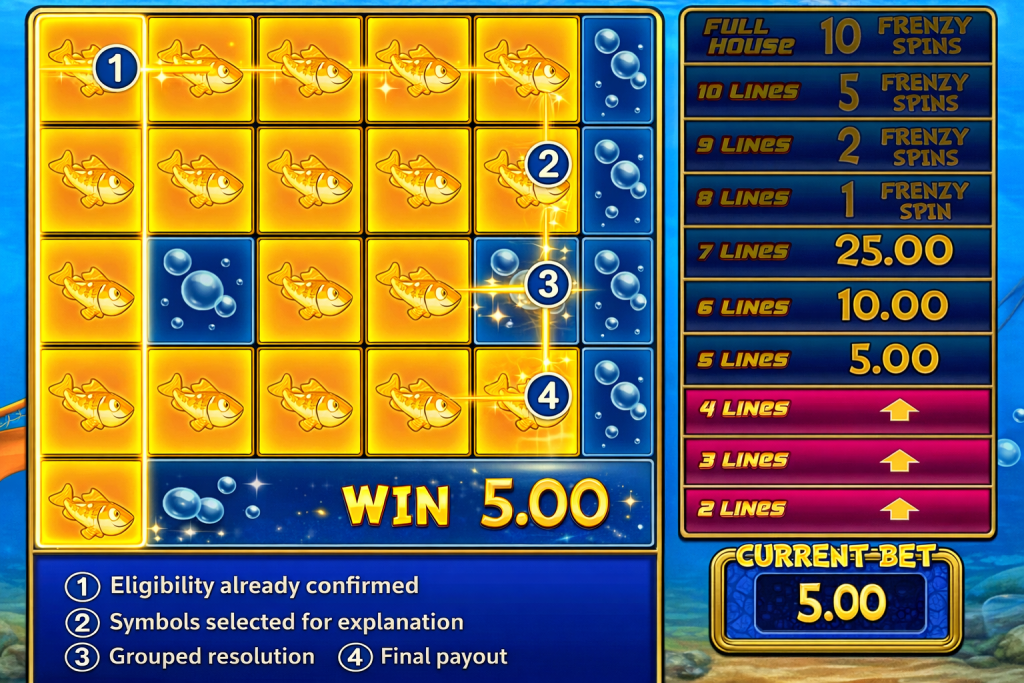
The process begins with eligibility, not appearance. The engine first determines whether a valid winning condition exists under the active prize line logic. This decision is binary and invisible. By the time symbols begin to highlight, the outcome is already final. Demo mode never shows the moment of evaluation; it only shows the confirmation.
Next comes participation. The demo selects which symbols will be visually associated with the win. These are not always all contributing symbols. They are the symbols that best explain the result with minimal distraction. Others may have played a role mathematically but are omitted visually to preserve clarity. This selective representation is deliberate.
After participation comes grouping. If multiple winning structures exist within the same spin, demo mode decides how to cluster them for presentation. Sometimes this results in sequential highlights, sometimes in a single combined animation. The grouping choice affects perception but not value. A single highlighted sequence may represent several internal wins resolved together.
Only after these steps does the payout appear. The numerical value shown is the sum of all resolved conditions, adjusted by any applicable modifiers. Demo mode does not rewind to show how each modifier applied. It assumes the final number is sufficient confirmation. This is why attempting to calculate the payout from the animation alone often leads to incorrect conclusions.
The final step is closure. The demo clears the highlights, restores the grid to a neutral state, and prepares the player for the next spin. This reset is important. It reinforces the idea that each spin is self-contained, even when visual memory suggests continuity.
Reading a winning spin correctly requires patience and restraint. The instinct to judge the outcome based on the first highlighted symbols is understandable, but misleading. Demo mode speaks in summaries. The full sentence is only complete once the payout is displayed and the presentation ends.
Why Prize Lines Look Different From What You Expect
Most expectations about prize lines come from visual intuition. Players expect symmetry, continuity, and proportionality. When these expectations are not met, the result feels wrong, even when it is technically correct. Demo mode does not attempt to correct this instinct. It works around it.
One reason prize lines look unfamiliar is that modern slot logic no longer prioritises visual elegance. The engine prioritises rule satisfaction. A win that satisfies all internal conditions may look irregular, fragmented, or incomplete when translated into a simplified visual explanation. Demo mode accepts this trade-off.
Another factor is abstraction. Demo mode deliberately avoids showing rejected conditions. It does not explain why a near-match failed, only why a valid match succeeded. This creates a visual bias: the player sees what paid, not what almost paid. Over time, this bias can distort expectations about what constitutes a “reasonable” prize line.
Animation timing also plays a role. The order in which elements are highlighted can suggest causality where none exists. A symbol that lights up first feels more important than one that lights up later, even if both contributed equally. Demo mode uses timing to guide attention, not to indicate hierarchy.
There is also the issue of compression. When multiple internal paths or conditions resolve together, demo mode compresses them into a single visual narrative. The prize line shown may represent several simultaneous resolutions. The player sees one line; the engine counted many. The discrepancy is structural, not accidental.
Finally, familiarity works against accuracy. Players bring assumptions from other games, other interfaces, and older slot models. Demo mode does not adapt to these assumptions. It applies its own logic consistently, even when that logic conflicts with expectation.
Prize lines look different because they are not drawings of rules. They are symbols of resolution. Once this distinction is accepted, the visual experience becomes easier to read, and the sense of inconsistency fades. The demo stops feeling deceptive and starts feeling economical — showing only what is necessary to understand that a win has occurred.
Common Prize Line Misinterpretations
Misinterpretation Matrix
Common assumptions vs. what the demo is actually doing.
Most misunderstandings around prize lines do not come from lack of attention. They come from applying the wrong mental model. Players assume that what they see is what the game evaluated, when in fact they are only seeing what the demo chose to explain.
One of the most common misinterpretations occurs when matching symbols appear without a payout. Visually, the pattern looks convincing. Logically, it feels complete. Yet the demo produces no win. This usually happens because the visible symbols do not satisfy the eligibility rules of the active prize line logic. Demo mode does not highlight failed conditions. It simply ignores them. The absence of explanation is interpreted as inconsistency, when it is actually restraint.
Another frequent misunderstanding involves payout size. Players often expect a direct relationship between the number of highlighted symbols and the value of the win. In demo mode, this relationship is indirect at best. Some symbols carry more weight than others. Some contribute structurally rather than financially. The demo highlights participation, not contribution. The final number reflects internal weighting, not visual abundance.
The phrase “line win” itself causes confusion. Many players expect a visible line to appear whenever this label is used. When no such line is obvious, the result feels incorrect. In reality, the label refers to the category of resolution, not the shape of the win. Demo mode uses familiar language to reduce friction, even when that language lacks precision.
There is also a tendency to overinterpret animation. A symbol that flashes brightly is assumed to be more important than one that does not. A path that appears animated is assumed to be the exact route of calculation. These assumptions are natural, but they are rarely accurate. Demo mode uses animation as emphasis, not documentation.
Perhaps the most subtle misinterpretation is the belief that near-misses are meaningful. When symbols almost form a visible line, players often assume they were close to a win. Demo mode does nothing to correct this impression. It neither confirms nor denies proximity. Internally, near-misses have no special status. They are either valid or they are not.
Understanding these misinterpretations does not make demo play more predictable. It makes it more readable. The goal is not to anticipate outcomes, but to interpret them without frustration.
Demo Mode vs Real Play: Prize Line Differences
From a logical perspective, prize line rules do not change between demo mode and real play. The same conditions determine whether a win exists. The same structures resolve payouts. What changes is the way those outcomes are presented and perceived.
Demo mode is designed to be generous with explanation and conservative with complexity. It aims to introduce mechanics without overwhelming the player. To achieve this, it simplifies visual feedback, groups related events, and omits secondary details. Real play, by contrast, assumes familiarity. It often moves faster, highlights less, and provides fewer visual cues.
Timing is one noticeable difference. Demo mode frequently slows down the resolution of wins, allowing each highlight to register. Real play prioritises flow. Prize lines may appear and disappear quickly, sometimes without any explicit animation beyond a brief flash. The underlying logic remains the same, but the opportunity to observe it is reduced.
Another difference lies in emphasis. Demo mode draws attention to winning structures, even when the payout is small. This reinforces learning. Real play treats small wins as part of the background. Prize lines are still there, but they are not framed as teaching moments.
There is also a psychological difference. In demo mode, the absence of risk encourages exploration. Players are more likely to observe, pause, and question. In real play, attention shifts toward balance and momentum. Prize lines become confirmations rather than points of analysis.
Importantly, demo mode does not distort prize line logic to produce better outcomes. It does not change probabilities or invent wins. It changes presentation. Confusing the two leads to misplaced expectations when transitioning from demo to real play.
Seen correctly, demo mode is a reading tool. Real play is an execution environment. Prize lines exist in both, but their role in the experience is different. Demo mode teaches recognition. Real play rewards familiarity.
FAQ – Prize Lines Demo
Prize Lines Demo — Quick Answers
Tap a question to reveal the answer below. One open at a time.
Reading Prize Lines the Right Way
Demo mode in Fishin Frenzy is not a reduced version of the game, and it is not a simplified simulation of real play. Its function is narrower and, at the same time, more precise. Demo mode exists to make outcomes legible. Everything it shows — animations, highlights, labels, prize lines — serves that single purpose.
Prize lines are the most visible part of this translation layer. They appear after the outcome has already been determined and never before. Their role is not to guide the spin or shape the result, but to explain why the result qualifies as a win under the active rules. This explanation is intentionally selective. It focuses on confirmation, not disclosure.
When players attempt to treat prize lines as maps of calculation, confusion follows. Visual symmetry is mistaken for eligibility. Animation is read as causation. Near-misses are interpreted as signals. Demo mode does nothing to reinforce these assumptions, but it also does nothing to correct them. It simply presents the resolved outcome and moves on.
Used correctly, demo mode teaches a different skill: interpretation without projection. Repeated observation reveals that prize lines behave consistently, even when they do not look consistent. What changes from spin to spin is not the logic, but the way that logic is summarised for display. Once this is understood, the visual layer stops demanding explanation.
Prize lines also play a psychological role. They create a sense of order in a system that does not require the player’s understanding to function. Highlighted wins feel earned. Clean paths suggest intention. This impression is not accidental, but it should not be mistaken for influence. Prize lines confirm decisions; they do not invite participation.
The most useful shift occurs when prize lines are read as closure rather than opportunity. They are the final statement of a completed process, not a hint at what might happen next. In demo mode, this distinction matters more than any specific rule or payout value.
Understanding prize lines will not increase the frequency of wins. It will not improve timing or selection. What it does change is the quality of engagement. Frustration is replaced by clarity. Expectation gives way to observation. The demo stops being a source of mixed signals and becomes what it was always meant to be: a transparent window into how results are explained, not how they are produced.
In Fishin Frenzy demo mode, prize lines are not promises. They are explanations. Reading them that way is the final step in understanding the game on its own terms.