
Power 4 Slots as a Distributed Game Experience
Fishin Frenzi Power 4 Slots — An Introduction to a Different Kind of Slot
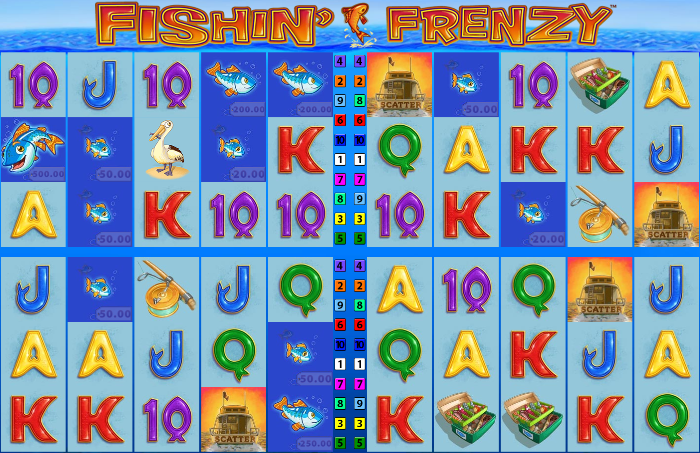
When players first encounter Fishin Frenzi Power 4, the instinctive reaction is to treat it as another sequel in a familiar franchise. Same fisherman. Same fish symbols. Same coastal theme that has been recycled across the Fishin Frenzi line for years.
That assumption is understandable — and fundamentally wrong.
Power 4 is not a content upgrade. It is not a cosmetic refresh, and it is certainly not a promise of “more wins”. What Blueprint Gaming did here was far more structural: they altered the format through which outcomes are experienced. The result is a slot that feels immediately familiar on the surface, yet behaves very differently once the session begins.
At its core, Fishin Frenzi Power 4 is built around parallel outcomes. A single spin no longer resolves into one result that the player reads and reacts to. Instead, it produces several outcomes simultaneously, each competing for attention. The game does not speed up mechanically — but cognitively, it becomes denser.
This distinction matters. Power 4 is not about increasing volatility or generosity in a straightforward sense. It is about increasing event density: the number of meaningful signals a player receives per spin. Small movements. Near triggers. Partial stories unfolding side by side. The perception of activity rises, even when the underlying mathematics remain familiar.
I approach Fishin Frenzi Power 4 as a study in structure rather than spectacle. What happens when you take a franchise built around anticipation and stretch it across multiple concurrent fields? How does this affect focus, patience, and decision making over time? And most importantly: who is this format actually for?
This page is not a review and not a recommendation. It is an attempt to explain how Fishin Frenzi Power 4 works as a system — and how it changes the experience of play compared to every other entry in the series.
Power 4 Within the Fishin Frenzi Series
Series positioning, at a glance
A compact comparison that anchors rhythm and attention across the line, without turning into a full review.
| Version | Core focus | Rhythm | Attention style |
|---|---|---|---|
Classic FF
| Anticipation | Slow | Single-focus |
FF2
| Refinement | Moderate | Single-focus |
Power 4
| Parallel states | Continuous | Split attention |
Megaways
| Scale & variance | Volatile | Expanding focus |
To understand Power 4 properly, it has to be placed back inside the wider Fishin Frenzi ecosystem. This is a series that has always been less about line wins and more about deferred resolution. From the earliest versions, the emotional centre of the game has not been the reels themselves, but what happens after something lands.
Fish symbols do not resolve value on their own. They wait. Fisher symbols do not create excitement by appearing — they create it by collecting. The entire series trains players to tolerate inactivity in exchange for the possibility of a decisive moment later. This rhythm is intentional, and it is consistent across most Fishin Frenzi titles.
Power 4 does not abandon this philosophy. It compresses it.
Instead of asking the player to wait through long stretches of quiet spins, Power 4 distributes the same logic across multiple independent fields. Each field operates as its own micro version of Fishin Frenzi, complete with its own fish, reels, and potential triggers. The difference is that the player is now observing several of these micro systems at the same time.
Compared to classic Fishin Frenzi, the shift is immediate. Where the original relies heavily on patience and long anticipation cycles, Power 4 replaces waiting with scanning. The player is no longer focused on a single build up, but on monitoring several partial build ups simultaneously. The emotional investment is spread thinner, but refreshed more often.
Against Fishin Frenzi 2, Power 4 feels less narrative and more modular. Fishin Frenzi 2 refined pacing and presentation, but still asked the player to commit attention to one evolving state. Power 4 fragments that state into parallel tracks. You are no longer “in” one story — you are supervising several.
And when placed next to Fishin Frenzi Megaways, the contrast becomes even clearer. Megaways introduces complexity through variability and scale. Power 4 introduces complexity through multiplicity. One expands vertically, the other horizontally. Both can feel intense, but for very different reasons.
In that sense, Fishin Frenzi Power 4 is not an evolution in the traditional sequel sense. It is a side experiment — a structural remix of a known formula. It keeps the same ingredients, but changes how many plates are on the table at once.
Whether that feels engaging or overwhelming depends less on luck and more on how a player processes information. Power 4 does not reward faster reactions or bigger risks. It rewards the ability to tolerate incomplete information, repeated signals, and constant low level stimulation without expecting immediate resolution.
This is why Power 4 occupies a unique position within the Fishin Frenzi series. It is neither the most aggressive nor the most conservative entry. Instead, it is the most cognitively dense — and that makes it fundamentally different from everything that came before it.
Power 4 as a Structural Rule
Power 4 should not be understood as an upgrade, enhancement, or extension of the Fishin Frenzi formula. It is a structural rule that reshapes how the game communicates with the player. The symbols, themes, and mechanics may look familiar, but the way outcomes are delivered — and therefore interpreted — is fundamentally different.
In a traditional slot, a spin produces a single narrative. The reels stop, the player reads the result, and the moment resolves. Success or failure is clear, even if the reward is small. In Power 4, that clarity is deliberately softened. One spin produces four parallel resolutions, each belonging to its own field, each carrying its own level of relevance.
These fields do not combine into a single outcome. They coexist. One field may be entirely inactive. Another may present an early setup. A third may tease progression without delivering it. The fourth may resolve immediately. None of these outcomes cancel each other out, and none of them fully define the spin on their own.
This is where Power 4 begins to operate less like a slot and more like a monitoring system. The player is no longer reacting to a single result, but supervising multiple states at once. Attention shifts from outcome-based thinking to pattern recognition. The question becomes less “What did I get?” and more “What is forming?”
Importantly, Power 4 does not change the underlying risk structure in a simple way. Stakes are not multiplied by four. Potential is not automatically expanded. What changes is the distribution of feedback. Instead of receiving one strong signal per spin, the player receives several weaker ones. The game communicates more often, but with less finality.
This has a direct impact on how silence is perceived. In earlier Fishin Frenzi titles, quiet spins were unmistakable. Nothing happened, and the player felt it. In Power 4, quietness becomes fragmented. Even when no meaningful resolution occurs, something usually appears somewhere. A fish value. A partial alignment. A visual prompt that suggests movement.
As a result, the absence of progress is harder to detect. This does not make the game more generous, but it does make it feel more active. Power 4 replaces long stretches of waiting with constant low-level stimulation. For some players, this reduces frustration. For others, it blurs the sense of direction.
Seen clearly, Power 4 is not about delivering more results. It is about delivering more information. Whether that information leads to better decisions or simply more engagement depends on how the player processes complexity.
Event Density and Parallel Outcomes
Event density is one of the most misunderstood aspects of modern slot design. It is often confused with hit frequency or generosity, when in reality it describes something more subtle: how often the game gives the player something to interpret.
In Fishin Frenzi Power 4, event density is not increased by making wins more frequent. It is increased by allowing multiple independent events to occur simultaneously. A single spin no longer answers one question. It poses several.
Each field functions as its own channel of information. One may deliver nothing. Another may suggest potential. A third may hint at escalation. The player is constantly receiving partial signals, none of which demand immediate action, but all of which invite attention.
This creates a layered experience. Instead of waiting for a single decisive moment, the player exists in a continuous state of evaluation. Small developments feel meaningful because they arrive often. Near-misses feel closer because they appear somewhere on nearly every spin.
Crucially, this density changes how outcomes are emotionally weighted. In a single-field slot, a notable event stands out sharply against inactivity. In Power 4, notable events are absorbed into a background of constant motion. The peaks are flatter, but the valleys are shallower.
This is why Power 4 can feel deceptively engaging. The game rarely goes silent. Even when nothing resolves, the player’s attention remains occupied. The mind moves from field to field, scanning for relevance, assigning significance, discarding it, and repeating the process on the next spin.
Over time, this reshapes expectation. Progress is no longer measured by results alone, but by perceived momentum. A session can feel active and involved without producing any defining outcome. The sense of being “close” persists longer than it would in a more linear format.
This design choice is neither inherently positive nor negative. It simply serves a different type of player. Those who enjoy interpreting systems, tracking multiple threads, and staying mentally engaged often respond well to Power 4. Those who prefer clarity, decisive moments, and clear emotional punctuation may find the experience diffuse.
Event density in Power 4 is not about excitement in the traditional sense. It is about occupation. The game keeps the player mentally busy, not by offering more rewards, but by offering more to watch.
And that distinction defines the entire Power 4 experience.
Reel Geometry and Visual Layout
At first glance, Fishin Frenzi Power 4 appears visually conservative. Each reel field follows the familiar 5×3 structure, framed cleanly and presented without visual aggression. Nothing about the individual grids suggests novelty. The difference emerges only when these grids are placed side by side and treated as a single visual environment.
Four identical reel fields do not behave like one larger one. They alter spatial perception. Instead of a central focal point, the screen becomes a surface that must be scanned. The eye no longer rests; it moves. Attention circulates rather than settles.
This shift has consequences. In a single-field slot, visual hierarchy is clear. Symbols in the centre matter more. Events are read from top to bottom, left to right. In Power 4, hierarchy becomes fluid. Importance depends not on position, but on contrast. A quiet field next to an active one fades instantly. A small event can feel significant simply because it stands out against inactivity elsewhere.
The geometry also affects how players interpret probability. Identical reel structures suggest equality, yet the simultaneous presentation creates an illusion of imbalance. One field always appears “luckier” than another, even though no such hierarchy exists. This perceived asymmetry keeps attention rotating, reinforcing the idea that opportunity is constantly shifting.
Spacing plays a subtle role here. The separation between fields is just enough to define independence, but not enough to break continuity. The result is a layout that feels modular but unified. The player does not experience four separate games, but one distributed system.
Over time, this geometry trains behaviour. Players begin to track preferred zones subconsciously. Eyes return more often to fields that have recently shown activity. Others are ignored until something forces attention back. The layout encourages selective focus, even though the game itself offers no mechanical reason to favour one field over another.
Power 4 uses geometry not to impress, but to guide perception. It creates movement without animation, tension without escalation, and variation without altering the reels themselves. The complexity is not in what is shown, but in how much must be watched.
Symbol Behaviour in a Multi Field System
How symbol meaning shifts in a multi-field system
The symbol set stays the same, but once outcomes resolve across four fields, interpretation becomes contextual rather than linear.
| Symbol | Classic behaviour | Power 4 behaviour |
|---|---|---|
| Fish | Value holder with a single narrative focus. | Local signal interpreted inside one field. |
| Fisher | One clear resolution moment. | Meaning depends on parallel field context. |
| Empty spin | Clear silence that resets expectation. | Fragmented silence — absence is partial. |
Symbols in Fishin Frenzi have always been functional rather than decorative. Fish carry value. Fisher resolves it. Everything else exists to support that interaction. In Power 4, this relationship does not change — but its behaviour becomes more fragmented and, paradoxically, more influential.
Each field maintains its own symbolic logic. Fish values belong to their field. Fisher symbols resolve locally. There is no shared pool, no cross-field collection. And yet, the player experiences these symbols as part of a broader system because they appear simultaneously.
This simultaneity changes how symbols are read. A fish landing in isolation is rarely meaningful. A fish landing while another field shows a Fisher creates tension. The mind begins to compare, even though comparison has no mechanical value. Symbol behaviour gains importance through context rather than function.
The Fisher symbol, in particular, becomes more psychologically complex. In a single-field slot, its appearance is binary. It either matters or it does not. In Power 4, its relevance depends on what is happening elsewhere. A Fisher landing in a quiet field can feel disappointing if another field holds higher values. A modest collection can feel satisfying if other fields remain inactive.
Order also matters more than usual. When symbols resolve sequentially across fields, anticipation stretches. The player waits not just for a Fisher to appear, but for it to appear in the “right” place. This introduces a layer of subjective judgement that the game itself does not acknowledge.
What Power 4 ultimately does is detach symbol meaning from absolute outcomes. Value becomes relative. Importance becomes situational. Symbols do not simply perform actions; they participate in a visual conversation across the screen.
This design encourages interpretation rather than reaction. Players are less likely to respond emotionally to a single symbol and more likely to assess patterns over time. Symbol behaviour feels less decisive, but more persistent.
In this environment, Fishin Frenzi reveals its true nature. It has never been about instant reward. Power 4 simply makes that philosophy harder to ignore by spreading it across multiple fields at once.
Cross Field Interaction Logic
Cross-field interaction: what the code does vs what the mind assumes
Power 4 can feel interconnected even when each field resolves independently. This diagram separates the mechanical layer from the perceived layer.
- Separate resolution streams
- No shared “state” required
- Any synchrony is coincidence
- Pattern-seeking across fields
- Illusion of coordination
- “It’s building” feeling from density
On a mechanical level, the four fields in Fishin Frenzi Power 4 are independent. They do not share reels, symbols, or outcomes. Nothing that happens in one field alters the mathematical behaviour of another. And yet, very few players experience them as truly separate.
This gap between mechanical independence and perceived interaction is one of the most important design features of Power 4.
Because all four fields resolve simultaneously, the player instinctively looks for relationships. A quiet field next to an active one feels “left behind”. A field that produces repeated signals begins to feel favoured. These impressions are not supported by the system, but they shape how the game is read and remembered.
The mind is exceptionally good at creating structure where none exists. Power 4 relies on this. When multiple outcomes unfold at once, the player begins to compare them, rank them, and assign meaning across the screen. Independence becomes irrelevant to perception. What matters is contrast.
This is why Power 4 often feels more strategic than it actually is. The player feels involved in an evaluative process, constantly reassessing where attention should go. In reality, there is no correct field to watch and no incorrect one to ignore. The interaction exists entirely at the cognitive level.
Interestingly, this perceived interaction also affects patience. In a single-field slot, waiting is passive. In Power 4, waiting becomes active. The player is not simply enduring inactivity, but monitoring multiple threads for signs of change. Time feels occupied even when nothing resolves.
There is also a subtle emotional effect. Disappointment is diluted. A poor outcome in one field is softened if something interesting happens elsewhere. Conversely, satisfaction is fragmented. A strong result rarely dominates the entire screen. Emotional highs and lows are spread thinner, but they occur more often.
Cross-field interaction, then, is not a feature. It is an illusion created by simultaneity. Power 4 does not connect its systems — it invites the player to do so mentally. This invitation is what keeps attention engaged over longer sessions, even in the absence of decisive outcomes.
Bonus Architecture: Local and Systemic Modes
Three modes, three different “rhythms”
Bonuses are not just features — they’re session states. This accordion maps what changes in pacing, attention, and resolution when the game shifts from Base to Free and then to Super.
Base Default loop and baseline tempo What the game looks like between “events”.
Free Separate cycle with its own logic How the game changes when it enters a dedicated mode.
Super Intensity layer and attention pressure Why this mode feels louder even without obvious speed-up.
Fishin Frenzi has always treated bonuses as moments of resolution rather than escalation. They exist to conclude a period of waiting, not to transform the game into something else. Power 4 preserves this philosophy, but restructures how bonuses are framed and experienced.
At the most basic level, bonuses in Power 4 remain local. A trigger occurs within a field. The bonus belongs to that field. Fish values are collected where they appear. Resolution is contained. This preserves clarity and prevents the system from becoming unreadable.
However, the presence of four concurrent fields changes how these local bonuses are perceived. A bonus no longer feels like the singular focus of the session. It becomes one event among several potential ones. The player is aware, even during a bonus, that other fields remain unresolved.
This awareness alters emotional weight. A bonus win does not necessarily feel like a climax. It feels like a development. The session continues uninterrupted, and attention quickly redistributes. Power 4 resists the traditional rise-and-fall structure of bonus-driven slots.
Systemic modes, such as enhanced free games or Super-style features, attempt to counterbalance this diffusion. When these modes activate, they impose a temporary order on the screen. Rules become more unified. Outcomes feel more aligned. For a brief period, the four fields behave less like parallel threads and more like parts of a single system.
These moments are important. They restore coherence. They remind the player that the game can still produce decisive phases. But even here, Power 4 avoids full convergence. Independence is reduced, not eliminated. The system never fully collapses into one narrative.
The result is a bonus architecture that prioritises continuity over interruption. Bonuses do not reset the experience; they sit inside it. They resolve local tension without erasing the broader state of play.
This design choice suits the Power 4 format. In a game built around parallel observation, a bonus that demands total focus would feel intrusive. Instead, Power 4 integrates its bonuses into the ongoing flow, preserving the rhythm established in the base game.
Bonuses here are not fireworks. They are punctuation.
Session Flow and Tempo Dynamics
Tempo dynamics: when “no pauses” becomes the point
This timeline shows how a session feels longer not because spins are faster, but because signals remove clear moments to stop.
Fishin Frenzi Power 4 does not accelerate the game in any obvious way. Spin speed remains familiar. Animations are restrained. There is no mechanical pressure pushing the player forward. And yet, sessions in Power 4 often feel denser and longer than expected.
The reason lies in how tempo is distributed.
In a traditional slot, tempo is shaped by contrast. Quiet spins are followed by active ones. Periods of inactivity create space for anticipation. When something finally happens, it feels like a shift. Power 4 weakens this contrast. Silence becomes rare, not because events are more frequent, but because something is usually happening somewhere.
This has a subtle but powerful effect on flow. The player is rarely given a clean pause. Even when one field offers nothing, another may show movement, suggestion, or partial structure. The session never fully settles into stillness.
As a result, time perception changes. Without clear breaks, spins blend together. Progress feels continuous rather than episodic. The player does not wait for the next moment — they remain inside one extended moment.
This does not make the game more aggressive, but it does make disengagement harder. Stopping feels less natural when there is no obvious endpoint. There is always another field to watch, another potential to observe. The decision to continue becomes passive rather than deliberate.
Importantly, Power 4 achieves this without increasing volatility or volatility spikes. The tempo is psychological, not mechanical. The game does not demand faster input. It simply occupies attention more consistently.
Over longer sessions, this creates a steady rhythm rather than peaks and troughs. Some players find this calming. Others find it draining. What Power 4 removes is the clear emotional punctuation that tells a player when a session has meaningfully changed state.
The tempo does not push. It persists.
Who This Slot Is and Isnt For
Who Power 4 fits — and who it doesn’t
This is a format-driven slot. The question isn’t “is it good”, but whether split attention and continuous feedback match how you like to play.
- You like busy screens and constant small cues.
- You prefer short, frequent check-ins over one long focus session.
- You enjoy pattern-hunting even when it’s mostly a perception effect.
- You don’t mind scanning instead of tracking one reel set.
- You prefer momentum over “quiet buildup”.
- You want clear pauses and obvious stopping points.
- You prefer single-focus: one grid, one outcome path.
- You’re sensitive to overstimulation or screen “noise”.
- You dislike the illusion of coordination across elements.
- You need strong self-stop rules when momentum builds.
Fishin Frenzi Power 4 is not a universal refinement of the series. It is a format that aligns well with certain ways of thinking and clashes with others.
This slot suits players who are comfortable observing incomplete systems. Those who enjoy monitoring multiple threads, interpreting partial signals, and staying mentally engaged without demanding immediate resolution often respond positively to Power 4. For them, the constant presence of information feels involving rather than overwhelming.
Players who prefer clear rhythms may struggle. Power 4 rarely delivers a single dominant moment that defines a session. Wins and losses are absorbed into a wider stream of activity. Emotional clarity is replaced by cognitive continuity.
This format also favours patience of a particular kind. Not the patience to wait through silence, but the patience to remain attentive without closure. Power 4 asks the player to tolerate ambiguity for extended periods.
Conversely, players who seek decisiveness, clean progressions, and strong emotional punctuation may find the experience unsatisfying. The game can feel diffuse. Outcomes can feel underemphasised. The lack of a central narrative may create distance rather than immersion.
Fishin Frenzi Power 4 is also less forgiving for players who rely on instinctive stopping points. Without clear pauses, it becomes easier to continue by default rather than by choice. This does not make the slot inherently risky, but it does require awareness.
Ultimately, Power 4 is for players who value engagement over resolution, observation over reaction, and continuity over climax. It is not better or worse than other Fishin Frenzi entries — it is simply tuned to a narrower psychological profile.
Understanding that profile is essential before committing time to the format.
Cognitive Load and Attention Split
Focus / blur zones: the “attention lock” illusion
One field gets treated as the main stream because it receives the strongest visual attention. The mechanics stay independent — the mind just stops tracking the rest.
Fishin Frenzi Power 4 does not overwhelm the player through speed or aggression. It overwhelms through simultaneity. The cognitive load of the game comes not from what happens, but from how much is happening at the same time.
Human attention is not designed to track four equivalent systems in parallel. When presented with multiple information streams, the brain does not divide focus evenly. It prioritises, filters, and simplifies. Power 4 exploits this limitation quietly.
At any given moment, the player believes they are watching all four fields. In reality, attention rotates. One field becomes dominant, usually the one that last produced a signal. Others fall into the background until movement pulls focus back. This creates a constant shift between focus and blur across the screen.
The competition between fields is visual rather than mechanical. A small event in one area can feel more important than a larger one elsewhere simply because it interrupts the current focus. The game does not tell the player where to look, but it ensures that something is always competing for attention.
This dynamic feeds into an illusion of control. Monitoring multiple fields gives the impression of active decision making, even though the player cannot influence outcomes. Watching becomes mistaken for managing. Awareness feels like agency.
Over time, the brain adapts by simplifying the experience. Instead of tracking outcomes, it tracks activity. Fields are labelled subconsciously as “alive” or “quiet”. These labels persist longer than individual results, shaping memory and expectation.
What the brain actually follows is not probability, value, or structure. It follows motion, contrast, and repetition. Power 4 aligns perfectly with these instincts. It keeps the cognitive system occupied without demanding resolution.
This is why Power 4 can feel mentally engaging even during unproductive sessions. The load is continuous, but diffuse. There is rarely a moment of complete disengagement, and rarely a moment of full clarity.
The game does not force attention. It fragments it.
RTP, Variability and Configuration Reality
RTP & settings: three things to verify
Practical clarity — no “how to win”, just where the truth is shown.
RTP is often treated as a fixed truth, a single number that defines a slot’s fairness. In practice, it is a configuration. And in a format like Power 4, configuration matters more than most players realise.
Nominal RTP represents the theoretical return under ideal conditions, over an extended period, using a specific set of parameters. What players actually encounter is implemented RTP, determined by the operator’s chosen settings. These settings can vary, sometimes subtly, sometimes significantly.
Power 4 is particularly sensitive to this variability because of its structure. When outcomes are distributed across multiple fields, small changes in return or volatility do not appear as isolated shifts. They accumulate across the screen. Perception magnifies difference.
A slightly lower RTP does not necessarily feel harsher in a single-field slot. In Power 4, it can feel persistently unproductive, even when activity remains high. The game continues to signal, but resolves less often. The gap between stimulation and reward widens.
Conversely, a higher RTP configuration can soften the experience without making it feel generous. Resolution becomes just frequent enough to validate attention. The balance between observation and outcome holds.
This is why Power 4 should never be evaluated purely on advertised figures. The format amplifies the consequences of configuration. Two versions of the same game can feel materially different depending on how they are set.
Players who wish to understand what they are engaging with must look beyond promotional descriptions. The information panel within the game, the paytable, and the rules section typically disclose RTP ranges or active settings. These details are not decorative. In Power 4, they are foundational.
RTP does not change how the game looks. It changes how long the illusion of momentum can be sustained.
Ignoring this reality leads to misinterpretation. Power 4 does not hide its structure. It simply assumes the player will not question the environment in which that structure operates.
Those who do are better equipped to read the game honestly.
Risk, Overstimulation and Control
When the format feels “too alive”
Power 4 can reduce natural pauses by design. If you notice your attention getting pulled continuously, treat that as a *signal about pacing* — not about outcomes.
- Less silence can make a session feel “unfinished”.
- Split attention can create an illusion of control.
- If the screen feels noisy, it’s okay to step out early.
Fishin Frenzi Power 4 does not pressure the player through speed, sound, or escalation. Its risk lies elsewhere — in sustained stimulation without interruption.
By design, the game reduces empty space. There are fewer moments where nothing appears to be happening. Something moves, forms, or hints at possibility on nearly every spin. Over time, this creates a state of continuous engagement that feels mild, manageable, and therefore easy to underestimate.
The absence of pauses removes natural stopping points. In many slot formats, silence provides a moment to reflect. In Power 4, silence is fragmented. When one field goes quiet, another often becomes active. The session continues without offering a clear signal to disengage.
This is where overstimulation becomes subtle rather than obvious. The player is not overwhelmed by intensity, but by persistence. Attention is never demanded sharply, yet it is rarely released. Play continues by default rather than by renewed intention.
Power 4 also sustains the illusion of control. Monitoring four fields creates a sense of involvement. Watching feels like managing. Evaluation feels like decision making. In reality, the player’s influence remains unchanged, but the perception of participation is stronger.
None of this makes the game inherently dangerous. But it does make self-regulation more important. Power 4 rewards awareness. It is a format that benefits players who consciously decide when to stop, rather than waiting for the game to tell them.
Risk here is not tied to loss. It is tied to drift.
Understanding this aspect of Power 4 does not diminish the experience. It clarifies it. The format is neither manipulative nor neutral — it is precise. And precision, when unexamined, can be disarming.
FAQ – About Power 4
Structural questions about Power 4
These answers focus on structure and perception — not optimisation or outcomes.
| What actually changes in Power 4 — the odds or just the format? | + |
| Power 4 changes the format, not the probability model. The mathematical structure remains consistent with the Fishin Frenzi series. What changes is how results are delivered: instead of one outcome per spin, several appear at once. This feels like increased opportunity, but is better understood as increased information. | |
| Are the four fields truly independent from each other? | + |
| Yes. Each field functions as its own reel system. There is no shared weighting, no hierarchy, and no internal priority. Differences in perceived activity are created by timing and contrast, not by design bias. | |
| Can features or bonuses trigger at the same time? | + |
| They can. Different fields may enter bonus-related states independently. When this happens, the experience becomes more layered, not more powerful. Parallel triggers increase complexity of observation, not outcome strength. | |
| Does Power 4 make the game more volatile? | + |
| Not by definition. Volatility is defined by payout distribution, not by the number of visible events. Power 4 can feel more volatile because attention is constantly engaged, but perceived volatility and actual volatility often diverge in this format. | |
| Is there a “main” field to focus on? | + |
| No. All four fields are mechanically equal. Players often focus on the field that last produced activity, creating a personal bias. This focus feels meaningful, but it does not reflect system priority. | |
| Does Power 4 affect how long a session lasts? | + |
| Often, yes. Fewer moments of complete inactivity mean fewer natural stopping points. This does not guarantee longer sessions, but it does require more conscious stopping decisions. | |
| Is Power 4 closer to classic Fishin Frenzi or Megaways? | + |
| Structurally, it is closer to classic Fishin Frenzi. The anticipation and collection logic remains. Power 4 changes observation density, not scale or volatility. | |
| Does watching more fields actually help the player? | + |
| Watching more fields increases awareness, not control. The player receives more signals, but those signals do not translate into influence over outcomes. Understanding replaces management. | |
Final Positioning Inside the Fishin Frenzi Series
Fishin Frenzi Power 4 is not a culmination of the series, nor is it a replacement for what came before. It is an experiment in form — a deliberate shift in how the familiar logic of Fishin Frenzi is delivered to the player.
The core identity of the series remains intact. Anticipation still matters more than instant resolution. Collection still outweighs line wins. Patience is still the underlying currency. What Power 4 changes is not what the player waits for, but how many things they are waiting for at once.
By spreading the experience across multiple parallel fields, Power 4 transforms a traditionally linear slot into a distributed one. Progress is no longer felt through a single narrative arc, but through overlapping states. Momentum becomes perceptual rather than structural. Engagement comes from observation rather than escalation.
This makes Power 4 neither better nor worse than other Fishin Frenzi entries — simply more specific. It favours players who are comfortable with ambiguity, who enjoy monitoring systems rather than chasing climactic moments. For these players, Power 4 feels absorbing, textured, and mentally engaging.
For others, the same qualities can feel like dilution. Without a clear centre, outcomes may lack weight. Without silence, stopping points may blur. The format demands awareness, not because it is aggressive, but because it is persistent.
Within the wider Fishin Frenzi catalogue, Power 4 sits between the restraint of the classics and the scale of Megaways. It does not expand vertically. It expands laterally. It does not amplify volatility. It amplifies presence.
Seen clearly, Fishin Frenzi Power 4 is not about more action or greater reward. It is about more to observe. It invites the player to stay engaged not through spectacle, but through structure.
That invitation will not suit everyone. And that, in itself, is what makes Power 4 one of the more honest experiments the series has produced.