
Fortune Spins Demo: Understanding the Bonus in Practice
What the demo actually lets you see
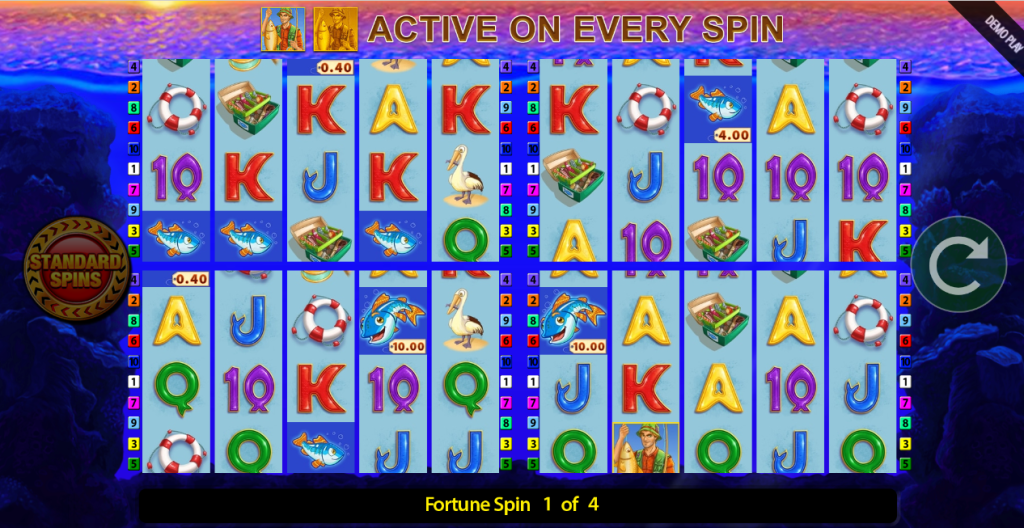
The Fishin’ Frenzy Fortune Spins demo is not a shortcut and it is not a preview of outcomes. It is a viewing window. Stripped of stakes and consequence, the demo removes the emotional noise that usually dominates the first encounter with this mode.
What remains is structure.
In a demo environment, Fortune Spins reveals what it is built to do: compress activity, multiply visual signals, and keep attention in motion. Without money involved, the player is no longer negotiating risk. They are observing rhythm. This distinction matters more here than in most slots, because Fortune Spins is a mode designed to feel active even when nothing of consequence is resolved.
If you want to understand how the mode behaves rather than how it pays, the demo is the cleanest place to start.
What “Fortune Spins Demo” really is
A demo version of Fortune Spins uses simulated credits. There is no balance pressure, no deposits, and no withdrawals. On the surface, this is standard. What makes Fortune Spins different is how little the mode relies on financial tension to create engagement.
In real play, the 20× Total Bet entry cost frames the session before the first spin. In demo mode, that framing disappears. The mode still behaves the same, but the psychological contract changes. Without cost, the player’s tolerance for ambiguity increases. Near-misses feel lighter. Long stretches without resolution feel less threatening.
This is precisely why the demo is useful — and also why it is dangerous if misunderstood. The demo does not simplify Fortune Spins. It removes resistance, allowing the underlying design to operate without friction.
Fortune Spins vs base game and Free Spins — a demo perspective
Viewed through a demo, the contrast between play modes becomes clearer, not flatter.
The base game is sparse. Each spin stands on its own. Outcomes resolve quickly, and attention is allowed to reset. In a demo, this clarity is almost stark. You see how little actually happens per spin.
| Mode | What demo highlights | What demo hides |
|---|---|---|
| Base Game | Clear resolution and readable pacing | Long-run variance and distribution |
| Free Spins | A contained intensity spike | Return shape over distance |
| Fortune Spins | Continuous activity and dense signals | The real “weight” of unresolved play |
Free Spins, by contrast, present a short-lived disruption. Volatility increases, pacing changes, and then the system returns to normal. In a demo, this feels contained — a spike with a beginning and an end.
Fortune Spins sits between these two states. It is not a bonus, and it is not a baseline. In demo mode, this becomes obvious. The session does not build toward a climax, nor does it pause often enough to feel resolved. Instead, it sustains motion. The game is always doing something, but rarely concluding anything.
Understanding this positioning early prevents a common mistake: expecting Fortune Spins to behave like a reward rather than a format.
What the demo does NOT prove
A Fortune Spins demo does not validate returns, frequency, or value. It cannot confirm RTP, and it does not simulate long-run behaviour in any meaningful way. Short demo sessions exaggerate perception, especially in a mode designed around density.
Because there is no financial consequence, the player’s memory becomes selective. Small wins blend into background activity. Empty spins feel shorter. Strong moments stand out more sharply because they are not competing with loss aversion.
This creates an illusion of generosity that exists only in context. The demo shows how Fortune Spins feels, not how it performs. Confusing the two leads to misplaced expectations the moment real stakes enter the picture.
Used correctly, the demo clarifies design. Used incorrectly, it distorts judgement.
Four windows in demo: observing attention, not outcomes
The Fortune Spins demo is uniquely suited to one task: observing how attention is managed across four simultaneous windows. Without the distraction of balance changes, the player can see how quickly focus fragments and how rarely it settles.
Each window presents its own unresolved state. Fish appear, linger, and disappear. Symbols hint at potential value without delivering it. In a demo, these signals lose their monetary weight and become what they always were — prompts competing for attention.
What becomes clear is that Fortune Spins is not about maximising any single screen. It is about ensuring that no screen is ever quiet. The demo exposes this design choice with unusual clarity. Instead of watching outcomes, the player watches themselves: scanning, shifting, waiting for alignment that may never arrive.
This is not a weakness of the demo. It is its most honest contribution. It shows that Fortune Spins is an exercise in attention distribution rather than outcome optimisation.
Fish symbols and Fisherman behaviour in demo mode
Fish symbols in a demo environment reveal their true function more clearly than they do in real play. Without the emotional pull of real value, Fish are exposed as visual anchors rather than rewards.
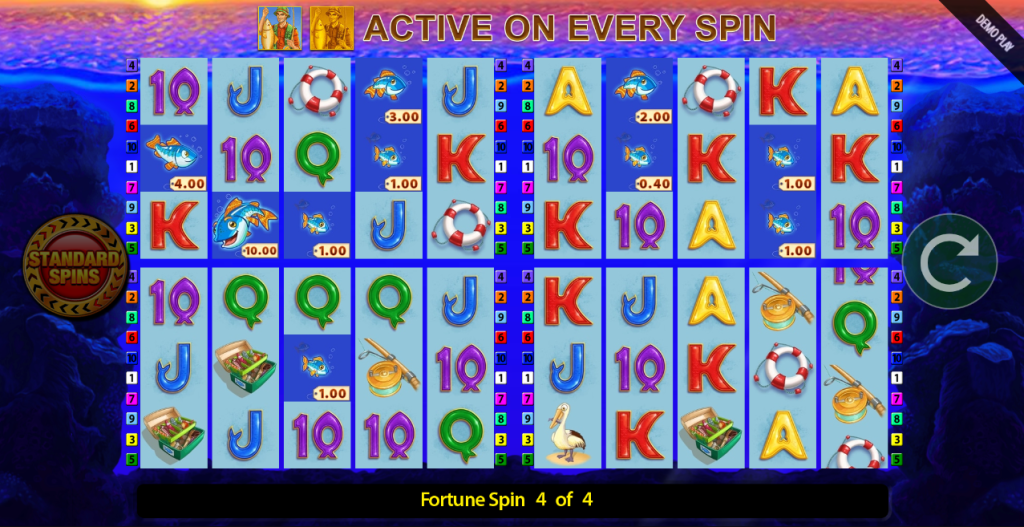
They persist. They accumulate across windows. They create unfinished situations that invite anticipation but do not resolve it. In demo mode, this behaviour feels almost mechanical. The Fish exist to be seen, not to be collected.
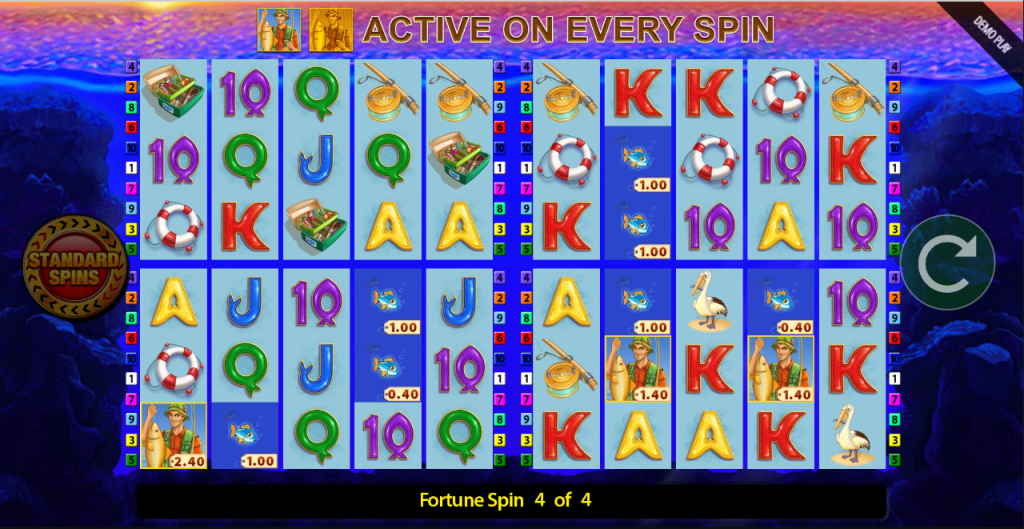
The Fisherman, when he appears, reinforces this dynamic. His role is not to introduce surprise, but to provide delayed resolution. In a demo, his presence feels less dramatic and more procedural. Collection happens, numbers change, and then the system resets to anticipation once again.
This cycle is easier to recognise when nothing is at stake. The demo strips away the excitement and leaves the structure intact: accumulation, pause, collection, reset.
Why Fortune Spins feels generous in demo
Fortune Spins often feels more generous in demo mode, even though nothing meaningful is being proven. This sensation emerges from three overlapping factors.
First, the absence of financial loss removes resistance. The player is willing to sit through longer stretches of unresolved play because there is no cost attached to waiting. Time becomes elastic.
Second, the density of events is misread as frequency of success. Four windows create four times as many signals, even when those signals are neutral. The demo amplifies this effect by removing the one counterbalance that normally sharpens perception: risk.
Finally, demo play encourages casual engagement. Spins are clicked without reflection. Sessions extend longer than they would with money involved. Over time, this creates a false sense of productivity — as if something must be happening simply because the screen remains busy.
The demo does not create this illusion. It reveals how easily it forms.
Who the demo is actually useful for
The Fortune Spins demo is most useful for players who want to understand experience rather than outcome. It suits those who are curious about pacing, interface behaviour, and attention flow.
It is far less useful for players seeking confirmation. The demo cannot confirm profitability, advantage, or consistency. Anyone approaching it with those expectations will leave with distorted impressions.
In this sense, the demo acts as a filter. It rewards patience, observation, and tolerance for ambiguity. It punishes the need for certainty and quick conclusions.
Understanding whether you belong in the first group or the second is, arguably, the most valuable information the demo can provide.
Demo vs real play: what changes the moment money is involved
The shift from demo to real play in Fortune Spins is not cosmetic. Nothing on screen changes, yet the experience does. The reason is simple: once money is involved, every unresolved element acquires consequence.
-
No cost
Continuation feels neutral. -
Observation
Attention can wander without penalty. -
Patience
Unresolved states feel lighter.
-
Cost
Continuation becomes a decision. -
Commitment
The session feels “entered”. -
Pressure
Unfinished states demand closure.
In demo mode, Fish that persist across windows are visual artefacts. They suggest possibility without demanding action. In real play, those same Fish become deferred outcomes attached to cost. The four-window layout, which felt spacious in demo, begins to compress attention. What was previously observation turns into monitoring.
The entry structure amplifies this shift. Paying to enter Fortune Spins reframes the session before the first spin is even played. The player is no longer testing a mode; they are committing to it. Momentum stops being neutral. Continuing no longer feels free.
This is where expectation often breaks. Players carry impressions from demo into real play without accounting for the change in psychological load. Fortune Spins does not become harsher. It becomes heavier. The same density that felt engaging without stakes becomes demanding when each spin carries weight.
Understanding this transition is essential. Without it, demo experience is misapplied, and frustration follows.
Using the demo responsibly
A Fortune Spins demo is most useful when treated as an observational tool rather than a rehearsal. Its purpose is not to simulate success, but to reveal preference.
The demo allows players to test their tolerance for ambiguity. It answers questions that real play obscures with emotion. Can you remain comfortable when outcomes are delayed? Does constant activity maintain focus or erode it? Do unresolved situations motivate patience or provoke impatience?
These questions matter more than any short-term result. The demo provides clean signals because it removes the emotional distortion created by financial risk. In that sense, it is more honest than real play.
Misuse occurs when the demo is treated as a predictor. Short sessions, simulated credits, and the absence of consequence create a distorted sense of ease. The mode feels lighter because nothing is at stake. That lightness is not a property of Fortune Spins itself. It is a property of the demo environment.
Used responsibly, the demo clarifies alignment. Used casually, it manufactures expectation.
Final thoughts
The Fishin’ Frenzy Fortune Spins demo is not a promise and not a preview of outcomes. It is a window into design intent.
By removing money from the equation, the demo exposes what Fortune Spins prioritises: continuous motion, visual density, and sustained attention. It shows how four concurrent windows reshape perception and how delayed resolution becomes the dominant feature of the session.
This clarity is the demo’s real value. It allows the player to see the mode as it is built, rather than as it is hoped to behave. Few slots benefit from this kind of examination as much as Fortune Spins, precisely because its appeal is experiential rather than mathematical.
If you approach the demo as a way to understand structure, it does its job exceptionally well. If you approach it as a substitute for real play, it will inevitably disappoint.
That distinction is the only conclusion worth taking from it.