
Even Bigger Fish: A Slot Built Around the Moment of Collection
Where Fishin Frenzy Even Bigger Fish Fits in the Series
Fishin Frenzy Even Bigger Fish should not be viewed as a standalone slot or a radical redesign of the franchise. Its role within the Fishin Frenzy series is evolutionary rather than experimental. The game follows a clear internal logic that has been shaping the franchise since its earliest versions.
From the beginning, Fishin Frenzy has relied on a simple visual theme and a restrained base game to support a bonus-driven experience. The series never attempted to compete through reel complexity or unconventional layouts. Instead, its identity was built around anticipation, accumulation, and delayed reward.
The original Fishin Frenzy established this foundation by introducing the fisherman collection mechanic and value-based fish symbols. Big Catch refined that idea, shifting more attention toward the bonus phase and reducing the importance of line wins. Even Bigger Catch pushed the model further by increasing the weight and impact of bonus rounds within the overall session.
Even Bigger Fish continues this same trajectory. It does not introduce a new theme, nor does it significantly alter the base structure. What changes instead is the perceived scale of outcomes. Bonus rounds are less frequent, but they carry greater narrative and mathematical importance. The game conditions the player to treat each bonus trigger as a decisive moment rather than a routine feature.
In practical terms, Even Bigger Fish represents a version of Fishin Frenzy designed for players who understand the series and accept its rhythm. The game is not concerned with constant engagement through small wins. Its design philosophy assumes patience and rewards longer sessions where tension gradually builds toward a single defining bonus phase.
This positioning makes Even Bigger Fish a natural continuation of the franchise rather than a departure from it. The series does not grow wider here; it grows deeper.
Core Game Architecture
The core architecture of Fishin Frenzy Even Bigger Fish remains intentionally conservative. This is not a limitation, but a deliberate design choice aligned with how the series functions as a whole. Complexity is not introduced at the reel level, because the game’s primary mechanics operate elsewhere.
The base game follows the familiar Fishin Frenzy structure:
- five reels,
- three rows,
- fixed paylines.
A quick model of how the base layer is organised
A short reference that explains function, not “features”. Built to stay readable on desktop and mobile.
| Element | Structural role |
|---|---|
| Reels & Rows | Keeps the presentation stable and low-noise so the session rhythm stays readable. |
| Paylines | Resolves outcomes cleanly, but does not carry the main value narrative of the session. |
| Fish Symbols | Shows potential (amounts visible) that can exist without immediate conversion into a realised result. |
| Fisherman | Acts as the pivot where stored potential can consolidate into a single, decisive collection moment. |
Keeps the presentation stable and low-noise so the session rhythm stays readable.
Resolves outcomes cleanly, but does not carry the main value narrative of the session.
Shows potential (amounts visible) that can exist without immediate conversion into a realised result.
Acts as the pivot where stored potential can consolidate into a single, decisive collection moment.
Shortcut: the calmer the base layer looks, the more the model relies on fewer collection pivots to define the session.
That is why the same layout can feel “light” or “heavy” across versions: the difference is how often the pivot resolves what you have been shown.
This configuration provides clarity rather than excitement. Spins resolve quickly, outcomes are easy to read, and there is little visual distraction. The base game exists to establish rhythm and maintain balance between anticipation and restraint.
Symbol distribution follows a clear hierarchy. Lower-paying symbols stabilise the session and prevent extreme variance in short play cycles. Higher-paying symbols appear infrequently and are not intended to carry the game on their own. Their function is largely psychological, reinforcing the idea that value exists but is not easily accessed.
Fish symbols with monetary values form a separate category altogether. These symbols do not behave like traditional payline elements. Instead, they operate as stored potential. When they appear in the base game, they rarely feel conclusive. Their presence signals what the game is building toward, rather than what it has already delivered.
This separation between visible value and realised value is central to the architecture of Even Bigger Fish. The game repeatedly shows the player what could be collected, while postponing the act of collection itself. Over time, this creates a structured sense of incompleteness that only the bonus phase can resolve.
Importantly, the base game does not attempt to disguise this model. There is no illusion of frequent success. The design communicates clearly that line wins are secondary and that the true outcome of a session depends on how and when the collection mechanics are activated.
Fishin Frenzy Even Bigger Fish therefore uses simplicity as a structural tool. By keeping the base game predictable and readable, it ensures that attention remains focused on progression, accumulation, and the eventual transition into the bonus phase where the game’s real logic unfolds.
The “Bigger Fish” Concept: What Actually Became Bigger
The phrase “Even Bigger Fish” does not describe a single mechanical upgrade. It is not limited to higher values, more symbols, or a visible increase in features. Instead, it reflects a structural shift in how value is distributed and perceived throughout a session.
In earlier Fishin Frenzy versions, the balance between frequency and impact was relatively even. Bonus rounds appeared often enough to feel familiar, and their outcomes varied within a moderate range. Even Bigger Fish alters this balance by compressing value into fewer, more decisive moments.
What becomes “bigger” is not the number of winning events, but their weight.
The game reduces the sense of progression through small, regular pay-offs and replaces it with a longer build-up phase. During this phase, the player is repeatedly shown potential value without being allowed to convert it. Fish symbols appear, monetary amounts are visible, but resolution is delayed. This creates a widening gap between what is seen and what is collected.
That gap is the core of the Bigger Fish concept.
From frequent bonuses to heavier resolution
A clean structural progression across the Fishin Frenzy line — rhythm first, numbers never.
By stretching this distance, the game changes how time is experienced during play. Sessions feel slower, not because nothing happens, but because nothing concludes. Each spin contributes to an unresolved state where value exists but remains inaccessible. The longer this state persists, the more significance is assigned to the eventual bonus trigger.
From a design perspective, this approach serves two purposes. First, it increases contrast. When a bonus finally activates, it stands out sharply against the restrained base game. Second, it reduces noise. Fewer meaningful events occur, but each carries more narrative and mathematical importance.
Even Bigger Fish therefore shifts player focus away from individual spins and toward the session as a whole. The game is not asking whether a spin was successful. It is asking whether the session has reached its defining moment.
This is what truly becomes bigger: the role of a single bonus round in determining how the entire session is remembered.
Bonus Phase Logic: How Free Spins Actually Behave
In Fishin Frenzy Even Bigger Fish, the Free Spins feature is not a reward layered on top of the base game. It is the structural endpoint toward which the entire session moves. Understanding its behaviour requires looking beyond the trigger itself and examining how the bonus unfolds over time.
The bonus phase can be divided into distinct behavioural stages rather than treated as a uniform block of spins.
The opening spins often establish the tone. Early activity typically focuses on positioning and initial value exposure rather than immediate collection. Fish symbols may appear quickly, creating the impression of momentum, but actual outcomes remain limited. This stage reinforces the idea that the bonus is still “setting up”.
The middle portion of the bonus is where tension is most pronounced. Here, the game alternates between apparent opportunity and controlled restraint. Fish values accumulate visually, but collection events are selective. This is where players most strongly feel the imbalance between visible value and realised returns. The bonus appears active, yet outcomes remain uncertain.
The final spins function differently. Whether the result is strong or modest, the bonus phase tends to resolve decisively. Collection mechanics become clearer, outcomes consolidate, and the session moves from anticipation to conclusion. The game avoids prolonged ambiguity at this stage, ensuring that the bonus feels complete rather than interrupted.
Bonus flow in four clear steps
Read this as a timeline: each step describes what the bonus is doing at that moment — and what the player should notice.
The feature “settles in”: early spins establish pace and show the first hints of potential.
This is orientation, not payout. The bonus is setting conditions for later consolidation.
More on-screen value appears. Symbols communicate potential faster than they deliver it.
This is the build-up layer: visibility increases, but collection remains selective.
Alternation: activity continues, but results feel delayed. Moments look promising, then pause.
This is the decision zone. The bonus tests patience until a pivot event resolves value.
Consolidation: value gathers into a clear outcome. The feature ends decisively.
Closure is the point: it converts the entire bonus into a single remembered result.
What is important is not the size of any single spin, but the shape of the bonus as a whole. Free Spins in Even Bigger Fish are designed to feel like a progression from expectation to resolution, rather than a random sequence of events.
This structure also explains why bonus rounds feel rare but significant. Because the base game invests so much time in building unresolved value, the bonus phase carries the responsibility of closure. It is not merely an opportunity for profit; it is the mechanism through which the game justifies the time spent reaching it.
For the attentive player, this makes the Free Spins feature readable. While outcomes remain unpredictable, the internal rhythm of the bonus follows a consistent logic. The game shows when it is still building, when it is testing patience, and when it is ready to conclude.
Fishin Frenzy Even Bigger Fish uses its bonus phase not to surprise, but to resolve. That distinction defines how the game feels and why its Free Spins behave differently from those in earlier versions of the series.
Fisherman Mechanic and Collection Dynamics
In Fishin Frenzy Even Bigger Fish, the fisherman is not a visual centrepiece or a conventional wild symbol. Its role is structural. The fisherman exists to convert visible potential into realised outcomes, and this conversion does not happen continuously.
Throughout the base game and the bonus phase, fish symbols introduce monetary values into the playfield. These values are intentionally exposed early and often. The player sees numbers accumulating across spins, which creates the impression that progress is being made. However, without the fisherman, these values remain inert.
The fisherman’s appearance marks a transition rather than a reward. When it enters the reels, the game shifts from accumulation to resolution. This shift is abrupt by design. Long periods of visible value can pass without collection, followed by a single moment where multiple elements are consolidated.
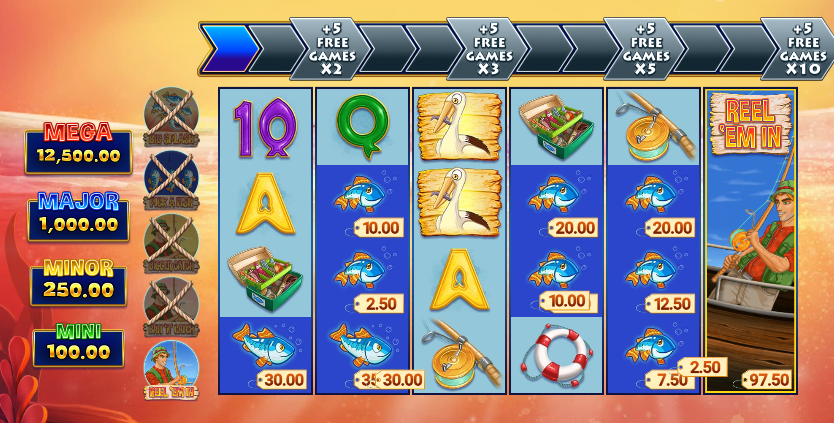
This mechanic serves a dual function. Mathematically, it concentrates outcomes into fewer events, increasing variance within specific moments while keeping the overall structure controlled. Psychologically, it transforms passive observation into active engagement. The player is no longer watching values appear; they are watching whether those values will be taken.
Importantly, the fisherman does not guarantee efficiency. Not every appearance results in meaningful collection, and not every accumulation phase leads to a strong outcome. This inconsistency prevents the mechanic from becoming predictable and maintains tension across sessions.
In Even Bigger Fish, the fisherman is less frequent but more consequential. Its reduced visibility increases its symbolic weight. Each appearance signals the possibility of closure, not certainty. The game uses this restraint to reinforce the idea that collection is earned through timing rather than repetition.
By separating accumulation from collection so clearly, the slot establishes a rhythm where value is first promised, then delayed, and only occasionally delivered. The fisherman is the pivot point of this rhythm.
RTP, Volatility and Long-Session Behaviour
Why volatility reads as “session-based”
A conceptual line: long flat stretches followed by a decisive spike. No values, no promises — just the shape of the experience.
Discussions around RTP and volatility often focus on headline numbers, but in Fishin Frenzy Even Bigger Fish these metrics only become meaningful when viewed across extended play sessions.
The theoretical RTP sits within the familiar range for the series, but its distribution is uneven by design. Returns are not spread smoothly across spins. Instead, they are concentrated within bonus-driven events, particularly those involving successful collection phases.
Volatility in this version is best described as session-based rather than spin-based. Individual spins rarely produce outcomes that define a session. Their function is preparatory. The mathematical model assumes that value will be realised in clusters, separated by longer periods of restrained activity.
This structure affects how the game behaves over time. Short sessions often feel inconclusive. Without a completed bonus cycle, the experience can appear flat or unrewarding. Longer sessions, however, reveal the intended balance, where extended build-up is occasionally offset by a decisive resolution.
From a player experience perspective, this creates a clear dividing line. Fishin Frenzy Even Bigger Fish does not reward impatience. It favours sustained play where the internal logic has time to unfold. RTP, in this context, reflects the average outcome of complete cycles rather than isolated moments.
Understanding this behaviour helps explain why the game feels heavier than earlier versions. The same RTP figure supports a different emotional profile when value is delayed and concentrated. Variance is not expressed through constant fluctuation, but through contrast between long quiet stretches and rare defining events.
Even Bigger Fish therefore operates on a longer horizon. Its mathematical identity becomes visible only when the game is allowed to complete its cycles, reinforcing the idea that outcomes are shaped by structure rather than by individual spins.
UX Psychology: Why This Version Feels Heavier
Fishin Frenzy Even Bigger Fish creates a noticeably heavier experience compared to earlier versions in the series. This weight is not visual or thematic. It is psychological, shaped by pacing, restraint, and delayed resolution.
The base game operates at a controlled tempo. Spins resolve cleanly, animations are brief, and outcomes are rarely dramatic. This consistency reduces sensory fatigue but also limits emotional spikes. Over time, the player becomes accustomed to a state of mild tension without release.
What intensifies this feeling is the repeated exposure to uncollected value. Fish symbols appear with clear monetary amounts, yet nothing happens to them. The game repeatedly shows what could matter while postponing any confirmation that it will. This creates a subtle but persistent sense of incompletion.
The absence of frequent confirmation is intentional. Many slots rely on constant reinforcement through small wins or visual feedback. Even Bigger Fish avoids this approach. It allows anticipation to accumulate, trusting that the eventual resolution will carry more impact precisely because it was delayed.
Another factor contributing to the heavier feel is the lack of misleading signals. Near-miss effects are restrained, and bonus triggers do not appear artificially frequent. When a bonus finally activates, it feels earned rather than engineered. This strengthens the perceived legitimacy of the outcome, regardless of its size.
From a user experience perspective, the game asks for patience and awareness. It rewards players who are comfortable with long stretches of neutrality and who recognise progression through structure rather than through immediate returns.
The result is a slot that feels slower, denser, and more deliberate. Even Bigger Fish does not attempt to entertain continuously. It waits, builds, and resolves, creating a heavier emotional arc than most games within the same genre.
Even Bigger Fish vs Other Fishin Frenzy Versions
Comparing Fishin Frenzy Even Bigger Fish with other entries in the series highlights how subtly the franchise has evolved. The differences are not defined by layout or theme, but by emphasis and distribution of value.
How the versions differ at a glance
A quick structural snapshot for readers who want the difference in one scan — without turning it into a “spec sheet”.
| Version | Bonus Frequency | Value Concentration | Session Weight |
|---|---|---|---|
| Classic | Higher | Lower | Light |
| Big Catch | Medium | Medium | Balanced |
| Even Bigger Fish | Lower | Higher | Heavy |
The original Fishin Frenzy established the core idea: a simple base game supporting a collection-driven bonus. It delivered regular engagement and moderate outcomes, making it accessible and easy to read.
Big Catch shifted focus toward the bonus phase, increasing the importance of collection mechanics while still maintaining relatively frequent triggers. The game began to reward longer sessions, but base game participation remained visible.
Even Bigger Catch intensified this model. Bonus rounds became more influential, and outcomes more polarised. The player experience started to centre on fewer, larger moments rather than steady progression.
Even Bigger Fish continues this trend by pushing concentration even further. Bonus events occur less often, but their role in defining a session is absolute. The base game becomes more clearly transitional, existing primarily to support the eventual bonus cycle.
Compared to Megaways adaptations or experimental variants, Even Bigger Fish remains conservative. It does not seek to reinvent the series or attract a new audience. Instead, it refines a specific type of experience for players already familiar with the franchise’s logic.
In this context, Even Bigger Fish represents the most focused expression of the Fishin Frenzy philosophy. It removes excess stimulation and relies on structure, patience, and delayed payoff to define its identity within the series.
Who This Slot Is Actually For And Who It Isn’t
Fishin Frenzy Even Bigger Fish is not designed to appeal to a broad or casual audience. Its structure, pacing, and reward distribution make that clear early on. The game assumes a certain level of familiarity with how Fishin Frenzy works and does little to accommodate players who expect constant stimulation.
This version suits players who are comfortable with delayed outcomes and who understand that value in this game is not measured spin by spin. It appeals to those who read progression through structure rather than through immediate feedback. For such players, long stretches of neutral play are not frustrating but informative. They indicate that the game is still building toward resolution.
Even Bigger Fish is also better suited to players who approach slots as extended sessions rather than short experiments. Without allowing the internal cycle to complete, the game can feel unrewarding or inconclusive. Players who prefer quick results or frequent feature activation are unlikely to find satisfaction here.
A practical fit-check before you commit a session
Two columns, no hype: one side matches the rhythm, the other fights it.
- You enjoy structured bonuses with a clear build → tension → closure arc.
- You prefer “moment of collection” mechanics over constant micro-hits.
- You can sit through calm stretches without forcing the pace.
- You like reading symbols as stored potential, not instant reward.
- You want a session that ends with a memorable resolution event.
- You need frequent bonus triggers to feel “progress”.
- You dislike delayed outcomes and want constant feedback every few spins.
- You chase short sessions and judge the game too early.
- You prefer predictable pacing over concentrated resolution moments.
- You treat visible potential as guaranteed collection.
Conversely, the slot is not well matched with an audience seeking constant action or reassurance. Those who rely on frequent small wins, rapid bonus triggers, or aggressive visual feedback may perceive the game as slow or unresponsive. The design does not attempt to compensate for this perception.
Importantly, Even Bigger Fish does not attempt to educate or guide the player. There are no layered tutorials or progressive unlocks. The game reveals itself through repetition and observation. Players either adapt to its rhythm or disengage from it.
In this sense, the slot makes a clear choice. It prioritises coherence and internal logic over accessibility, accepting that a narrower audience will engage more deeply with what it offers.
Final Structural Summary: How Even Bigger Fish Is Meant to Be Read
Fishin Frenzy Even Bigger Fish is best understood as a structured experience rather than a sequence of independent spins. Its design does not reward constant interaction, nor does it attempt to create excitement through frequency. Instead, it organises play around accumulation, restraint, and eventual resolution.
The base game functions as a preparatory layer. It introduces symbols, exposes monetary values, and establishes rhythm without offering closure. This is not a flaw or a limitation. It is the foundation on which the rest of the game is built. By keeping this layer predictable and restrained, the slot ensures that attention remains focused on what truly matters.
The concept of “bigger” in this version is not visual or superficial. It manifests through concentration. Value is shown early but delivered late. Bonus rounds are fewer, yet they carry disproportionate influence over the session’s outcome. One completed bonus cycle can outweigh dozens or even hundreds of uneventful spins.
Collection mechanics, particularly the fisherman, act as structural hinges. They do not appear often, but when they do, they transform potential into outcome. This separation between accumulation and collection defines the emotional arc of the game and explains why results feel decisive rather than incremental.
From a mathematical perspective, RTP and volatility support this structure by distributing returns unevenly across time. The model assumes patience and rewards it selectively. Short sessions remain ambiguous. Longer sessions reveal the intended balance, where anticipation is occasionally resolved through a clear, consolidated outcome.
Psychologically, the game avoids constant reinforcement. It does not reassure, distract, or exaggerate. Instead, it relies on the player’s ability to recognise patterns and accept uncertainty. This approach creates a heavier experience, but also a more coherent one.
Fishin Frenzy Even Bigger Fish does not promise consistency, frequency, or control. What it offers instead is clarity of design. Every element serves the same purpose: to delay resolution until it matters. Players who understand this structure are more likely to appreciate the game for what it is, rather than judge it for what it intentionally avoids.
As a result, Even Bigger Fish stands as one of the most focused entries in the Fishin Frenzy series. It refines an existing philosophy rather than expanding it, favouring depth over variety and structure over spectacle.