
Even Bigger Catch: Understanding the Structure Behind Fishin Frenzy
Why Fishin Frenzy Even Bigger Catch Exists
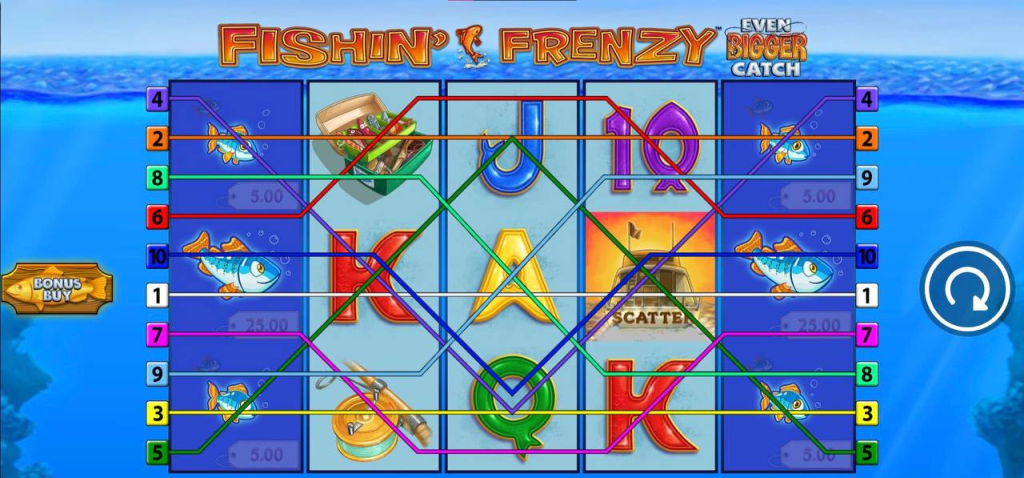
I have spent enough time analysing slot mechanics to recognise a familiar pattern when it appears. Fishin Frenzy Even Bigger Catch did not come into existence because the original formula was broken. Quite the opposite. It exists because the original Fishin Frenzy model proved to be unusually stable, predictable in structure, and emotionally effective for a wide audience. When a slot reaches that level of maturity, developers do not reinvent it. They extend it.
Even Bigger Catch is not a redesign. It is a deliberate expansion of a known system. The reels are familiar, the pacing is recognisable, and the visual language remains intentionally conservative. This version was not built to surprise the player with novelty. It was built to stretch the upper limits of an already proven bonus framework.
What Blueprint Gaming appears to be testing here is not creativity, but tolerance. How much additional variance can be layered onto a simple fishing mechanic before it becomes unstable? How far can the bonus phase be amplified without changing the base game rhythm? Even Bigger Catch is the answer to those questions.
The title itself is revealing. It does not promise a different experience. It promises a larger one. Larger potential, larger swings, larger emotional contrast between an empty bonus and a productive one. This is not a slot designed to feel generous. It is a slot designed to feel capable of generosity, under very specific conditions.
That distinction matters. Many players approach this version expecting improvement in frequency or reliability. What they actually encounter is an extension of range. The highs are higher, but the pathway to those highs remains narrow. From a structural point of view, Even Bigger Catch exists to reward patience and punish misinterpretation. It assumes the player already understands the Fishin Frenzy language, and it quietly raises the stakes of that understanding.
This is why analysing this slot as a standalone product misses the point. Its logic only becomes clear when placed back into the wider Fishin Frenzy lineage.
Position of Even Bigger Catch Within the Fishin Frenzy Series
Position in the Series
Quick comparison that shows where this version sits — the change is about a wider outcome range, not “better” frequency.
| Version | Core Mechanics | Bonus Complexity | Variance Feel |
|---|---|---|---|
| Fishin Frenzy | Classic | Low | Medium |
| Bigger Catch | Expanded | Medium | Medium-High |
| Even Bigger Catch Wider range | Expanded + Multiplier | High | High |
Fishin Frenzy has always occupied a particular niche within modern slot design. It is intentionally modest in appearance, mathematically conservative in its base game, and heavily concentrated around a single bonus-driven outcome. This structure has remained consistent across the series, regardless of visual updates or feature additions.
Even Bigger Catch sits near the far end of that evolutionary line.
Earlier entries in the series established a clear contract with the player: modest base gameplay, infrequent but meaningful free spins, and a bonus phase where most of the theoretical value resides. That contract has not been altered. What has changed is the amplification of the bonus layer rather than its frequency.
In practical terms, Even Bigger Catch does not aim to trigger bonuses more often than its predecessors. Instead, it increases the internal spread of outcomes once a bonus is triggered. This is a subtle but important shift. The slot is not more active. It is more volatile within its active moments.
Compared to the original Fishin Frenzy, this version introduces an additional decision layer during free spins, adding a multiplier selection that directly influences the final resolution of the bonus. Compared to later variants that experimented with jackpots or alternative side features, Even Bigger Catch remains purist in structure. There are no external prize pools, no progressive distractions, and no parallel mechanics competing for attention.
This places the slot in a specific role within the series. It is not the most accessible version, and it is not the most forgiving. Instead, it functions as a high-ceiling interpretation of the classic model. A version aimed at players who already accept long stretches of low activity in exchange for the possibility of a significantly enhanced bonus outcome.
From a design perspective, this makes sense. Blueprint Gaming did not need another entry-level Fishin Frenzy. They needed a version that could justify its existence to experienced players without abandoning the brand’s recognisable identity. Even Bigger Catch achieves that by intensifying what was already there, rather than introducing something foreign.
In the broader series context, this slot represents a confidence play. It assumes familiarity. It assumes restraint. And it assumes the player is willing to judge the game not by how often it pays, but by how it behaves when it finally does.
Core Slot Architecture: A Compact System Built Around One Outcome
Core Slot Architecture
Base Game
Neutral state
Scatter Trigger
State switch
Free Spins
Bonus phase
Value Build
Potential accumulates
Collection / Resolution
Outcome state
At its core, Fishin Frenzy Even Bigger Catch is an exercise in restraint. The game operates on a classic 5×3 reel layout with ten fixed paylines, a configuration that has long proven effective for maintaining a clear rhythm and predictable visual flow. There is nothing experimental here, and that is entirely intentional.
This architecture serves a specific purpose. Fixed paylines remove ambiguity from outcomes. The player is never distracted by expanding grids, cascading reels, or shifting win structures. Every spin resolves quickly, clearly, and without visual noise. The slot does not attempt to disguise its mathematical intentions behind spectacle. Instead, it funnels attention toward one inevitable conclusion: the bonus phase is where meaning resides.
The base game and the bonus game are not equal participants in this system. They are complementary states with very different roles. The base game exists primarily to sustain momentum and establish contrast. It generates small wins, near-misses, and occasional visual reinforcement through wilds and fish symbols, but it rarely attempts to resolve significant value. That restraint is not a weakness. It is a structural decision.
By limiting the expressive power of the base game, the slot preserves the emotional weight of the bonus. When free spins are triggered, the experience changes immediately. Sound design, animation pacing, and symbol behaviour all signal that the game has entered a different state. This separation is clean and deliberate, and it is one of the reasons the Fishin Frenzy formula has endured.
Even Bigger Catch does not disrupt this architecture. It reinforces it. Rather than adding secondary features or parallel mechanics, it deepens the existing bonus logic. The entire system remains compact, but the ceiling above the bonus phase is raised. From a design standpoint, this keeps the game legible. From a player perspective, it creates a sharper distinction between ordinary play and meaningful play.
In short, the architecture of Even Bigger Catch is not about complexity. It is about focus. Everything in the slot points toward a single outcome state, and everything else exists to make that state feel earned rather than frequent.
Base Game: Sustaining Play Without Creating Illusions
Base Game Holding Pattern
Illustrative model: base activity stays mostly flat with small “pulses”. There is no upward build — the base sustains attention, but doesn’t develop momentum.
The base game in Fishin Frenzy Even Bigger Catch is often misunderstood, largely because players expect more from it than it was designed to provide. It is not a space for growth, progression, or meaningful accumulation. It is a holding pattern.
Spins in the base game tend to resolve quickly, with modest line wins appearing just often enough to prevent long periods of complete inactivity. Wild symbols contribute to this sense of movement, but they rarely transform a spin into something memorable. Fish symbols appear regularly, carrying visible cash values, yet without a fisherman present, those values remain inert. This visual tease is deliberate.
The base game teaches patience by refusing to reward impatience. It presents fragments of potential without allowing them to combine into something substantial. This can feel frustrating to players who interpret frequent fish symbols as a sign of impending success. In reality, these symbols serve a psychological function rather than a mathematical one. They keep attention anchored to the reels while the game waits for a state change.
Importantly, the base game does not escalate. There is no sense of momentum building toward a bonus through increased win sizes or intensified animations. Each spin is largely independent in feel, even though the overall session is shaped by long-term probability. This flatness is not accidental. It prevents players from falsely identifying patterns where none exist.
In Even Bigger Catch, this restrained base behaviour is even more important. Because the bonus phase has been amplified, the contrast between base and bonus must remain sharp. If the base game were more generous, the bonus would lose its emotional dominance. By keeping the base game deliberately modest, the slot ensures that free spins remain the central event of the session.
From a structural perspective, the base game functions as a filter. It removes players who expect constant stimulation and rewards those willing to endure long stretches of neutrality. It does not promise improvement, and it does not suggest progression. It simply maintains the conditions under which the bonus, when it arrives, can feel decisive rather than routine.
Understanding this role is essential. Once the base game is seen not as an opportunity but as a necessary delay, the logic of Fishin Frenzy Even Bigger Catch becomes far clearer.
Scatter and Bonus Entry Logic: Crossing the Only Meaningful Threshold
Scatter & Bonus Entry: The Threshold
Two states separated by one gate: the bonus is access to a higher-variance mode, not a reward by itself.
Base State
Small oscillations keep the session alive, but the system does not build upward momentum.
Scatter Trigger
Gate to a new mode
Bonus State
The game shifts into a mode where outcomes spread wider: weak rounds stay weak, strong rounds can resolve sharply.
In Fishin Frenzy Even Bigger Catch, the transition from base play to free spins is not merely a feature trigger. It is the single most important structural event in the entire game. Everything before it is preparation. Everything after it is resolution.
Scatter symbols do not function as rewards in themselves. Their presence carries no intrinsic value, no immediate payout worth noting. Instead, they act as a gate mechanism. When three or more scatters appear, the game does not simply grant free spins. It shifts into a fundamentally different mode of operation, one where symbol behaviour, payout density, and variance are all recalibrated.
This distinction is critical. Many slots blur the line between base and bonus by offering escalating wins or intermediate features. Even Bigger Catch avoids that ambiguity. The bonus entry is clean, binary, and unmistakable. Either the game remains in its restrained base state, or it crosses the threshold into free spins. There is no halfway condition.
The number of free spins awarded often attracts attention, but it is a secondary concern. Whether the player receives ten, fifteen, or twenty spins matters less than how those spins are structured internally. The slot does not distribute value evenly across the bonus. Instead, it allows for wide internal variance, where several spins may resolve with little effect before a single interaction defines the outcome.
This is where many misinterpret the role of the trigger. A bonus entry is not confirmation of success. It is permission to access a higher volatility environment. The scatters open the door, but they do not guarantee that what lies beyond will be productive.
Even Bigger Catch reinforces this philosophy by refusing to signal quality at the point of entry. There are no enhanced animations suggesting a strong bonus, no visual indicators that hint at multiplier potential. The game remains deliberately opaque until the bonus unfolds. From a design standpoint, this preserves uncertainty and prevents early emotional anchoring.
The result is a bonus entry logic that feels decisive but not reassuring. It tells the player that something important is about to happen, but it withholds judgement on whether that event will be favourable. This tension is not accidental. It is the emotional core of the Fishin Frenzy structure.
Free Spins Phase Model: Build, Tension, and Final Resolution
Free Spins Phase Scanner
A bonus isn’t “random spins” — read it as one process: Entry → Build → Tension → Resolution.
What you see
The bonus begins as access. It doesn’t promise a result — it sets the stage.
What it means
The brain marks this as “special”, even though nothing decisive has happened yet.
Once free spins begin, Fishin Frenzy Even Bigger Catch reveals its true nature. This phase is not a series of independent spins. It is a structured sequence with a clear internal rhythm, even though that rhythm is never explicitly stated.
The opening spins of the bonus typically function as a calibration stage. Symbols appear, fish values populate the reels, and the fisherman begins to establish presence. During this early phase, outcomes are often modest. This is not a failure of the bonus; it is the system setting its parameters. The game is defining the density of value that will be available for collection.
As the bonus progresses, tension builds not through increasing payouts, but through accumulation of unresolved potential. Fish symbols carrying cash values begin to cluster. The screen fills with visible numbers that remain unclaimed. Each spin adds to a sense of suspended resolution. The player is not rewarded for these appearances. They are asked to wait.
The defining moment of the free spins phase is not the appearance of value, but its collection. When the fisherman symbol arrives, the bonus shifts from a state of creation to one of resolution. All visible fish values are gathered, and the accumulated potential finally collapses into a tangible result.
In Even Bigger Catch, this collapse is further intensified by the multiplier layer, which can radically alter the final outcome of an otherwise ordinary bonus. Importantly, this amplification occurs at the point of resolution, not during the build. This preserves uncertainty until the very end of the bonus sequence.
The structure encourages a particular emotional arc. Early spins establish context. Middle spins build anticipation without reward. Final spins deliver clarity, either confirming that the bonus was structurally weak or revealing that it carried significant hidden weight. There is very little middle ground.
What distinguishes this model from more chaotic bonus systems is its consistency. While outcomes vary widely, the internal logic does not. Every free spins round follows the same conceptual path: potential appears, tension accumulates, and resolution is delayed until a decisive interaction occurs.
Understanding this phase model changes how the bonus is perceived. Instead of judging it spin by spin, it becomes more coherent to view the free spins as a single event with multiple internal steps. Success or failure is not determined early, and premature conclusions often prove inaccurate.
Fishin Frenzy Even Bigger Catch relies on this delayed judgement. It withholds satisfaction until the structure has fully played out. In doing so, it transforms the bonus from a sequence of spins into a single, high-stakes narrative moment.
The Fisherman Mechanic: A Collector, Not a Catalyst
Fisherman Mechanic: Role Breakdown
This symbol feels like a saviour — but its real job is to convert what already exists and close the bonus.
What players assume
“He shows up to save the bonus.” That’s the illusion: a visual climax mistaken for a value-creation mechanic.
What the system does
He collects existing value (fish already on screen) and resolves the phase — often by closing the bonus window.
Creates value
Doesn’t generate new value out of nothing.
Improves odds
Doesn’t make triggers more likely or “help” RNG.
Collects existing value
Converts what’s already present into an outcome.
Ends bonus phase
Often signals closure of the bonus window.
The fisherman is the most recognisable figure in Fishin Frenzy Even Bigger Catch, and also the most consistently misunderstood. Players tend to treat this symbol as the moment of salvation, the hero who arrives to transform a mediocre bonus into a winning one. Structurally, that interpretation is incorrect.
The fisherman does not create value. He does not improve the underlying state of the bonus, nor does he alter the probability landscape. His role is far more limited and far more precise. He is a collector. His sole function is to convert already-existing potential into a realised outcome.
This distinction matters because it reframes how the bonus should be read. A fisherman landing on empty or low-value reels does not represent bad luck at the moment of collection. It reflects a bonus that failed to build meaningful potential beforehand. Conversely, a fisherman collecting a large amount does not indicate exceptional timing. It indicates that the bonus phase successfully accumulated value prior to resolution.
Even Bigger Catch reinforces this logic by maintaining strict boundaries around the fisherman’s influence. He does not appear more frequently during strong bonuses, nor does his presence scale with the amount of value on the screen. He arrives according to predefined probabilities, indifferent to the emotional state of the player or the visual density of fish symbols.
This neutrality is intentional. By separating the creation of value from its collection, the slot avoids false narratives. The fisherman is not a signal. He is not a promise. He is the closing mechanism of a process that has already succeeded or failed by the time he appears.
Many players focus excessively on waiting for the fisherman, interpreting his absence as denial and his arrival as opportunity. In reality, the meaningful work of the bonus happens without him. It occurs in the quiet accumulation of fish values across multiple spins, long before resolution becomes possible.
Seen through this lens, the fisherman becomes less dramatic but more honest. He is not the reason a bonus wins. He is the reason a bonus finally ends.
Golden Fisherman and the Multiplier Layer: Controlled Instability
Golden Fisherman & Multiplier: Outcome Spread
A multiplier layer doesn’t have to raise the average — it can widen the distribution: a broader middle, longer tails, more extremes.
The defining addition in Fishin Frenzy Even Bigger Catch is the introduction of the golden fisherman and the multiplier selection that accompanies him. This feature is often described as an upgrade or enhancement, but such labels obscure its true function. It is not an upgrade in reliability. It is an increase in spread.
When the golden fisherman appears, the player is presented with a choice of multipliers, typically ranging from modest to extreme. This moment creates the illusion of agency, yet the underlying logic remains unchanged. The multiplier does not influence how much value was built during the bonus. It only affects how dramatically that value is expressed at the moment of resolution.
From a system perspective, this layer exists to amplify variance. A weak bonus remains weak, even under a high multiplier. A strong bonus can become exceptional, but only if the multiplier aligns favourably. This creates a wider distribution of outcomes without altering the average behaviour of the slot.
What makes this mechanism particularly effective is its timing. The multiplier is introduced at the point of maximum emotional tension, when the player has already invested attention and expectation into the bonus. By placing the decision here, the slot intensifies the sense of consequence without granting meaningful control.
Importantly, the multiplier does not rescue bonuses that failed to build structure. It does not compensate for empty reels or sparse fish values. Instead, it magnifies whatever state already exists. This makes the feature inherently unforgiving. It rewards well-constructed bonuses disproportionately and exposes weak ones more clearly.
In the broader context of the Fishin Frenzy series, this multiplier layer represents a calculated risk by the developer. It increases the number of extreme outcomes, both positive and negative, while preserving the familiar framework. The game feels capable of more, but it also demands more patience and tolerance for disappointment.
The golden fisherman, then, is not a symbol of generosity. He is a symbol of instability, carefully contained within a system that otherwise remains conservative. His presence does not change what the slot is. It simply expands how far the outcome can swing when the structure aligns.
Symbol Behaviour: Why Fish Is Never Just Fish
Symbol Behaviour: Mechanic Lens
Pick a symbol. Switch context. The readout shows what the symbol actually does — not what it looks like.
Fish
Looks rich. Doesn’t resolve value by itself.
Wild
A stabiliser: keeps motion, not climax.
Fisherman
Resolution tool: converts what exists.
In Fishin Frenzy Even Bigger Catch, symbols do not exist as independent units. They only gain meaning through interaction, timing, and state. This is especially true of the fish symbols, which many players instinctively treat as direct indicators of potential value. That assumption is only partially correct.
Fish symbols function as containers rather than rewards. Their visible cash values create the impression of immediacy, but without the correct structural conditions, that value is inaccessible. A fish appearing in the base game carries no functional weight beyond visual reinforcement. Even during free spins, fish values are provisional until a collection event occurs.
This distinction becomes clearer when observing how different fish values behave across a bonus sequence. High-value fish appearing early in free spins often generate excitement, but their impact depends entirely on what follows. If they remain uncollected, they contribute nothing to the outcome. Lower-value fish appearing consistently, however, can form a more stable base for accumulation when combined with timely collection.
Wild symbols play a contrasting role. They do not create value directly, nor do they store it. Instead, they stabilise outcomes by increasing line win frequency and maintaining engagement during otherwise unproductive stretches. Their presence smooths variance rather than amplifying it. In this sense, wilds are structural supports, not drivers.
The interaction between fish, wilds, and the fisherman defines the internal logic of the slot. Fish create latent potential. Wilds maintain continuity. The fisherman resolves. None of these elements is sufficient on its own. The slot only becomes expressive when all three align within the same bonus phase.
Even Bigger Catch does not alter these relationships. What it does is stretch the distance between them. Larger fish values, higher multipliers, and wider variance mean that the consequences of misalignment are more pronounced. A bonus with many fish but poor resolution feels emptier. A bonus with modest fish but effective collection can feel surprisingly complete.
Understanding symbol behaviour in this way removes much of the emotional noise from the reels. The slot stops being a sequence of encouraging visuals and becomes a system of delayed outcomes. Fish are not signals. They are ingredients. Their presence alone says very little about how the bonus will end.
Volatility and RTP in Real Play: How the Slot Behaves Over Time
Volatility & RTP: Session Rhythm Graph
Read it like this: blue = most spins (small activity). yellow = rare moments (big jumps). The point is the pattern, not the numbers.
This is where a session can “change shape”. It’s not frequent — that’s the point.
How to read it
Stay in the blue zone most of the time: small motion, no “build”.
Big changes arrive as yellow spikes: short, rare, decisive.
Rhythm matters more than RTP: the feel is “waiting + jump”, not “steady climb”.
What it explains
RTP is an average. A session is a tempo. If the tempo is flat-and-spike, decisions should be based on patience and window size, not on expectations per spin.
Discussions of volatility and RTP often remain abstract, reduced to percentages and labels that fail to capture how a slot actually feels in extended play. In Fishin Frenzy Even Bigger Catch, these parameters are not theoretical. They are experienced directly through pacing, droughts, and abrupt resolution.
The slot operates within a medium-to-high volatility range, but that description understates its character. Most sessions are dominated by neutrality. The base game produces frequent low-impact results that preserve balance without meaningfully advancing the session. True progress, whether positive or negative, is concentrated almost entirely within the free spins phase.
RTP, where variable, subtly shapes this experience rather than defining it. A higher RTP setting does not make the slot more generous in a visible sense. It marginally increases the likelihood that accumulated potential resolves favourably over long play. This distinction is important. Players rarely feel RTP. They feel variance.
Even Bigger Catch accentuates this variance by widening the outcome distribution of bonuses. Many free spins rounds will resolve with underwhelming results, reinforcing the impression of stagnation. Occasionally, however, the structure aligns: sufficient fish values accumulate, collection occurs at the right moment, and the multiplier layer amplifies the result. These events are infrequent but decisive.
Over time, this creates a rhythm that can be deceptive. Long periods of inactivity are punctuated by sharp spikes of resolution. Players who judge the slot spin by spin often conclude that it is unresponsive or cold. Players who assess it over longer sessions recognise a pattern of delayed expression.
This behaviour has practical implications. Even Bigger Catch is poorly suited to short, impulsive sessions. It does not provide regular feedback that feels meaningful. Instead, it demands endurance and emotional neutrality, qualities that many players underestimate.
Viewed through this lens, volatility and RTP are not abstract metrics but behavioural forces. They shape how the slot asks to be played. Even Bigger Catch does not reward attention in the short term. It tests tolerance, and only occasionally reveals why that tolerance was required.
Player Psychology and UX Traps: Why This Slot Is Easy to Misread
Player Psychology: UX Trap List
These are not “player mistakes”. They are interface patterns that steer expectations — even when the underlying odds don’t change.
Familiarity trap
“I know this slot” becomes “I know what will happen”.
High
Familiarity trap
“I know this slot” becomes “I know what will happen”.
What you feel
The layout looks familiar, so the brain treats it like a “solved” system — even if the mechanics have expanded.
What the UI is doing
It reuses visual language (fish, nets, collectors) to create confidence. Confidence increases session length.
Visible value trap
You see “stored value” and assume it’s already yours.
High
Visible value trap
You see “stored value” and assume it’s already yours.
What you feel
A fish symbol looks like money. A pile looks like progress. It creates ownership before resolution.
What the UI is doing
It separates “value shown” from “value collected”. The delay creates tension — and keeps you chasing closure.
Choice illusion
Options feel strategic, but they often only change pacing.
Medium
Choice illusion
Options feel strategic, but they often only change pacing.
What you feel
Selecting stakes, turbo, or “when to stop” feels like a control panel for outcomes.
What the UI is doing
It gives you levers that mostly affect session rhythm: speed, exposure, and how long you stay in the holding state.
Delayed judgement
You can’t evaluate the session until the “resolution” happens.
High
Delayed judgement
You can’t evaluate the session until the “resolution” happens.
What you feel
“It’s not bad yet — it just hasn’t paid.” The judgement is always postponed to the next bonus.
What the UI is doing
It structures outcomes around closure moments (collect / end of bonus). Until then, everything feels “unfinished”.
Fishin Frenzy Even Bigger Catch is not psychologically neutral. It actively shapes player perception through familiarity, repetition, and delayed resolution. One of its most effective traits is how ordinary it appears on the surface. The reels are calm, the symbols are familiar, and nothing about the interface suggests risk or instability. This visual modesty lowers defensive thinking.
The first psychological trap lies in recognition. Players who have experience with earlier Fishin Frenzy titles bring expectations with them. They expect a similar rhythm, similar bonus behaviour, and a similar balance between effort and outcome. Even Bigger Catch quietly breaks this expectation by expanding variance without changing appearance. The game looks the same, but it behaves differently under pressure.
Another trap is visible potential. Fish symbols displaying cash values create a constant sense of proximity to reward. The screen frequently shows numbers that appear meaningful, even when they are structurally irrelevant. This encourages players to assign significance to individual spins rather than to the bonus as a whole. The result is emotional investment without confirmation.
The multiplier selection during the golden fisherman interaction introduces a further layer of psychological distortion. The act of choosing creates responsibility. When a bonus resolves poorly, the disappointment is often internalised as a bad decision rather than recognised as a structural outcome. This illusion of control intensifies emotional response without offering actual influence.
From a UX perspective, the slot is remarkably efficient. Animations are restrained, transitions are smooth, and there are no intrusive features competing for attention. This efficiency keeps the player engaged even during long stretches of low activity. The absence of disruption makes time pass quietly, which can mask the true pace of value generation.
Perhaps the most significant psychological effect is the delayed judgement model. Because outcomes are often determined late in the bonus, players are encouraged to remain optimistic deep into an otherwise unproductive sequence. This postponement of clarity keeps sessions alive longer than the mathematical behaviour alone would suggest.
Understanding these UX dynamics does not make the slot more generous, but it does make it more legible. Once the psychological hooks are recognised, the game becomes less frustrating and more transparent. It reveals itself not as deceptive, but as highly disciplined in how it manages attention and expectation.
FAQ: Clear Answers Before the Final Assessment
FAQ: Fishin Frenzy Even Bigger Catch
Tap a question to expand the answer. This keeps the page fast, readable, and mobile-clean.
What is the maximum potential payout in Fishin Frenzy Even Bigger Catch?
Does this version trigger free spins more often than earlier Fishin Frenzy games?
Is the golden fisherman a guaranteed improvement over the standard bonus?
Is Fishin Frenzy Even Bigger Catch suitable for short playing sessions?
Does the RTP remain fixed across all casinos?
Final Conclusion: Understanding the Slot on Its Own Terms
Fishin Frenzy Even Bigger Catch does not attempt to redefine what the Fishin Frenzy series represents. It does not modernise the format, nor does it seek to compete with feature-heavy contemporary slots. Its ambition is narrower and more deliberate. It takes a familiar, disciplined structure and stretches its outcome range without disturbing its foundations.
This is a slot built around patience and delayed judgement. Its base game remains intentionally modest, offering continuity rather than progression. Its bonus phase concentrates almost all meaningful value into a small number of decisive interactions. The addition of the golden fisherman and the multiplier layer does not make the game more generous; it makes it more extreme. Outcomes become less predictable, not more frequent.
For players who approach the slot expecting constant feedback or steady improvement, this structure can feel unresponsive. For those willing to accept long periods of neutrality in exchange for occasional, sharply defined resolution, the design becomes coherent. Even Bigger Catch rewards understanding over optimism.
What ultimately defines this version is discipline. Each mechanic has a clear role. Value is created, stored, and resolved in separate steps. Visual excitement is never allowed to override structural logic. The slot does not promise success, and it does not disguise failure. It simply runs its system and allows the outcome to fall where it may.
Seen in this light, Fishin Frenzy Even Bigger Catch is best understood not as an opportunity, but as a framework. One that tests tolerance, manages expectation, and occasionally delivers clarity in a single decisive moment. For players who value structure over spectacle, that clarity is precisely the point.