
Comparisons of Fishin Frenzy Games: Finding the Right Version
Understanding the Fishin Frenzy Series Through Comparison
I am Max Rubin, and this page exists for one simple reason: the Fishin Frenzy series is no longer a single game. It is a small ecosystem of related designs that share a theme, a bonus identity, and a recognisable rhythm, yet behave very differently once you actually sit down and play them.
When players search for “best Fishin Frenzy game”, they are rarely asking for a mathematical answer. What they usually want is clarity. They want to understand why one version feels calm and steady, while another feels restless and demanding. They want to know why some sessions stretch comfortably for an hour, while others burn out in ten minutes. Most importantly, they want to avoid choosing the wrong entry point and walking away with the impression that the entire series is “not for them”.
This comparison page is written to solve exactly that problem.
Rather than ranking titles or crowning a winner, the goal here is to map the differences inside the Fishin Frenzy lineup in a way that reflects real gameplay behaviour. Mechanics, tempo, bonus structure and session dynamics matter far more than surface statistics when you are deciding which version actually suits your style.
If you are looking for hype, promises, or shortcuts, you will not find them here. What you will find is a structured, experience-driven comparison designed to help you choose the right Fishin Frenzy game, not the supposedly “best” one.
What Does “Best Fishin Frenzy Game” Actually Mean?
The word best is one of the most misleading terms in slot discussions, and nowhere is that more obvious than in the Fishin Frenzy series.
There is no single version that performs better in every situation, for every player, across every type of session. Each Fishin Frenzy title is built around a specific design intention: how fast the game should move, how often the player should feel momentum, how central the bonus round should be, and how much attention the base game demands between features. These intentions shape the experience far more than any headline number.
For some players, best means stability. They want predictable pacing, clear outcomes, and a base game that feels comfortable rather than noisy. For others, best means variation and movement: frequent reel changes, shifting outcomes, and the sense that something is always happening. A third group defines best almost entirely through bonuses, valuing progression systems and feature depth over the calmness of regular spins.
This is why asking “which Fishin Frenzy game is the best?” without context almost always leads to disappointment. The question only becomes meaningful once it is reframed as:
- best for long, relaxed sessions
- best for fast, high-input play
- best for bonus-focused strategies
- best as a first entry into the series
Throughout this page, best will never mean superior. It will mean most suitable within a clearly defined scenario. By anchoring comparisons to gameplay behaviour rather than abstract labels, the Fishin Frenzy series starts to make sense as a set of deliberate design choices rather than a confusing list of similar-looking games.
Once that shift in perspective is made, choosing the right version becomes far easier — and far more satisfying.
The Fishin Frenzy Series at a Glance
At first sight, the Fishin Frenzy series appears simple and uniform. The visual language is familiar, the fishing theme is consistent, and the core bonus concept revolves around collecting fish values during free spins. This surface similarity is precisely why many players assume that all versions behave in roughly the same way. In real play, that assumption quickly falls apart.
The Fishin Frenzy series is not a linear progression of improvements. It is a set of parallel interpretations built on the same idea. Each version answers a slightly different question about how the game should feel during a session. Some focus on calm continuity, others on movement and variation, and some introduce layered bonus logic that changes how progress is perceived over time.
The original Fishin Frenzy establishes the baseline. It is restrained by design. The reel set is fixed, the rhythm is steady, and the base game rarely interrupts itself with constant visual events. Long stretches of ordinary spins are not a flaw here but a feature. This version teaches patience and makes the bonus round feel like a genuine shift in state rather than a frequent interruption. For many players, this is the purest expression of the concept.
Fishin Frenzy Megaways takes the same theme and pushes it in a very different direction. The focus moves away from calm repetition and towards continuous variation. Reel heights change, outcomes fluctuate more visibly, and the player receives more feedback from the base game itself. Even when nothing significant happens, the game feels busy. This version exists for players who associate engagement with movement rather than silence.
The Big Catch line adds another layer entirely. Here, the defining element is progression. Instead of treating free spins as a single isolated event, these versions introduce an internal sense of development within the bonus. The player is not just waiting for a feature but is working through a structure once it arrives. This shifts attention away from individual spins and towards longer bonus narratives.
Prize Lines sits slightly apart from the rest. It reinterprets the core idea using a different layout logic, changing how wins are formed and read. The theme remains familiar, but the visual and mechanical experience feels distinct enough to attract players who want something recognisable yet structurally different.
Seen together, these versions form a spectrum rather than a hierarchy. Each one is coherent within its own logic, and none can replace the others without changing what the series represents.
How We Compare Fishin Frenzy Games
Comparing Fishin Frenzy games only makes sense if the comparison is grounded in how the games actually behave during play. Abstract rankings and surface statistics rarely explain why one version feels comfortable while another feels exhausting. For that reason, this page uses a behavioural framework rather than a numerical one.
The first axis is core structure. Fixed line games, variable reel systems, and grid based layouts create fundamentally different rhythms. Structure determines how predictable outcomes feel and how much attention a player must invest on each spin.
The second axis is tempo. Some Fishin Frenzy games are intentionally slow, allowing sessions to breathe. Others compress information into every spin, creating constant motion even when results are modest. Tempo has a direct effect on session length and fatigue, yet it is often ignored in casual comparisons.
Base game stability is another critical factor. In certain versions, the base game exists mainly as a bridge to the bonus. In others, it provides enough variation to stand on its own. This difference shapes how rewarding non bonus play feels over time.
Bonus behaviour is evaluated not just by frequency, but by impact. A rare bonus that meaningfully changes the game state can feel more satisfying than frequent features that blur together. The way bonuses reset attention is more important than how often they appear.
Volatility is treated here as a feeling rather than a number. Some games communicate risk clearly, with visible swings and sharp contrasts. Others smooth those swings into a more even experience. Both approaches have value, depending on the player mindset.
Finally, session suitability ties everything together. Certain Fishin Frenzy games are built for extended, low pressure play. Others are better suited to short, focused sessions where intensity matters more than comfort.
This framework does not aim to decide which game is better. It exists to explain why different versions feel the way they do, and why the right choice depends less on labels and more on how you actually want your time with the game to unfold.
Core Comparison Table
A comparison table only works if it simplifies rather than distorts. In the case of the Fishin Frenzy series, the purpose of placing versions side by side is not to score them, but to expose how their design priorities diverge once they are stripped of theme and presentation.
Across the series, the most immediate difference lies in structural complexity. The original Fishin Frenzy relies on a fixed and easily readable reel layout. Outcomes are clear, wins are legible at a glance, and there is very little visual ambiguity. Megaways versions introduce structural fluidity instead. Reel heights fluctuate constantly, and the player processes more information per spin. Big Catch variants sit between these two extremes, maintaining a recognisable base while layering additional logic into the bonus phase. Prize Lines breaks away almost entirely, replacing traditional expectations with a grid-driven approach that changes how wins are perceived.
Tempo reveals another sharp contrast. The original game moves at a measured pace, allowing quiet stretches without pressure. Megaways accelerates the experience, not necessarily through faster spins, but through constant variation. Even when outcomes are modest, the game feels active. Big Catch versions moderate the pace during the base game, then compress attention into the bonus rounds. Prize Lines creates its own rhythm, often slower to read but more deliberate in outcome formation.
Bonus structure is where the series truly separates. In the original, the bonus is a destination. Everything points towards it, and once it arrives, the contrast is unmistakable. Megaways integrates the bonus more tightly into the overall flow, making it feel like an extension rather than a disruption. Big Catch transforms the bonus into a layered system, where progress inside the feature matters as much as triggering it. Prize Lines reframes bonuses as part of a broader pattern rather than a single event.
Learning curve also differs significantly. Some versions communicate their logic almost immediately, while others require a period of adjustment before their behaviour becomes intuitive. This affects not only accessibility but also long-term comfort.
Seen in table form, these differences stop being abstract. They become practical signals that help a player recognise which version aligns with their expectations before committing time or balance.
Gameplay Behaviour Analysis
Statistics rarely explain why a game feels the way it does. Behaviour does. When Fishin Frenzy titles are examined through actual play patterns, their differences become far more pronounced than any comparison of features alone would suggest.
In the original Fishin Frenzy, the base game behaves as a waiting space. Spins resolve cleanly, often without fanfare, and the absence of constant stimulation creates a distinctive calm. This calm is not empty; it builds anticipation. When the bonus finally triggers, the shift in tone is clear and satisfying. The game teaches restraint, and players who appreciate structure often find this behaviour reassuring rather than dull.
Megaways versions behave very differently. Here, the base game is rarely neutral. Changing reel heights, shifting combinations, and frequent small interactions keep attention engaged. Even losing spins feel busy. This reduces the psychological distance between base play and bonus play, but it also means there are fewer moments of silence. For some players, this creates momentum. For others, it introduces fatigue more quickly.
Big Catch versions modify behaviour primarily through their bonus logic. The base game remains relatively familiar, but once the feature triggers, the player enters a different mode of thinking. Instead of reacting to individual outcomes, attention shifts towards progression within the bonus itself. Decisions feel cumulative rather than isolated. This can make bonuses feel deeper, but it also raises expectations for each feature appearance.
Prize Lines alters behaviour at the most fundamental level. Because wins form differently, the act of reading the screen becomes part of the experience. Sessions tend to feel slower and more deliberate, even when outcomes are similar in value. This version rewards players who enjoy observing patterns rather than chasing immediate reactions.
Across all versions, one behavioural truth remains consistent: Fishin Frenzy games are defined less by volatility and more by rhythm. The way each game fills time, handles silence, and punctuates progress determines whether a session feels controlled, demanding, or exploratory.
Understanding this behavioural layer is essential. Without it, comparisons remain theoretical. With it, the series reveals itself as a set of intentional experiences rather than minor variations on a single theme.
Variants Logic: Why These Versions Exist
It is tempting to view the different Fishin Frenzy games as updates or attempts to improve on an original formula. That interpretation misses the point. These versions exist because the same core idea can serve very different design goals, depending on how it is framed.
The original Fishin Frenzy was built to prioritise clarity and restraint. Its role in the series is foundational. It defines the rhythm, the visual language, and the idea that the bonus round should feel like a meaningful change of state. Nothing in its design pushes the player to hurry. It exists for sessions where time is open-ended and attention is steady.
Megaways versions exist for a different reason entirely. They address players who associate engagement with motion. By allowing reel structures to change constantly, these games create variation without relying on frequent bonuses. The theme remains familiar, but the experience is more kinetic. This is not an evolution of the original; it is a reinterpretation aimed at a different type of focus and tolerance for visual activity.
The Big Catch line answers a separate question: what happens when the bonus becomes a system rather than an event? These versions are designed for players who want their attention to be rewarded with progression. The base game stays recognisable so that the bonus can carry additional weight. Instead of aiming to trigger features repeatedly, the design encourages players to care about what happens inside them.
Prize Lines exists because some players want familiarity without repetition. By changing how wins are formed and read, this version keeps the theme intact while altering the mental process of play. It is not louder or faster; it is structurally different. Its presence in the series shows that variation does not always require complexity, only a shift in perspective.
Taken together, these versions are not competing for superiority. They are solving different design problems. Understanding that logic prevents unrealistic expectations and makes comparison productive rather than frustrating.
Best Fishin Frenzy by Player Scenario
The only meaningful way to talk about the best Fishin Frenzy game is through context. Different players enter a session with different intentions, and each version of the series responds better to certain scenarios than others.
For long, relaxed sessions, the original Fishin Frenzy remains the most comfortable choice. Its steady pace, clear outcomes, and limited visual noise support extended play without pressure. Silence is part of the experience, and patience is rewarded with contrast when the bonus finally arrives.
For fast paced play, Megaways versions stand out. The constant variation in reel structure keeps attention engaged, even during unremarkable spins. These games suit shorter sessions where intensity matters more than comfort, and where the player wants to feel active from the first spin.
For players focused on bonuses rather than base game rhythm, the Big Catch line is often the better fit. These versions place more emotional weight on the feature itself. Once triggered, the bonus becomes the centre of the experience, offering a sense of internal development rather than a single burst of excitement.
For beginners, the best entry point is usually the original game. Its mechanics are easy to read, its behaviour is predictable, and it teaches the core identity of the series without overwhelming the player. Starting elsewhere can create false expectations about what Fishin Frenzy is meant to feel like.
For players who enjoy risk and variation as a feeling rather than a statistic, Megaways versions often feel more satisfying. The visible swings and shifting outcomes communicate uncertainty clearly, which some players find more engaging than long stretches of stability.
In every scenario, the defining factor is not which game offers more, but which one aligns with the player’s intention for that session. When that alignment is right, the question of which Fishin Frenzy game is best answers itself naturally.
Why Best Changes Over Time
A common mistake in slot selection is assuming that preference is static throughout a session. In the Fishin Frenzy series, this assumption breaks down particularly quickly. What feels like the best game at the start of play can feel very different thirty minutes later.
At the beginning of a session, attention is high and expectations are open. Games with movement, variation, and frequent visual change tend to feel more engaging in this phase. Megaways versions often benefit here, as they provide constant feedback from the first spin onward. The sense of activity can make the opening phase feel productive, even before any meaningful outcome occurs.
As a session progresses, tolerance for stimulation often shifts. Constant motion that initially felt engaging can begin to feel demanding. At this point, calmer structures start to assert their value. The original Fishin Frenzy, with its measured pace and quieter base game, often becomes more comfortable over time. What once seemed uneventful now feels controlled and stable.
During longer sessions, the role of the bonus also changes. Early on, triggering a feature may feel like a simple objective. Later, its impact on overall rhythm becomes more important. Big Catch versions reveal their strength here, as their bonuses provide structure and progression that can re-centre attention when fatigue sets in.
This shifting perception explains why players sometimes abandon a game they initially enjoyed, or return to one they dismissed too quickly. Best is not a fixed label. It is a moving target shaped by time, attention, and mental energy. Recognising this dynamic is essential to making sense of the Fishin Frenzy series as a whole.
Design and UX Differences Across Fishin Frenzy Games
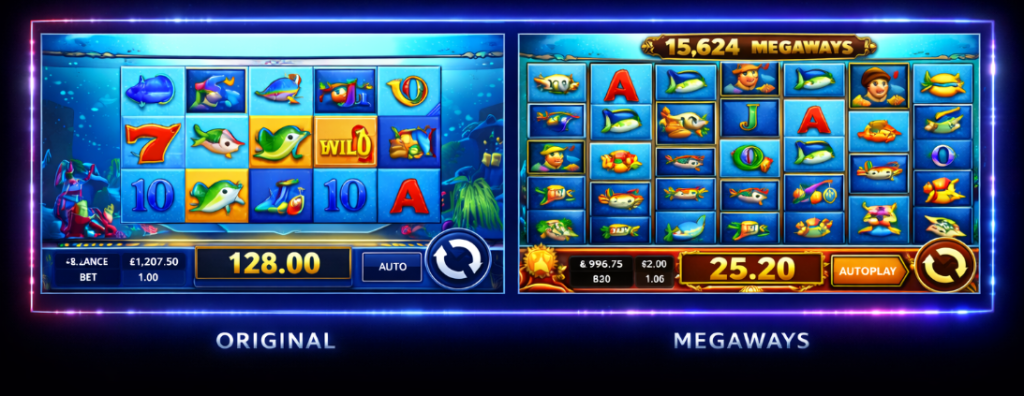
Design in the Fishin Frenzy series is not about decoration. It is about how information is delivered and how much effort is required to interpret each spin. These differences in user experience often matter more than mechanics alone.
The original Fishin Frenzy prioritises clarity. Symbols are large, outcomes are easy to read, and the screen rarely feels crowded. This reduces cognitive load and supports longer sessions without fatigue. The game does not rush the player or demand constant interpretation.
Megaways versions increase density. More symbols, changing reel heights, and frequent recalculations of outcomes create a busier screen. For players who enjoy processing information quickly, this adds energy. For others, it increases strain. The design choice is deliberate and aligns with the intended pace of play.
Big Catch versions use design to support progression. Visual cues inside the bonus help track development and maintain focus on the feature’s internal logic. Outside the bonus, the presentation remains familiar, preventing overload while preserving continuity.
Prize Lines approaches design differently. By altering how wins form and appear, it changes the act of reading the screen itself. This slows perception and encourages deliberate observation rather than immediate reaction.
Across the series, UX choices shape how long a player remains comfortable, how quickly fatigue appears, and how easily the game communicates its state. These factors quietly influence preference, often more strongly than players realise.
Understanding these design differences adds another layer to comparison. It explains not just what the games do, but how they feel to live with over time.
Entry Point: Which Fishin Frenzy Game Should You Start With?
Choosing an entry point into the Fishin Frenzy series matters more than most players expect. First impressions tend to shape how the entire series is perceived, and starting with the wrong version can easily create a false idea of what these games are designed to offer.
For a first encounter with Fishin Frenzy, the original game remains the most reliable starting point. Its structure is transparent, its rhythm is easy to follow, and nothing in its design competes for attention unnecessarily. It introduces the core identity of the series without distortion. Players learn how the base game behaves, how anticipation builds, and why the bonus round carries weight. This context becomes essential when exploring other versions later.
Starting with Megaways can be effective, but only for players who already know they prefer constant motion and visible variation. Without that preference, Megaways risks misrepresenting the series as faster and more demanding than it truly is. What feels exciting to one player may feel chaotic to another, particularly without a baseline for comparison.
The Big Catch line works best as a second or third step rather than a first. Its layered bonus logic assumes familiarity with the underlying concept. Without that familiarity, the progression inside the feature can feel abstract instead of rewarding. Once the foundation is understood, however, these versions offer a deeper way to engage with the series.
Prize Lines is best approached deliberately. It is not difficult, but it is different. Players who enjoy structural experimentation often appreciate it more after they understand the conventional layout first.
A good entry point does not promise the strongest experience. It provides the clearest one. From that clarity, the rest of the series becomes easier to navigate.
Common Myths About the Best Fishin Frenzy Game
Several persistent myths shape how players talk about the Fishin Frenzy series, and most of them obscure rather than clarify meaningful differences.
One of the most common beliefs is that Megaways versions are automatically better because they appear more complex. Complexity, however, is not value. For many players, constant variation reduces comfort and shortens sessions rather than improving them.
Another widespread assumption is that higher volatility always leads to a better experience. In reality, volatility only describes the shape of outcomes, not how those outcomes feel moment to moment. A smoother game can be more satisfying over time than one with sharper swings but less coherence.
There is also the idea that newer versions replace older ones. In the Fishin Frenzy series, this is simply untrue. Each release occupies its own role. The original remains relevant precisely because nothing else in the lineup replicates its restraint and clarity.
Finally, many players assume that the bonus defines the entire game. While the bonus is central, the base game determines how enjoyable the journey towards it feels. Ignoring that balance often leads to frustration, regardless of which version is chosen.
Letting go of these myths allows the series to be seen for what it is: a set of intentional designs rather than a competition for superiority.
FAQ: Fishin Frenzy Comparisons
FAQ
Fishin Frenzy comparisons and version differences
The original Fishin Frenzy. It offers the clearest structure, the most stable pacing, and the easiest introduction to the series.
No. Megaways focuses on constant variation, while the original prioritises stability and clarity. Each suits a different playing style.
Yes. Big Catch titles place more emphasis on progression within the bonus rather than on repeated base game cycles.
No. New versions expand the series instead of replacing earlier designs.
Not necessarily. Rhythm, pacing, and overall comfort often matter more than volatility alone.
No Best Game, Only the Right Fit
The Fishin Frenzy series is often approached with the wrong question. Players search for the best game as if the answer should be universal, fixed, and easy to apply. In reality, the series was never designed to produce a single dominant version. It was designed to explore the same idea through different forms of play.
Every Fishin Frenzy game is built around a specific rhythm. Some emphasise silence and anticipation, allowing long stretches of uneventful spins to exist without pressure. Others compress attention into constant variation, keeping the player engaged through movement rather than waiting. None of these approaches is inherently superior. Each one creates a different relationship between time, focus, and expectation.
This is why comparisons inside the series only make sense when they are grounded in behaviour. Mechanics, volatility labels, and feature lists explain very little on their own. What matters is how the game fills a session, how demanding it becomes over time, and how clearly it communicates its state to the player. A game that feels exciting in the first ten minutes may feel exhausting after forty. Another that seems uneventful at first may reveal its value only once the session settles.
The original Fishin Frenzy remains relevant because it offers restraint. It gives space for patience and allows the bonus to feel meaningful through contrast rather than frequency. Megaways versions exist because some players prefer constant motion and visible variation, even at the cost of calm. Big Catch titles shift attention towards structured bonus play, turning features into phases rather than moments. Prize Lines shows that familiarity does not require repetition, only a change in perspective.
None of these designs replaces the others. Together, they form a range of options that respond to different moods, different levels of attention, and different expectations from a session. The strength of the series lies precisely in this diversity.
The idea of a single best Fishin Frenzy game disappears once this is understood. What remains is a more useful framework: choosing the version that fits how you want to play right now. When that alignment is right, the game feels coherent and controlled. When it is wrong, even the most praised version feels uncomfortable.
Fishin Frenzy does not reward chasing the best title. It rewards understanding rhythm, recognising limits, and selecting the experience that matches your intention. That is not a shortcut, but it is the only comparison that truly holds.