
Big Splash Demo — Understanding the Game Before the Outcome
Pick a Fish: how the bonus is configured, not decorated
The Pick a Fish stage in Fishin Frenzy Big Splash is often presented as a simple pre-bonus choice. In practice, it is the moment where the entire bonus structure is defined. This choice does not guarantee outcomes, but it sets the behavioural frame of the Free Spins phase.
Each fish represents a different balance between:
- number of free spins
- multiplier potential
- pace of progression
Some configurations lean towards shorter bonuses with higher volatility, while others stretch the session and rely more on accumulation. The important point is that this decision changes how the bonus unfolds, not whether it pays.
In demo mode, this stage becomes especially valuable. Without financial pressure, it is easier to notice that different picks produce different rhythms. Some bonuses feel front-loaded, others take time before any real momentum appears. Over several demo bonuses, patterns begin to emerge — not in winnings, but in structure.
Pick a Fish is also where expectations are often misplaced. Choosing a “bigger” option does not automatically mean larger results. It means accepting a configuration that relies more heavily on successful collect sequences later in the bonus. When those sequences fail to form, the bonus can feel flat despite its apparent potential.
Viewed this way, Pick a Fish is less about optimism and more about selecting a bonus temperament. Demo play allows this to be tested repeatedly, without the urge to chase a particular result.
Quick Snapshot
Game Summary
| Provider | Blueprint Gaming |
|---|---|
| Volatility range | Medium–High |
| Max potential (x) | Up to 4,000x |
| Bonus structure type | Pick + Collect + Progress |
| Demo availability | Playable in-browser |
Free Spins phase: how Big Splash behaves once the bonus starts
Once Free Spins begin, Fishin Frenzy Big Splash shifts into its true form. The reels stop being about paylines and start functioning as a resource system, where value appears first and is only realised later.
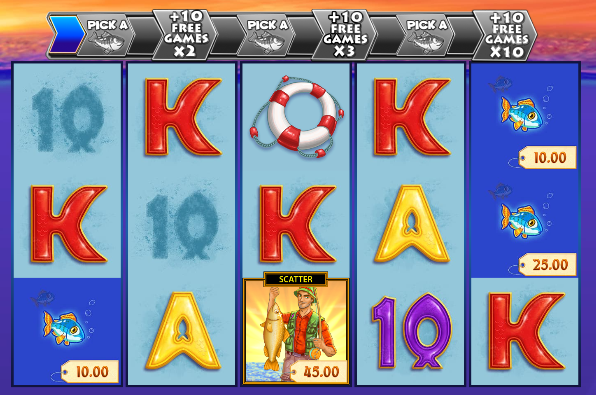
The key elements at work are:
- cash symbols with fixed or scaled values
- Fisherman symbols that collect those values
- a visible progression logic that rewards successful chains
The Fisherman symbol is central, but not dominant on its own. A Fisherman without meaningful values on the reels achieves very little. Likewise, high-value fish without a collect symbol remain unrealised. The bonus only comes together when timing aligns.
This creates a noticeable stop-start dynamic inside Free Spins. Some spins do almost nothing. Others suddenly consolidate several values at once. This contrast is intentional and forms the “splash” moments the game is named after.
As the bonus progresses, upgrades and multipliers may activate. These do not arrive randomly; they are tied to accumulation thresholds. When triggered, they change the scale of future collections rather than retroactively boosting past ones. This reinforces the idea that Big Splash rewards continuation, not isolated events.
In demo mode, this phase clearly shows why short sessions can be misleading. A single bonus can end quietly, while the next one — under the same settings — develops into a much stronger sequence simply because more pieces align before the spins run out.
What becomes clear over time is that Big Splash is not designed to peak instantly. Its Free Spins phase is structured to either build steadily or collapse early, depending on how quickly collect opportunities form. Demo play exposes this behaviour without exaggeration.
Multipliers and progress logic: where the Big Splash potential is actually formed
-
Collect Values
Value appears first (the bonus needs material).
-
Progress Threshold
Internal checkpoints that unlock development.
-
Multiplier Unlocked
Scales future collects — not retroactive.
-
Higher Impact Collections
Where progression converts into stronger outcomes.
In Fishin Frenzy Big Splash, multipliers are not decorative features added on top of wins. They are the result of successful progression within the bonus structure. This distinction matters, because it explains why the game often feels restrained early and explosive only in specific circumstances.
Multipliers typically enter the bonus after certain collection milestones are reached. Until that happens, the game operates in a relatively neutral state. Cash values are gathered, but their impact remains limited. Once a multiplier is unlocked, every subsequent collect changes in scale, not in frequency.
This creates a layered dynamic. Early Free Spins are about survival and setup. Later spins, if progression has been achieved, are where the bonus finally opens up. The game is not chasing one large symbol; it is waiting for the system to mature.
What is often misunderstood is that higher multipliers do not mean constant high payouts. They increase the weight of successful collections, but they do not increase how often Fisherman symbols appear. This keeps volatility controlled while still allowing for sharp upward swings when timing aligns.
From a demo perspective, this logic becomes easier to read. Without the emotional reaction to balance changes, it is clear that Big Splash rewards bonuses where:
- values appear consistently before collectors
- collectors arrive after sufficient accumulation
- multipliers activate early enough to affect multiple spins
When these elements fail to align, even a visually busy bonus can underperform. When they do align, results scale rapidly, sometimes within just a few spins. The “big splash” moment is not a trigger, but the outcome of sustained progression.
Over multiple demo sessions, this reveals a key trait of the slot: it is not chaotic. It is conditional. Large outcomes are possible, but only when the internal logic reaches its final phase.
Bonus Buy in demo mode: understanding the shortcut without confusing it for advantage
Bonus Buy in Fishin Frenzy Big Splash is often described simply as a faster way into Free Spins. In demo mode, however, it serves a more analytical purpose. It allows direct access to the bonus system without spending time in the base game, but it does not bypass the internal logic of the bonus itself.
The typical cost of Bonus Buy sits at a fixed multiple of the base bet, where available. This cost grants immediate entry into the Pick a Fish stage, followed by Free Spins under the selected configuration. What it does not provide is any guarantee of progression, multipliers, or strong collect sequences.
This is important, because Bonus Buy does not alter volatility. It compresses time, not outcomes. A weak bonus remains weak. A strong bonus still depends on how quickly the system begins to build.
In demo play, Bonus Buy is best used selectively. Running several bought bonuses in sequence makes it easier to compare how different Pick a Fish choices behave under similar conditions. It also highlights how often bonuses fail to progress beyond their early phase, even when accessed directly.
What Bonus Buy cannot show is long-term efficiency. Demo mode removes cost, so the price of repeated buys is not felt. As a result, it is easy to overestimate how “reliable” the bonus appears when viewed in isolation.
Used carefully, Bonus Buy in demo becomes a diagnostic tool. It exposes the range of bonus outcomes and clarifies how much of the game’s potential is locked behind progression rather than access. Used carelessly, it creates the illusion that entering the bonus is the same as unlocking its strongest phase, which is not the case.
In this sense, demo mode strips Bonus Buy of its marketing appeal and reveals it for what it really is: a shortcut into uncertainty, not a controlled path to high returns.
RTP and volatility: what demo mode shows, and what it cannot
Fishin Frenzy Big Splash is commonly associated with variable RTP settings, most often sitting around the mid-90% range depending on configuration. In demo mode, this number is largely abstract. What matters more is how volatility expresses itself through structure rather than statistics.
Big Splash operates with medium-to-high volatility, but not in the traditional sense of rare massive hits. Its volatility is layered. Periods of low activity are normal, even expected. These phases are not signs of malfunction; they are part of the game’s pacing.
Demo play reveals this clearly. Extended stretches without meaningful returns occur, especially in the base game. The bonus, once triggered, does not automatically compensate for this downtime. Some Free Spins end with minimal impact, while others gradually escalate. This uneven distribution is the core of the slot’s volatility.
What demo mode does well is show relative behaviour:
- how often bonuses fail to develop
- how frequently progression reaches multiplier stages
- how different Pick a Fish configurations affect the length and rhythm of bonuses
What it cannot show is long-term expectation. Short demo sessions exaggerate extremes. A run of poor bonuses can make the game feel harsher than it statistically is, while a single successful bonus can distort perception in the opposite direction.
Understanding this distinction prevents false conclusions. Demo mode is a behavioural lens, not a statistical guarantee. It allows observation of how Big Splash pays, not how much it pays over time.
Seen this way, volatility in Big Splash is not erratic. It is conditional, driven by whether the internal system has time to mature before the bonus concludes.
UX behaviour: how interaction changes the perception of the slot
User interaction plays a larger role in Fishin Frenzy Big Splash than many players realise. While the underlying mechanics remain fixed, the way the game is played directly affects how its pacing and logic are perceived.
Turbo spins and fast autoplay compress time. They do not change outcomes, but they remove the pauses that help contextualise what is happening. In Big Splash, this often makes the game feel more erratic than it actually is. Collect sequences appear sudden, progression feels abrupt, and bonus outcomes seem disconnected from what preceded them.
- Turbo
- Autoplay
- Compressed perception
- Manual spins
- Clear sequencing
- Readable progression
Slower play exposes structure. Watching values land before a Fisherman arrives, or seeing a bonus stall before suddenly upgrading, makes the system easier to read. In demo mode, this difference is particularly noticeable, because there is no incentive to rush.
Autoplay introduces another distortion. Long autoplay sequences flatten memory. Individual spins blur together, and only extremes stand out. This can lead to the impression that the game is either very generous or very dry, depending on the last few events.
Manual play, especially during Free Spins, restores granularity. It becomes easier to see why certain bonuses fail and others succeed. Patterns do not appear as predictions, but as repeated structural behaviours.
This does not make the game predictable, but it makes it intelligible. Big Splash rewards observation more than speed. Demo mode, when combined with deliberate pacing, allows the slot’s internal rhythm to surface without distraction.
Fishin Frenzy Big Splash vs Big Bass Splash: similar names, different logic
The similarity in names between Fishin Frenzy Big Splash and Big Bass Splash regularly causes confusion. From a distance, both appear to sit in the same thematic space: fishing visuals, collect-style bonuses, large splash moments. In reality, they are built on different design philosophies.
Big Splash vs Big Bass Splash
| Fishin Frenzy Big Splash | Big Bass Splash | |
|---|---|---|
| Bonus philosophy | Built as a conditional system: value accumulates first and only becomes meaningful when collectors and progression align. | Built for immediate impact: bonus flow is designed to show visible spikes and frequent hit moments quickly. |
| Progression role | Primary driver. Progression gates multipliers and determines whether the bonus opens up or collapses early. | Secondary driver. Progression exists, but the experience relies more on repeated collector presence and direct feedback. |
| Pacing | Slower, stop-start. Quiet spins are normal; splash moments are outcomes of buildup, not guarantees. | More front-loaded. Bonuses tend to feel busier earlier, with clearer short-term reinforcement. |
| Player expectation | Suited to players who value observation, structure, and patience through low-activity phases. | Suited to players who prefer faster feedback and more immediately visible volatility. |
Fishin Frenzy Big Splash follows a progression-driven model. Value is accumulated, collected, upgraded, and only then amplified. The bonus is not a single event, but a sequence that either develops or collapses depending on how the system aligns. Player choice at the Pick a Fish stage influences the structure of this sequence, even if outcomes remain unpredictable.
Big Bass Splash, by contrast, is designed around immediate impact. Its bonuses are more direct, often relying on repeated collector appearances and visible win spikes. Progression exists, but it plays a secondary role. The experience is more front-loaded, with clearer short-term feedback.
This difference matters most in demo play. A player expecting Big Bass-style behaviour from Big Splash may assume something is missing when bonuses fail to explode quickly. In reality, Big Splash is simply waiting for conditions to form. When they do not, the bonus ends quietly.
Understanding this distinction prevents misinterpretation. Big Splash is not a weaker version of a more popular game. It is a slower, more conditional system, built for players who value internal logic over immediate reinforcement.
Who the Fishin Frenzy Big Splash demo is actually for
The demo version of Fishin Frenzy Big Splash is not universally satisfying. It is not designed for instant gratification, nor does it reward short attention spans. Its value depends heavily on what the player is looking to understand.
This demo suits players who:
- are interested in collect-based bonus systems
- want to observe how progression influences outcomes
- prefer analysing bonus behaviour over chasing quick hits
It is particularly useful for those already familiar with the Fishin Frenzy series. Big Splash builds on familiar elements, but rearranges them into a more layered structure. Demo play allows this evolution to be seen clearly.
For players who judge a slot within a handful of spins, Big Splash may feel underwhelming. Its strongest moments often occur after patience has already been tested. Demo mode does not soften this. If anything, it exposes the game’s unwillingness to perform on demand.
This honesty is its strength. The demo does not attempt to impress; it reveals. Over time, it becomes clear that Big Splash is less about excitement per spin and more about how often the game allows its full system to activate.
For those willing to engage with it on those terms, demo play provides a clear and unfiltered view of what the slot truly offers.
FAQ — Fishin Frenzy Big Splash Demo
Is Fishin Frenzy Big Splash demo the same as the real game?
Can the demo version show how often big wins happen?
Does the demo version make bonuses easier to trigger?
Is Pick a Fish random or does it actually change something?
Are multipliers fixed or random in Big Splash?
Can I test Bonus Buy in demo mode?
Does RTP change in demo mode?
Is Fishin Frenzy Big Splash suitable for short sessions?
Is this game similar to Big Bass Splash?
What is the best way to use the demo version?
Final perspective: using Fishin Frenzy Big Splash demo with intent
Fishin Frenzy Big Splash demo is not designed to impress quickly. It does not try to win attention within the first few spins, and it does not reward impatience. This is deliberate. The game is built around a system that only reveals itself over time, and demo mode is the cleanest way to observe that system without interference.
What becomes clear after extended demo play is that Big Splash operates on internal conditions rather than visible triggers. Bonuses are not the end goal; they are the environment where the game’s real logic either activates or stalls. A bonus that ends quietly is not a failure of the game, but a demonstration of how fragile progression can be when timing does not align.
Demo mode allows this fragility to be seen clearly. Without the emotional weight of real stakes, it is easier to notice how often bonuses fail to mature, how frequently collect opportunities appear without collectors, and how progression sometimes arrives too late to matter. These outcomes are not anomalies. They are part of the design.
At the same time, demo play also shows why Big Splash can produce such sharp contrast between sessions. When accumulation happens early, when collectors arrive after sufficient value has formed, and when multipliers unlock while spins are still available, the game shifts rapidly. What felt restrained moments earlier suddenly opens up. These transitions are not random spikes; they are the logical conclusion of a system reaching its final phase.
Using the demo with intent means resisting the urge to draw conclusions too quickly. One or two bonuses are not representative. Neither are ten base game spins. The value of the demo lies in repetition and observation, not in outcome. Over time, patterns emerge — not predictive patterns, but structural ones. The player begins to recognise when a bonus is unlikely to develop and when it still has room to grow.
This perspective also reframes expectations. Big Splash is not a slot that pays steadily, and it is not one that delivers excitement on demand. It rewards patience and tolerance for low-activity phases. Demo play makes this unmistakably clear. Anyone expecting constant engagement will quickly feel friction. Anyone interested in how a layered bonus system behaves under different conditions will find clarity instead.
There is also an important psychological aspect to demo mode here. Without the pressure of balance management, the game’s pacing feels slower but more honest. Each phase has time to register. Each failure to progress becomes informative rather than frustrating. This turns the demo into a learning environment rather than a distraction.
Ultimately, Fishin Frenzy Big Splash demo serves as a filter. It does not persuade; it reveals. Players who enjoy analysing how value is built, collected, and amplified will recognise its depth. Those who rely on immediate feedback will likely move on. Neither reaction is wrong, but the demo makes the distinction early.
Seen this way, the demo is not a preview. It is the game, stripped of consequence. And in that state, Big Splash shows exactly what it is willing — and unwilling — to offer.