
Big Splash — Analytical Slot Architecture
How to Read Fishin Frenzy Big Splash Correctly
Fishin Frenzy Big Splash is a slot that is very easy to misjudge. When viewed superficially, it looks like a typical fishing-themed bonus game where everything depends on randomness. This is exactly how most players perceive it — and this is precisely why many end up disappointed.
The problem is that Big Splash does not respond to conventional slot logic.
The expectation that “the longer you play, the better your chances” does not apply here.
The idea that each bonus round should stand on its own does not apply either.
And what happens in the base game is almost irrelevant to the final outcome.
This is a slot where spins are not important — configurations are.
Big Splash is designed in such a way that meaningful results only appear when several internal conditions align within a single bonus cycle. When this alignment does not occur, a bonus can feel completely empty, even though all features have technically triggered.
This leads to a familiar pattern:
- the player spins for a long time with little happening,
- a bonus round is triggered,
- the result is minimal,
- and the conclusion is that the slot “does not pay”.
In reality, the slot is simply not required to pay in every bonus.
Its mathematics are built around a different principle: rare bonus windows with a high concentration of events.
For this reason, the key question is not how often the bonus triggers, but what actually happens inside it, and why in some cases a payout forms while in others it does not.
This page approaches Fishin Frenzy Big Splash as a system rather than a spectacle. There are no promises here, no romanticised interpretations, and no attempts to outplay the game — only an effort to understand how it works.
Slot Architecture Overview
At first glance, the architecture of Fishin Frenzy Big Splash appears deliberately simple. A standard 5×3 grid, a limited number of paylines, familiar symbols, and no complex base-game mechanics. All of this creates the impression that the slot is easy to read. In practice, the opposite is true.
The first point that must be clearly stated is this:
this slot does not distribute RTP evenly across its game modes.
A system-level map of what each layer is designed to do — and what it is not designed to deliver.
| Game Layer | Primary Function | What It Does NOT Do |
|---|---|---|
| Base Game Layer 1 | Separates bonus cycles | Does not build value |
| Bonus Entry Layer 2 | Configures volatility | Does not guarantee payout |
| Bonus Cycle Layer 3 | Allows interaction | Does not correct outcomes |
| Big Splash State | System state | Is not a feature |
The base game and the bonus mode serve entirely different purposes and cannot be evaluated using the same criteria.
Level One — Base Game (Isolation Phase)
The base game in Big Splash is not designed to demonstrate anything to the player. It:
- generates very little tension,
- does not build expectations,
- and does not reward persistence.
Its purpose is to separate bonus cycles from one another. This is why it feels empty and uneventful. This is not a flaw — it is a deliberate design choice.
Level Two — Bonus System (Concentration Zone)
All meaningful complexity begins only once the bonus is triggered. This is where:
- value accumulation appears,
- symbol interaction becomes relevant,
- and payout potential either forms or fails to form.
It is important to understand that the bonus in Big Splash does not guarantee a result. It merely opens a window in which the correct configuration may or may not emerge.
Level Three — Big Splash (Critical State)
Big Splash is not a mode and not a feature. It is a state in which:
- Fisherman symbols appear within the same bonus window,
- accumulated values are sufficiently high,
- and the system has time to collect them within a short sequence.
If even one of these elements is missing, the bonus feels weak.
When all of them align, the outcome can appear sudden and disproportionate compared to the rest of the session.
This architecture is the reason why Big Splash is often described as unstable. In reality, it is simply not designed around average outcomes. It is designed around extreme scenarios.
To understand this properly, it is necessary to begin with the least attractive but most important part of the game — the base game.
Base Game Analysis: The Waiting Phase
The base game in Fishin Frenzy Big Splash is one of the most commonly misunderstood elements of the slot. Many players treat it as a weak or poorly balanced part of the game, assuming that low engagement and sparse payouts indicate a flawed design. In reality, the opposite is true.
The base game is intentionally stripped down.
From a mathematical perspective, it carries very little strategic or emotional weight. Wins are infrequent, combinations are unremarkable, and there is almost no sense of momentum. This is not accidental. The base game is not designed to entertain or reward in a traditional sense — it is designed to create distance between bonus cycles.
In Big Splash, the base game functions as a waiting phase rather than an active playing field. Its role is to absorb spins without meaningfully redistributing RTP. By doing so, it allows the bonus system to remain highly concentrated without making the overall volatility unbearable.
This design leads to a specific behavioural effect.
During the base game:
- players receive little feedback,
- patterns are difficult to perceive,
- and individual spins feel interchangeable.
As a result, players often attempt to impose meaning where none exists — changing stakes, switching sessions, or attributing significance to small wins. None of these actions interact with the system in any meaningful way.
The base game does not store progress.
It does not “warm up” the bonus.
And it does not signal what will happen next.
Its sole purpose is temporal separation.
This separation is crucial. Without it, the bonus mechanics would feel either too frequent or too diluted. By keeping the base game deliberately quiet, the slot ensures that when a bonus finally triggers, it feels like a distinct event rather than a continuation of normal play.
Understanding this changes how the base game should be approached. It is not something to optimise or analyse in isolation. It is something to endure, not to engage with. Once this is accepted, much of the frustration associated with Big Splash disappears.
The real game does not start here. It merely waits here.
Bonus Entry Logic: Triggering and Configuring the Cycle
When a bonus round is triggered in Fishin Frenzy Big Splash, it is often described as a reward for persistence. This interpretation is misleading. The bonus is not a reward — it is an entry point into a different mathematical environment.
Triggering the bonus does not guarantee value. It merely grants access to a system where value may or may not form.
The first important thing to understand is that not all bonus entries are equal. The pre-bonus selection phase, often treated as a minor interactive moment, plays a structural role in shaping the upcoming cycle.
This is where configuration happens.
The Pick-A-Fish selection does not determine how much the player will win. What it determines is how the bonus is allowed to behave. Different selections bias the cycle towards:
- more Fisherman symbols,
- more value-bearing fish,
- or a longer time window in which interactions can occur.
How often “useful” symbols stack into the same window.
How much time the cycle has to form overlap.
How sharply results swing when alignment happens.
Minor tuning effects that do not change guarantees.
None of these options is inherently “better”. Each one simply shifts the internal balance between density, duration, and potential volatility.
A common mistake is to interpret this choice as an opportunity to maximise outcomes. In reality, it is an opportunity to select a volatility profile. Choosing incorrectly does not reduce the chance of a win — it changes the shape of the bonus itself.
Once the bonus begins, the system operates under strict constraints. There is limited time, limited space, and no guarantee that required elements will align. This is why many bonus rounds end with minimal returns: the configuration allowed interaction, but interaction never fully materialised.
Importantly, the bonus logic does not compensate for poor alignment.
There is no fallback payout.
There is no correction mechanism.
If the necessary elements do not appear within the allotted spins, the cycle simply ends.
This can feel harsh, but it is consistent. Big Splash does not smooth results across bonuses. Each cycle stands alone, evaluated solely on whether the internal conditions were met.
Understanding bonus entry logic reframes the entire experience. The question is no longer “Was this bonus good or bad?” but rather “What kind of bonus did the system allow this time — and did the conditions align?”
Only after this point does it make sense to analyse the Fisherman mechanic itself, because without the correct configuration, even the most powerful symbol cannot produce a meaningful result.
That is where we go next.
Fisherman Mechanic: The Core of Big Splash
The Fisherman symbol is often described as a Wild with added value collection. This description is technically correct, but analytically useless. In Fishin Frenzy Big Splash, the Fisherman is not a multiplier, not a booster, and not a guarantee of success. It is a conditional aggregator, and its effectiveness depends entirely on timing and context.
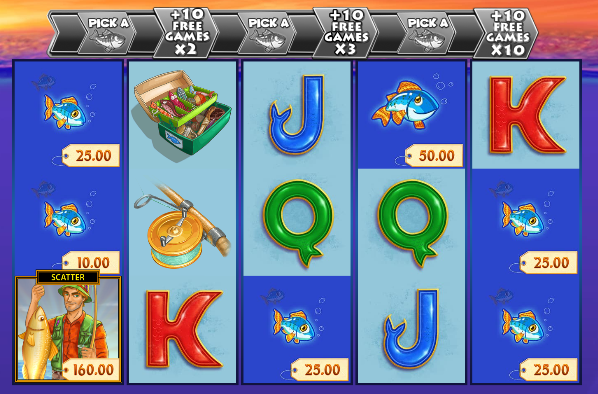
On its own, the Fisherman does nothing.
This is the first point many players fail to recognise. A single Fisherman appearing in a bonus round does not imply a strong result. Without accumulated values on the reels, there is nothing to collect. Without sufficient remaining spins, there is no opportunity for follow-up interaction.
The Fisherman does not create value — it extracts it.
Fish values in Big Splash behave like a temporary pool rather than independent payout symbols. They appear, linger briefly, and either get collected or disappear without consequence. The Fisherman’s role is to intercept this pool at the right moment. If the interception fails, the system does not retry.
This creates a very specific dependency:
- value must exist,
- Fisherman symbols must appear,
- and both must overlap within a narrow time window.
What makes this mechanic particularly deceptive is its clustering behaviour. Fisherman symbols tend not to appear evenly across a bonus. Instead, they often arrive in short bursts. When this burst coincides with high accumulated values, the result can look dramatic. When it does not, the bonus collapses quietly.
This is why Big Splash outcomes often feel extreme.
Nothing happens — and then everything happens at once.
It is also why analysing Fisherman frequency in isolation is meaningless. What matters is density, not count. Two Fisherman symbols in consecutive spins can be more significant than five spread across an entire bonus.
From a design perspective, this mechanic serves a clear purpose. It allows the slot to produce high-impact moments without increasing average payout frequency. The Fisherman compresses value into short sequences, creating the illusion of volatility spikes rather than a steady curve.
Understanding this reframes the symbol entirely. The Fisherman is not something to hope for. It is something that only matters when the system is already ready.
Bonus Cycle Analysis: How Payouts Are Formed
A bonus round in Fishin Frenzy Big Splash should not be evaluated as a single event. It is more accurate to think of it as a closed cycle with a fixed lifespan and no memory.
Each bonus cycle begins with a configuration, unfolds through a limited number of spins, and ends without carrying anything forward. There is no accumulation between bonuses, no progressive behaviour, and no long-term correction.
Within this cycle, payouts are formed through coincidence rather than progression.
The system does not build gradually towards a result. Instead, it waits for a short interval in which multiple conditions align:
- sufficient fish values on the reels,
- Fisherman symbols appearing in close proximity,
- and enough remaining spins to allow collection.
When this alignment occurs, the payout is released almost immediately. When it does not, the bonus expires with little to show for it.
This explains why Big Splash bonuses often fall into recognisable categories:
- Empty cycles, where interaction never meaningfully begins.
- Partial cycles, where value appears but is poorly timed.
- Compressed cycles, where most of the bonus value is delivered in a few consecutive spins.
No alignment
The cycle runs, but the required overlap does not form.
Value appears
The pool forms, but it still needs a collector in time.
Fisherman cluster
Density arrives in a tight window — the compression moment.
Collection
Value is extracted at once. The cycle resolves quickly.
The third category is what players usually remember. The first two are far more common, but far less memorable.
Importantly, the system does not attempt to balance these outcomes across sessions. A weak bonus is not “owed” a strong one later. Each cycle is self-contained and indifferent to previous results.
This design choice reinforces the slot’s identity. Big Splash is not meant to feel fair on a short horizon. It is meant to feel intermittently intense.
From an analytical standpoint, this also means that average values are misleading. The meaningful metric here is not expected return per bonus, but distribution shape — how often results cluster at the extremes.
Once this is understood, much of the emotional volatility disappears. The slot stops feeling inconsistent and starts feeling predictable in a different way: predictable in its refusal to smooth outcomes.
With the bonus cycle structure clear, the next step is to address the concept that gives the slot its name — and why it is so often misunderstood.
Big Splash Explained: A State, Not a Feature
Big Splash is not a feature.
It is a state that can only be identified after it occurs.
The term “Big Splash” is one of the most misleading elements of this slot. It suggests a feature, a trigger, or a clearly defined event that players can anticipate. In practice, none of this is true.
Big Splash is not a mode.
It is not a bonus within a bonus.
And it is not something the game decides to “activate”.
Big Splash is a state of the bonus system, reached only when several internal conditions overlap within a very limited timeframe.
This distinction matters, because it explains why Big Splash cannot be forced, predicted, or consistently repeated. The slot does not contain a switch labelled “Big Splash”. What it contains is a set of mechanics that, under certain circumstances, briefly align in a way that produces a visibly outsized result.
Those circumstances are narrow:
- accumulated fish values must already be present,
- Fisherman symbols must appear with sufficient density,
- and the collection must occur before the bonus window closes.
If any of these elements are missing or mistimed, the state never forms — even though the bonus technically ran as intended.
This is why players often describe Big Splash as “random” or “inconsistent”. From the outside, it looks like an unpredictable spike. From the inside, it is simply a rare configuration that the system does not attempt to reproduce or protect.
Another important point is that Big Splash is retrospective. It can only be identified after it has already happened. There is no reliable in-bonus signal that confirms a Big Splash is coming. By the time it becomes obvious, the outcome is already locked in.
This also explains a common misconception: that visual intensity equals payout potential. In Big Splash, visual effects often lag behind the actual mathematical decision. The splash is a presentation layer, not the decision point.
Understanding Big Splash as a state rather than a feature removes a great deal of unnecessary expectation. It reframes the slot from something that should regularly deliver “big moments” into something that occasionally allows them — without obligation or pattern.
Volatility and Risk Profile
Fishin Frenzy Big Splash is frequently described as a medium or medium-high volatility slot. While this classification is not incorrect, it is incomplete. Volatility here is not just a matter of payout size — it is a matter of payout distribution.
This slot concentrates risk in very specific areas.
Most spins, including most bonus rounds, resolve with minimal impact. A small number of cycles account for a disproportionate share of the total return. This creates a volatility profile that feels uneven even when mathematically consistent.
From a practical standpoint, this has several implications.
First, bankroll requirements are higher than they appear. Because the base game absorbs long stretches of spins with little return, short sessions are particularly vulnerable to variance. Players expecting frequent feedback are likely to experience frustration rather than engagement.
Second, emotional volatility closely mirrors mathematical volatility. Long neutral phases are followed by abrupt outcome resolution, with very little in between. This design rewards patience only in a statistical sense, not in a psychological one.
Third, Big Splash is poorly suited to risk-averse playstyles. There is no mechanism to smooth losses or to stabilise results over time. The slot does not reward cautious adjustment or incremental optimisation. It either aligns — or it does not.
Compared to other entries in the Fishin Frenzy series, Big Splash pushes further towards the extreme end of this spectrum. Earlier versions tend to distribute value more evenly across bonuses. Big Splash sacrifices that balance in exchange for sharper peaks.
This does not make it better or worse. It makes it more specific.
Understanding this risk profile is essential before attempting to evaluate performance, strategy, or suitability. Without it, the slot feels unfair. With it, the behaviour becomes clear — even if the outcomes remain uncompromising.
Session Logic and UX Perspective
Not signal-driven
Short-term “patterns” in base game do not indicate an approaching payoff.
Not momentum-based
A few quiet or active spins do not “build” anything by themselves.
Session-bound
What matters is how a session catches a bonus window, not what happened before it.
Outcome-compressed
Results concentrate inside short cycles; long waiting stretches are normal.
Once the internal mechanics of Fishin Frenzy Big Splash are understood, the way the slot should be approached at a session level changes significantly. Many frustrations associated with this game come not from volatility itself, but from a mismatch between session expectations and system behaviour.
Big Splash is not designed for extended, uninterrupted play. Its architecture actively resists the idea of a smooth, continuous session. Long neutral stretches are not an anomaly — they are the default state. As a result, long sessions often amplify fatigue rather than insight.
From a UX perspective, the slot operates on a tension–release imbalance:
- tension accumulates slowly and quietly,
- release, if it happens at all, is abrupt and final.
There is very little in-between.
This has practical consequences. Short sessions often end before any meaningful configuration can even form, making the slot feel unresponsive. Long sessions, on the other hand, expose the full weight of variance, with most time spent in non-eventful phases.
The slot does not reward attentiveness during play.
It does not respond to timing, pacing, or adjustment.
And it offers no feedback that can be acted upon.
This creates a specific UX pattern: the player is encouraged to wait without being given tools to evaluate when waiting makes sense. The interface remains visually active, but informationally silent.
In this context, the most effective way to approach Big Splash is not to search for signals, but to accept session boundaries. Treating each session as a finite experiment rather than an open-ended pursuit aligns far better with the way the system resolves outcomes.
Big Splash is not designed to feel engaging moment by moment. It is designed to make the end of a session feel disproportionately significant compared to everything that came before it.
Understanding this removes much of the unnecessary friction. The slot becomes easier to tolerate — not because it becomes generous, but because it becomes predictable in how little it communicates during play.
Pseudo-Strategy: How to Think, Not How to Play
Any discussion of strategy in Fishin Frenzy Big Splash must begin with a clear limitation: there is no actionable strategy that alters outcomes. The slot does not respond to behaviour, timing, or decision-making in a way that can be reliably exploited.
What can be adjusted is not the result, but the interpretation of the result.
A pseudo-strategic approach to Big Splash is therefore cognitive rather than mechanical. It focuses on expectation management, not optimisation.
The first principle is to abandon the idea of momentum. Big Splash does not build towards outcomes across spins or sessions. Each bonus cycle is isolated. Treating weak bonuses as steps towards a stronger one leads only to misinterpretation.
The second principle is to decouple bonus frequency from bonus value. A frequently triggered bonus is not a positive signal, and a rare bonus is not a negative one. Frequency and quality are intentionally uncorrelated in this system.
The third principle is to accept asymmetry. Most of the slot’s total return is delivered through a small number of highly compressed events. Expecting balance on a short horizon contradicts the design.
Finally, it is important to recognise when analysis ends and projection begins. Big Splash provides just enough structure to be understood, but not enough to be controlled. Confusing these two levels is where most frustration originates.
A correct mental model does not make the slot more profitable. It makes it less deceptive.
When approached with this mindset, Fishin Frenzy Big Splash stops being a game of anticipation and becomes a study in distribution. Whether that is appealing or not depends entirely on the reader — and not at all on the slot.
FAQ — Common Questions About Fishin Frenzy Big Splash
FAQ — Big Splash
No. Big Splash cannot be predicted in advance because it is not a triggered feature. It is a state that only becomes visible after several internal conditions have already aligned within a bonus cycle. There are no reliable signals that confirm its arrival beforehand.
Because the bonus system does not guarantee value. A bonus opens a window of opportunity, not a payout. If Fisherman density, accumulated values, and timing do not overlap within that window, the cycle ends without a meaningful result.
The Buy Feature does not improve payout quality. It only bypasses the base game and forces entry into a bonus configuration. The same internal constraints apply, and the same distribution of outcomes remains.
Yes, but not in the traditional sense. Outcomes are clustered within short bonus windows, not across sessions. These clusters can feel like streaks, but they are the result of compressed bonus cycles rather than sustained momentum.
Big Splash concentrates more of its RTP into fewer, sharper bonus moments. Earlier versions tend to distribute value more evenly across bonuses. Big Splash sacrifices consistency in favour of intensity.
A quick honesty check before the conclusion — useful for decision-making, not persuasion.
- High variance tolerance Comfortable with uneven sessions and compressed outcomes.
- Bonus-focused players Prefers short windows where results concentrate.
- Low-risk playstyles Prefers smoother sessions and frequent small feedback.
- Long grind sessions Expecting steady progression instead of cycle windows.
Understanding Fishin Frenzy Big Splash as a System
Fishin Frenzy Big Splash is not a slot that rewards optimism, persistence, or intuition. It does not respond to belief, pattern recognition, or session management in any traditional sense. Instead, it responds only to internal alignment — and even then, without obligation.
Throughout this analysis, one principle remains consistent: this is a slot built around distribution, not progression.
The base game exists to create distance, not engagement.
The bonus exists to allow interaction, not to guarantee reward.
The Fisherman exists to extract value, not to generate it.
And Big Splash exists only as a consequence, never as an intention.
When these elements are viewed in isolation, the slot appears erratic and often disappointing. When they are viewed together, as parts of a single system, the behaviour becomes clear — even if the outcomes remain uncompromising.
Big Splash does not attempt to feel fair in the short term. It does not aim to maintain emotional balance or deliver consistent feedback. Instead, it compresses most of its meaningful output into a small number of highly specific moments, surrounded by long periods of functional silence.
This is why the slot divides opinion so sharply.
For some players, this structure feels hostile. The lack of reinforcement, the frequency of weak bonuses, and the absence of visible progress create frustration. For others, the same structure feels honest. There are no illusions of control, no false sense of momentum, and no attempt to disguise variance as skill.
Understanding Fishin Frenzy Big Splash does not improve results. It improves expectations.
Once the slot is recognised as a system that either aligns or does not, the emotional narrative changes. Losses stop feeling personal. Wins stop feeling deserved. Outcomes become what they are: expressions of a distribution model designed around extremes.
This does not make the slot better.
It makes it transparent.
Fishin Frenzy Big Splash is a slot of moments, not of flow. It offers intensity instead of rhythm, compression instead of continuity, and silence instead of reassurance. Whether that is appealing depends entirely on the reader — and not at all on the mechanics.
The most common mistake is to approach it as something it is not.
The most accurate approach is to accept it exactly as it is.
And once that acceptance is in place, the slot no longer needs to be justified — only understood.