
Big Catch — How the Bonus Escalation Really Works
A clean snapshot before the deep analysis.
Sequel / Bonus Escalation
Built around a progressive Free Spins system rather than a high-action base game.
Free Spins Progression
Fish values are stored potential — the feature is about collection and escalation thresholds.
Blueprint Gaming
The studio behind the Fishin’ Frenzy line and its sequel-style bonus variations.
What “Big Catch” Actually Means in This Sequel
Free Spins Trigger
The bonus starts in a baseline state. Early spins set the floor before the system can refine outcomes.
Accumulation Phase
Fish symbols behave like stored value. The screen may look loaded, but nothing is realised until collected.
Fisherman Threshold
Collection events define progression. Reaching key Fisherman milestones moves the feature forward.
Bonus Optimisation
Weak outcomes are reduced, raising the bonus floor rather than chasing high but unstable peaks.
Big Catch State
The bonus reaches its most efficient configuration, with consistently high-value fish potential.
Within the Fishin Frenzy series, the title “Big Catch” is often misunderstood. Many players interpret it as a promise of frequent large wins or as a purely marketing-driven continuation of the original slot. In reality, The Big Catch is not a promise at all — it is a defined internal state of the bonus system. Understanding this distinction is essential if you want to understand how this game truly works.
Blueprint Gaming did not design this sequel to dramatically change the base mechanics or visual identity of Fishin Frenzy. Instead, they focused on restructuring the logic of value creation inside the bonus round. The phrase “big catch” refers to a specific outcome that can only be reached after passing through several internal stages of escalation during free spins. The slot is not designed to deliver immediate excitement; it is designed to build value gradually by removing weak outcomes from the bonus environment.
This approach places Fishin Frenzy: Big Catch in a different category from many modern slots. Rather than relying on constant volatility or frequent bonus retriggers, it operates on a controlled progression model. The player is not chasing random spikes. Instead, the game attempts — over the course of a single bonus session — to improve the quality of potential outcomes by design.
In practical terms, The Big Catch represents the moment when the bonus round has reached its most optimised state. Getting there is neither common nor guaranteed. Most bonus rounds end before this stage is achieved, and that is intentional. The structure is built to reward persistence within a single bonus, not to deliver instant results.
Core Game vs Bonus Game: Where the Value Is Really Built
| Element | Base Game | Free Spins |
|---|---|---|
| Role | Setup layer | Value creation |
| Volatility | Low | Structured |
| RTP Contribution | Minimal | Dominant |
| Player Impact | Passive | Progressive |
One of the most common mistakes when evaluating Fishin Frenzy: Big Catch is judging the slot based on its base game. When viewed in isolation, the core game can feel underwhelming, slow, or even unrewarding. This perception is not accidental — it is a deliberate design choice.
Base Game as a Bonus Preparation Layer
The base game functions primarily as a preparation layer, not as a profit-generating engine. Wins are generally modest, symbol behaviour is predictable, and there is very little volatility. This creates a clear message: the base game is not where this slot expresses its full potential.
Rather than spreading value evenly across all spins, Blueprint Gaming concentrated the majority of the slot’s expected return into the bonus phase. The base game exists to pace the experience, regulate bankroll depletion, and funnel the player toward free spins without artificially inflating expectations.
From a mathematical perspective, this structure reduces noise. The player is not distracted by constant medium wins that mask the underlying volatility. Instead, the slot feels quiet for long periods, punctuated by moments where the bonus round takes over as the dominant value driver.
Why Most of the RTP Lives Inside Free Spins
The advertised RTP of Fishin Frenzy: Big Catch is not realised through steady accumulation. It is realised through rare bonus sessions that reach advanced escalation stages. This means that many players experience long stretches of low engagement before encountering a bonus that feels meaningful.
This design creates a mismatch between expectation and experience for players who are unfamiliar with escalation-based bonus systems. Without understanding the structure, it can feel as though the game is withholding value. In reality, value is simply being concentrated into fewer, more decisive moments.
Free spins are not merely a reward for triggering a bonus. They are the environment in which the game’s real mechanics operate. Everything that matters — accumulation, collection, upgrading, and potential peak outcomes — happens there.
Free Spins Structure: Not Random, but Layered
The free spins feature in Fishin Frenzy: The Big Catch is often described as simple. In practice, it is anything but. While the visuals and symbol set appear straightforward, the bonus is built as a layered system with internal progression rules.
Trigger Conditions and Initial Setup
When free spins are triggered, the bonus does not begin in a favourable state. Fish symbols appear with relatively low values, and early spins frequently produce little or no immediate return. This is not a sign of a weak bonus; it is the baseline configuration from which progression begins.
The early stage of the bonus is designed to establish context. It sets a low starting floor so that later upgrades have meaningful impact. Expecting strong results immediately after triggering free spins often leads to frustration, but this expectation is based on misunderstanding rather than bad luck.
Fish Symbols as Stored Value
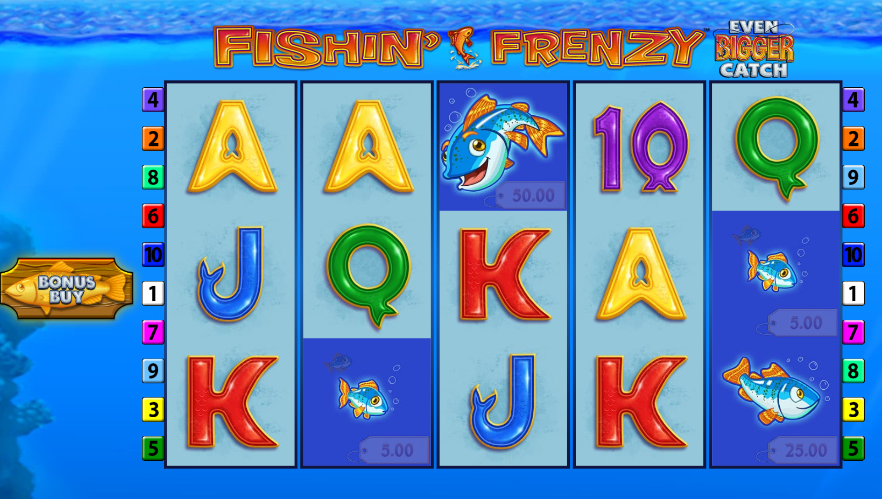
Fish symbols in this slot should not be interpreted as instant wins. They represent stored value, not realised profit. Until they are collected, they exist only as potential.
This mechanic is central to the psychological experience of the bonus. The screen may appear full of value, yet the balance remains unchanged. This creates tension and forces the player to focus on the appearance of collection symbols rather than the quantity of fish alone.
By separating visual value from actual payout, the game maintains suspense while controlling volatility. Nothing is paid out prematurely, and every meaningful gain must pass through a specific conversion step.
Fisherman Symbol: The Collect Mechanism
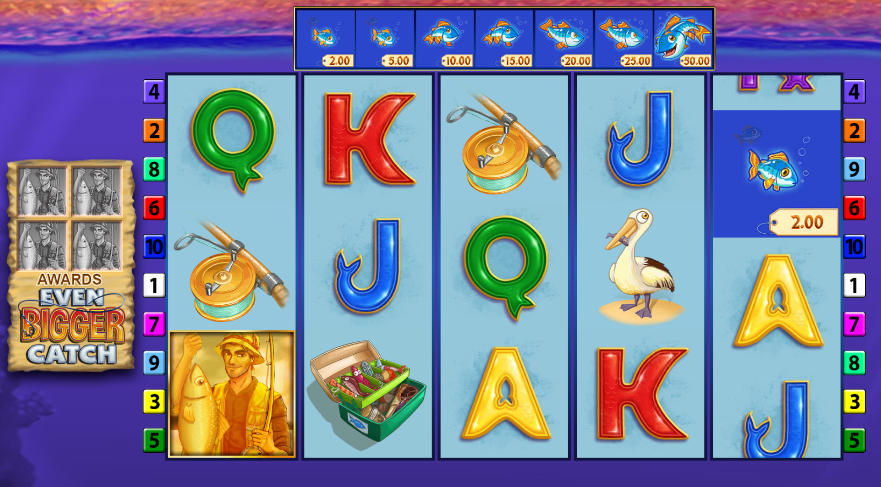
The Fisherman symbol is the most important element in Fishin Frenzy: The Big Catch. It acts as the conversion point between potential and realised value. When the Fisherman appears, all fish values currently on the screen are collected and paid.
Without the Fisherman, the bonus can feel stagnant, regardless of how many fish symbols are present. This is intentional. The game is structured around the idea that collection events, not symbol density, define success.
The appearance of Fisherman symbols also acts as a trigger for deeper progression mechanics later in the bonus. Their role goes beyond simple collection and becomes central to escalation, upgrades, and the eventual possibility of reaching the Big Catch state.
The 4-Fisherman Threshold: Why This Number Matters
Collect only
The symbol acts as a converter: fish values become a payout, but the bonus structure itself stays unchanged.
Accumulation continues
Stored value can build across spins, but outcomes still depend on future collection events to realise it.
Lowest fish removed + extra spins
This is the structural shift. Weak outcomes are reduced and the bonus gets more time to operate in a cleaner, higher-value environment.
One of the most important mechanics in Fishin Frenzy: The Big Catch is also one of the least explained. The game places a clear structural emphasis on the appearance of four Fisherman symbols within a single bonus round. This is not an arbitrary number, nor is it a simple reward trigger. It represents a threshold where the internal logic of the bonus begins to change.
Until this point, the free spins feature operates in a neutral or even fragile state. Fish values remain relatively low, and outcomes are highly dependent on occasional collection events. Once the fourth Fisherman is reached, the bonus enters a new phase where value is no longer just accumulated — it is refined.
Removing the Lowest Fish: How the Bonus Floor Is Raised
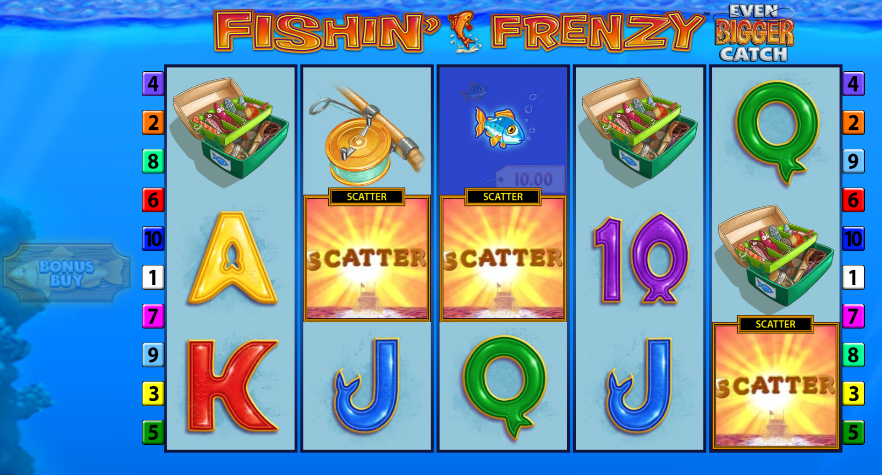
When the four-Fisherman threshold is crossed, the game removes the lowest-value fish symbol from the bonus environment. This single action fundamentally alters the mathematics of the feature. Instead of increasing volatility through higher peaks, the slot raises the minimum possible outcome of future collections.
This mechanic is subtle but powerful. By eliminating weak values, the game ensures that every subsequent Fisherman appearance has a higher expected return. The bonus becomes less about chance and more about progression. Each successful escalation step improves the quality of the bonus rather than simply extending its duration.
From a design perspective, this is a controlled form of risk reduction. The player is not guaranteed a strong result, but the worst possible outcomes are gradually removed from the equation. Over time, the bonus environment becomes cleaner, more focused, and more rewarding.
Extra Free Spins as Fuel, Not a Reward
At the same escalation point, the player is often awarded additional free spins. These spins are frequently misunderstood as a simple bonus. In reality, they serve a functional purpose. Extra spins act as fuel for the upgraded bonus state, giving the game more opportunities to capitalise on the improved value structure.
Without these extra spins, the escalation would have limited impact. With them, the game extends the window during which higher-quality outcomes can occur. This reinforces the idea that Fishin’ Frenzy: The Big Catch is not about sudden wins, but about giving upgraded systems time to operate.
Reaching the “Big Catch” State
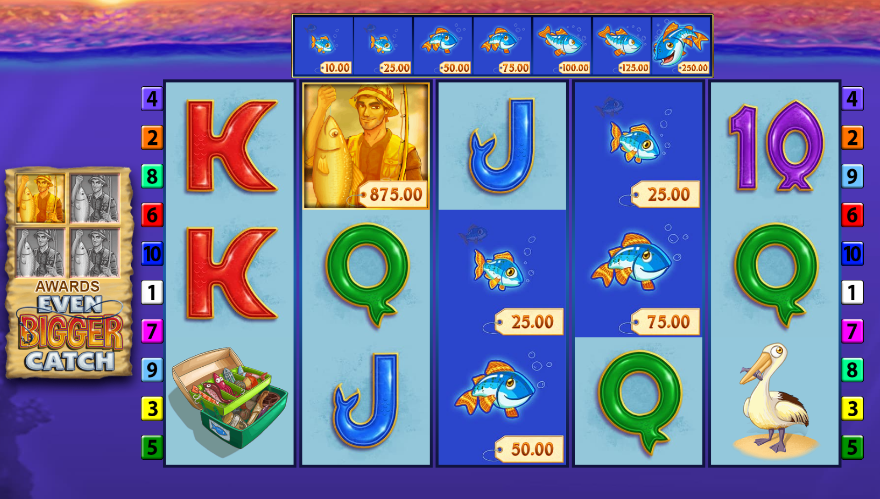
The term “The Big Catch” refers to a specific condition within the bonus round, not a general feeling of success. It describes the point at which all remaining fish symbols reach a fixed, high value, representing the most optimised version of the free spins environment.
When All Fish Become The Big Catch
If enough escalation steps are achieved, the bonus reaches a state where every fish symbol carries the same elevated value. At this stage, the structure of the feature changes dramatically. Variance between outcomes is reduced, and each collection event becomes consistently meaningful.
This is not a random transformation. It is the result of multiple internal upgrades that remove weaker elements and stabilise the value pool. When the Big Catch state is reached, the bonus has effectively completed its progression cycle.
Why This Is a Rare but Designed Outcome
It is important to understand that most bonus rounds will not reach this state. The game is designed so that the Big Catch represents the upper boundary of a successful escalation, not a standard result.
This rarity serves two purposes. First, it preserves long-term balance by preventing excessive payouts. Second, it creates a sense of narrative progression within the bonus. Players often feel that they were “close” to reaching the final state, which reinforces engagement without guaranteeing results.
Volatility and Perceived Risk in The Big Catch
Fishin Frenzy: The Big Catch often feels safer than it actually is. This perception comes from the structure of the base game and the visual clarity of the bonus mechanics. In practice, however, the slot operates with concentrated volatility.
Why the Slot Feels Low-Risk but Isn’t
The base game provides stability and predictability, which can mask the true risk profile of the slot. When the bonus triggers, the early stages often deliver little immediate value, reinforcing the illusion of control.
However, the real volatility lies in whether the bonus successfully escalates. Bonuses that fail to reach higher thresholds can end with modest returns, while those that progress further can deliver disproportionately stronger outcomes.
Player Misinterpretation of RTP
Many players assume that a slot with frequent bonuses will feel generous. In Fishin Frenzy: The Big Catch, frequency does not equal value. The RTP is realised through structural progression, not through repetition.
Without understanding where and how value is generated, players may misjudge the slot’s fairness. The game does not hide its mechanics, but it does require patience and context to be properly understood.
RTP, Max Win, and Version Variations
Long-term return calculated over a very large number of spins.
Theoretical upper limit defined by the game’s math model, not a realistic target.
RTP variation chosen by the operator, while the core game structure remains unchanged.
Discussions around Fishin Frenzy: The Big Catch often become confused once numerical values enter the picture. RTP figures differ from site to site, maximum win claims vary widely, and players are left trying to reconcile conflicting information. This confusion is not unique to this slot, but the structure of The Big Catch makes it particularly important to approach these numbers with caution.
Why Different Sites Show Different Numbers
Blueprint Gaming releases its slots with multiple RTP configurations, allowing operators to select the version that best suits their platform. As a result, two players can be playing the same game with noticeably different long-term return profiles.
This does not mean that one source is “wrong” and another is “right”. It simply reflects how modern slot distribution works. Public-facing review sites often list the highest available RTP, while the version encountered in practice depends entirely on the casino’s chosen configuration.
For analytical purposes, the exact RTP percentage matters less than how that RTP is distributed. In The Big Catch, return is not spread evenly across spins. It is compressed into bonus scenarios that successfully progress through escalation stages. Understanding this structure provides far more insight than focusing on a single headline number.
What the Maximum Win Figure Actually Represents
Maximum win values are another frequent source of misunderstanding. They represent a theoretical upper limit, achievable only under extremely specific conditions. In a slot like The Big Catch, this typically involves reaching the most advanced bonus state and triggering multiple high-value collection events.
In practical terms, the maximum win is not a target. It is a boundary condition. What matters more is the range of realistic bonus outcomes, which is determined by how often escalation thresholds are reached, not by the existence of a distant ceiling.
Players who fixate on maximum win figures often misjudge the slot’s behaviour. The Big Catch is not designed to regularly approach its upper limit. It is designed to offer occasional structured progression with controlled risk.
Big Catch Within the Fishin Frenzy Sequel Line
Fishin’ Frenzy
Straightforward collect loop with familiar pacing.
The Big Catch
Bonus progression that refines outcomes through thresholds.
Big Catch 2 / Megaways
More variance and/or more influence over the symbol mix.
To fully understand Fishin Frenzy: The Big Catch, it helps to view it within the broader context of the series. Each sequel builds on the same thematic foundation but explores different approaches to value generation and player control.
Big Catch vs the Original Fishin Frenzy
The original Fishin Frenzy is built around straightforward collection mechanics. Fish appear, Fisherman collects, value is paid. The experience is relatively flat, with limited progression inside the bonus.
The Big Catch shifts the focus from collection frequency to bonus quality over time. Rather than rewarding the player for triggering the bonus alone, it introduces internal milestones that determine how valuable that bonus ultimately becomes. This change makes the experience more layered, but also more demanding in terms of patience.
Big Catch vs Big Catch Megaways and Big Catch 2
Later entries in the series experiment with different dimensions of the same idea. The Megaways version increases outcome variability by expanding the reel structure, while Big Catch 2 introduces mechanisms that allow players to influence symbol distribution at a higher cost.
Compared to these, the original Big Catch occupies a middle ground. It does not offer direct control or extreme volatility. Instead, it relies on internal optimisation within the bonus itself. This makes it feel more restrained, but also more coherent as a system.
From a design perspective, The Big Catch represents a point where the series focused less on scale and more on process.
How to Read This Slot as a System
Read the session by phase, not by individual spins.
Fishin Frenzy: The Big Catch is often approached as a game that can be “figured out” through pattern recognition or short-term adjustments. This mindset usually leads to frustration. The slot does not reward tactical decisions; it rewards understanding of structure.
When the Slot Is Still in Setup Mode
During extended base game sessions or early bonus stages, the slot is effectively in setup mode. Nothing meaningful has happened yet, and no conclusions should be drawn. These phases exist to create contrast and to regulate pacing.
Attempting to interpret outcomes at this stage often leads to false assumptions. The absence of value does not indicate a negative trend; it simply reflects the design of the system.
When the Bonus Enters an Escalation Phase
Escalation phases are defined not by excitement, but by structural changes. The removal of low-value fish, the extension of free spins, and the stabilisation of collection outcomes signal that the bonus is operating in a higher-value environment.
Even at this stage, results are not guaranteed. The system has improved its internal conditions, but it still depends on specific symbols to convert potential into payout.
Why There Is No Way to Force the Big Catch
The most important takeaway is that The Big Catch cannot be forced. No betting pattern, timing adjustment, or session length can guarantee progression to the final bonus state.
This is not a flaw. It is the core principle of the slot’s design. The game offers a structured opportunity for escalation, not a predictable path to a fixed outcome. Players who understand this tend to evaluate the slot more accurately and engage with it on its own terms.
Who Fishin Frenzy: Big Catch Is Really For
Fishin Frenzy: Big Catch is not designed to appeal to every type of player, and it does not attempt to do so. Its structure favours a specific mindset — one that is comfortable with delayed gratification and understands that not every bonus trigger is meant to be memorable.
This slot is best suited to players who are interested in process rather than immediacy. Those who enjoy observing how a bonus develops over time, how internal thresholds alter potential outcomes, and how value is refined rather than randomly distributed will find The Big Catch engaging on a structural level.
By contrast, players who seek constant stimulation, frequent medium wins, or a sense of momentum in every session may find the game unsatisfying. The base game offers little reassurance, and many bonus rounds end before reaching meaningful escalation. This is not a failure of design; it is a deliberate trade-off.
In essence, Big Catch rewards understanding more than optimism. It does not punish impatience directly, but it offers no compensation for it either.
Process-first players
You enjoy systems that reveal themselves over time.
- Comfortable with quiet stretches
- Interested in how the bonus evolves
- Reads value through phases, not spins
- Accepts that not every trigger is memorable
Momentum-first players
You prefer constant feedback and frequent medium wins.
- Needs steady action to stay engaged
- Expects most bonuses to deliver value
- Dislikes delayed conversion mechanics
- Interprets quiet phases as a negative trend
Final Thoughts: Understanding the Slot on Its Own Terms
Fishin Frenzy: Big Catch is often misjudged because it looks familiar. The theme, symbols, and core mechanics closely resemble the original Fishin’ Frenzy, which leads many players to expect a similar experience. In reality, this sequel operates under a different internal philosophy.
The defining feature of The Big Catch is bonus escalation through refinement, not through expansion. Instead of adding more features, more symbols, or more volatility, the game focuses on improving the quality of what already exists within a single bonus session. Weak outcomes are gradually removed, and only under specific conditions does the bonus environment reach its most efficient state.
This approach has important implications. First, it explains why many bonus rounds feel unremarkable. They are not meant to all succeed. Second, it clarifies why the slot can feel simultaneously safe and unforgiving. The risk is not in individual spins, but in whether a bonus manages to evolve before it expires.
From a mathematical perspective, the slot concentrates its RTP into fewer, more structured scenarios. From a psychological perspective, it creates a sense of progression that is often incomplete. Both of these elements are intentional, and both define the identity of the game.
Understanding Fishin Frenzy: The Big Catch requires letting go of short-term expectations. It is not a slot that rewards constant engagement or reactive decision-making. It rewards patience, context, and acceptance of outcomes that are shaped more by system design than by surface-level activity.
For players who appreciate this kind of structure, The Big Catch offers a coherent and disciplined experience. For those who do not, it may feel distant or unrewarding. In either case, the slot is consistent in what it offers — and just as consistent in what it withholds.
Seen through this lens, Fishin Frenzy: The Big Catch is not about landing a single great spin. It is about understanding why most spins are intentionally unremarkable, and why, on rare occasions, the system aligns in a way that justifies its name.